
Stan Phelp's Blog

The Goldfish Chronicles

Sharing insights on customer experience, employee engagement, and brand strategy.

BJ Novak has an interesting relationship with images. A laissez-faire approach to an inadvertent stock photo and an absolute refusal to use pictures in a children’s book he authored. Both are examples of the Pink Goldfish of Opposing.

Stock Photo? The producer, actor, writer, and director of the hit television show “The Office” shared on Instagram, “Years ago, someone mistakenly put an image of me on a public domain site, and now apparently I am on products all around the world.”

Novak is inadvertently promoting face paint, razors, and even cologne on packaging all around the world.

What’s a celebrity to do? Most would go the Barbra Streisand route. Lawyer up and do everything you can to remove the image from both the site and the products. Then sue everybody for “damages.”

Not BJ. He went the opposite route and shared, “[I’m] too amused to do anything about it.”

Now, did you know BJ Novak is the author of a best-selling children’s book?

Think about what you expect in a book for children. The first thing that comes to mind is pictures. Children’s books win awards for illustrations. Illustrator is a profession. You can’t write a book for kids if it doesn’t have pictures, but that’s exactly what B.J. Novak did.

He authored “The Book with No Pictures,” which was published in September 2014. Novak could have found an illustrator. He could have hired one of the best illustrators in the world, but he didn’t.

In “Pink Goldfish 2.0,” David Rendall and I shared how BJ deliberately wrote a book for children with no pictures. We call this opposing, doing the opposite of what everyone else in a category or industry is doing.

Did it work? Definitely.

Critics loved it. Mark Levine from The New York Times said that the book is “conceptually radical… making the refreshing and contrarian case that words alone have sensory and imaginative vibrancy to spare.” Bustle said that it is “unlike any of the children’s books you read growing up.”

Parents and children loved it. “The Book with No Pictures” has 14,001 reviews on Amazon.com with an average rating of 4.8 out of 5 stars. Today it is ranked #278 in all books on Amazon, just over seven years after it was released.

But, some people really hate the book. Know that your efforts to differentiate are going to rub some people the wrong way. 

“The Book with No Pictures” has nearly 200 one-star reviews on Amazon. Some of them are mean and personal. “Don’t waste your money. . . If Ryan Howard were a book: Unfunny & Shallow.” Others call the book “stupid. . . not funny. . . dumb. . . useless. . . disappointing. . . not interesting. . . terrible. . . uneducated meaningless junk.”

Takeaway – Sometimes doing the opposite of a good thing… is also a good thing.

Follow me on Twitter or LinkedIn.
Stan Phelps

Stan Phelps walks the walk. He stands out in the sea of sameness by modeling his own Differentiated Experience (DX) message: Differentiation isn’t just about what you say, it’s about what you do and, more importantly, how and why you do it. Stan leverages his unique collection of 5,000+ case studies on customer, employee, and brand experience to engage audiences with informative learning-based experiences. He believes purposeful DX wins the hearts of employees and customers, and differentiation ultimately boosts loyalty, retention, referrals, and results.

Find Stan’s in-person and virtual keynotes, workshops, and Goldfish tank programs at StanPhelps.com.

A life lesson from my first home purchase. The house we bought in Norwalk, Connecticut was a beautiful old stone colonial. My Jennifer and I referred to it as “Het Stenin Haus.” (Dutch for “The Stone House”)

Did I mention the house was charming and old?

In the first five years, we renovated the kitchen, upgraded the bathrooms, replaced the windows, overhauled the sleeping porch, landscaped the backyard, and refinished the third floor.

The first project was the kitchen. A total gut and rebuild. Our contractor, Brian, hired a helper to patch and paint as the job was concluding.

The helper referred to himself as Ritchie. Ritchie had moved over with his family from Bosnia. Ritchie was a quiet, nice guy with an engaging toothy smile. Even though he was doing a small finishing job, you could tell he took great pride in his work. Ritchie’s true specialty was plastering and taping.

One day I came home and found Ritchie patching a crack in the ceiling of our back hallway next to the kitchen. I was a little taken aback and at first a little defensive. This wasn’t part of the job and I saw a bill coming. Ritchie just smiled and said not to worry as he was doing it for free. He saw that it needed to be fixed and had some extra material.

That little extra or “lagniappe” made quite an impression. Guess who was top of mind when we had our next painting project?

We developed a long-term relationship with Ritchie. Over the next three years, we would engage him on almost every project in our house. Each time he exceeded our expectations and did a little something extra. Ritchie turned a couple-hundred-dollar job into cumulative jobs that earned him tens of thousands of dollars. 

Takeaway: Do a little extra to honor the relationship and exceed expectations.


Follow me on Twitter or LinkedIn.

Stan Phelps

Stan Phelps walks the walk. He stands out in the sea of sameness by modeling his own Differentiated Experience (DX) message: Differentiation isn’t just about what you say, it’s about what you do and, more importantly, how and why you do it. Stan leverages his unique collection of 5,000+ case studies on customer, employee, and brand experience to engage audiences with informative learning-based experiences. He believes purposeful DX wins the hearts of employees and customers, and differentiation ultimately boosts loyalty, retention, referrals, and results.

Find Stan’s in-person and virtual keynotes, workshops, and Goldfish tank programs at StanPhelps.com.
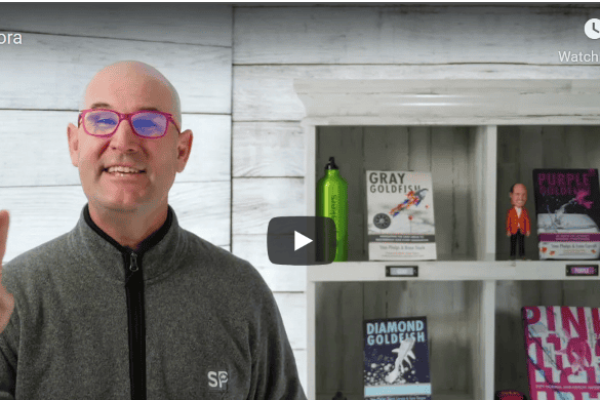
Today’s leaders must be able to manage the gray.

In preparation for the 2018 season, the Phillies, Mets, Red Sox, Yankees, and Nationals all replaced veteran managers with younger skippers.

The differences in age were dramatic.

The five managers ranged from eight to 26 years younger than their predecessors.

Some had no major league managing experience.

According to Tom Verducci of Sports Illustrated, “the ability to connect with young players and a comfort with analytics rose above experience.”

These new managers were better at relating to the latest generation of players.

One of them was 42-year-old Alex Cora who led the Boston Red Sox to a World Series title in his first year at the helm. He is currently managing the team in the American League Championship Series.

This move by traditionally conservative baseball owners should be a wake-up call for today’s leaders.

With the introduction of Generation Z (born starting in 1997) coming into the workplace, we now have an unprecedented five generations at work.

Generation Z joins the largest group, Millennials, followed by Generation X, Baby Boomers, and Matures.
It is not uncommon for today’s leaders to have team members that span 60 years from oldest to youngest.

Speaking from experience, my father-in-law, Fred Wills, is 90 years old. Till he was 89, Fred worked three days a week for the Town of Shelton, Connecticut.

The ability to relate and connect across these generations is vital. Each of the five generations brings its own unique expectations and needs. Managing across the generations is the focus of the Gray Goldfish.

Sticking with our initial theme of baseball, Chicago Cubs manager Joe Madden believes that effective leadership and culture starts with relationships.

In his words, “Strong relationships lead to trust and trust leads to the willingness to exchange thoughts and ideas. That foundation breeds success.”

For today’s leaders, the idea of managing teams that include five different generations is new territory.

According to Carol Hymowitz in The Wall Street Journal,

“That means they must create opportunities for young employees to advance (or risk losing them) while also making sure veterans, whose skills they need in today’s tight labor market, don’t feel overlooked. And to maintain productivity and innovation, they must persuade employees of disparate ages to collaborate.”

Takeaway: To avoid “The Great Resignation,” today’s leaders must engage across the generations and effectively navigate the gray.

Follow me on Twitter or LinkedIn.

Stan Phelps

Stan Phelps walks the walk. He stands out in the sea of sameness by modeling his own Differentiated Experience (DX) message: Differentiation isn’t just about what you say, it’s about what you do and, more importantly, how and why you do it. Stan leverages his unique collection of 5,000+ case studies on customer, employee, and brand experience to engage audiences with informative learning-based experiences. He believes purposeful DX wins the hearts of employees and customers, and differentiation ultimately boosts loyalty, retention, referrals, and results.

Find Stan’s in-person and virtual keynotes, workshops, and Goldfish tank programs at StanPhelps.com.

Rethinking Marketing: 11 Takeaways from Purple Goldfish 2.0:

1. Your brand is no longer just what you tell people it is. It’s what your customer experiences, how they feel, and, most importantly—what they tell others about that experience. 

2. There is no such thing as meeting customer expectations. You exceed them . . . or you fall short.

3. Experience design is the next frontier for brand building. Smart brands will find ways to add signature value to their experiences, enhance differentiation, and give customers a reason to share their own stories about brands. 

4. Marketing is about being so remarkable that people can’t help but talk about you. That if you absolutely delight someone—they will not only come back but they’ll bring friends. They become your sales force. 

5. Going forward, marketing will be about achieving customer-getting distinction by differentiating what you do and how you operate.

6. In today’s climate you need to stand out by answering two important questions: What is valued by your customers? Can you deliver on those things that are valued and create some signature elements of added value to create differentiation? 

7. Take care of the customers you have. When you provide them with a memorable experience, they’ll bring you the customers you want. 

8. We judge everyone and everything we encounter on two basic criteria:
– Warmth: What is their intent? 
– Competence: What is their ability to carry out that intent? 
You need to reinforce both through the customer experience.

9. LAGNIAPPE is a creole word meaning “the gift” or “to give more.” The practice originated in Louisiana in the 1840s whereby a merchant would give a customer a little something extra at the time of purchase. It is a signature personal touch by the business that creates goodwill and promotes word of mouth. 

10. A Purple Goldfish is defined as any time a business purposely goes above and beyond to provide a little something extra to differentiate the experience and honor the relationship. 

11. What are your customers talking about after leaving your business, logging off your website, or hanging up the phone? Purple Goldfish Strategy is the idea that the best marketing is first-person word of mouth… your customers. That you should control the things you can control… how you treat your existing customers. And that you need to deliver added value with your product or service… to exceed customer expectations. 

Questions:
– How are you standing out in a sea of sameness? 
– What are your one or two signature differentiators in customer experience?
– Instead of being a “me too,” what is the one special thing your company does that is superior and distinctive in the eyes of your customers? 
– What is that little something extra that is tangible, valuable, and talkable? 

What’s your Purple Goldfish?

Follow me on Twitter or LinkedIn.

Stan Phelps

Stan Phelps walks the walk. He stands out in the sea of sameness by modeling his own Differentiated Experience (DX) message: Differentiation isn’t just about what you say, it’s about what you do and, more importantly, how and why you do it. Stan leverages his unique collection of 5,000+ case studies on customer, employee, and brand experience to engage audiences with informative learning-based experiences. He believes purposeful DX wins the hearts of employees and customers, and differentiation ultimately boosts loyalty, retention, referrals, and results.

Find Stan’s in-person and virtual keynotes, workshops, and Goldfish tank programs at StanPhelps.com.
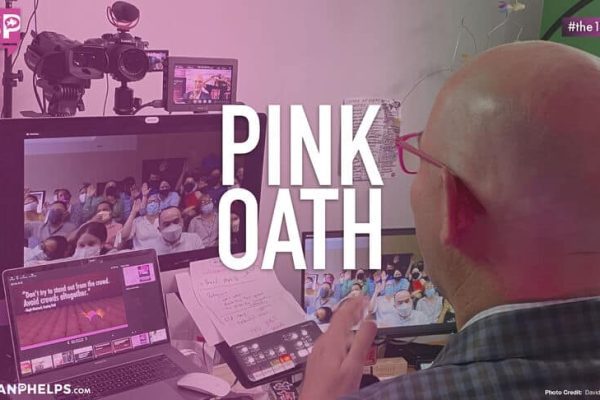
Repeat after me, “I promise to be different… I promise to be unique.”

This was the final exchange last week as David Rendall and I finished a day-long virtual GOLDFISH TANK program.

I then asked the attendees the last part of the PINK GOLDFISH oath:

“I promise not to repeat things other people say.”

Silence… followed by laughter.

I personally love this last part of the program. It’s weird and it feels awkward, but it hammers home an important point. Being different is not about following the crowd. Being different is about avoiding crowds altogether.

In her book “Different – Escaping the Competitive Herd,” Harvard Business School marketing professor Youngme Moon argues that “the ability to compete is dependent upon the ability to differentiate from competitors.”

However, she goes on to say, “The number of companies who are truly able to achieve competitive separation is depressingly small.”

Why?

Because companies tend to define their strengths and weaknesses using the same measurements and standards as their competitors. This leads to sameness, not differentiation. When everyone is trying to build on the same strengths and eliminate the same weaknesses, all companies start to look the same. 

Our client last week shared that INNOVATION was a core value of the organizations. They engaged with David and me on Goldfish Tank because they realize it’s important to do three things if you want your people to innovate:

1. Teach them how to think differently.
2. Create a safe space to apply what they’ve learned.
3. Give them a platform and incentives to pitch their innovative ideas.

Here is the feedback we received today from the client,

“This exceeded my expectations. You guys did a great job of making our folks, who are normally pretty reserved, feel comfortable enough to engage with and in front of each other. In addition, the material was very well prepared and the walk from understanding Pink Goldfish to applying Pink Goldfish was easy for all. I really feel like this was the springboard we needed and the takeaways are numerous, not just in innovation but also, people development.”

How about you? Are you ready to defy normal and exploit imperfection?

Are you willing to admit that fitting in and becoming a copycat brand will never lead to success?

Or that benchmarking and best practices are not the path to greatness.

That trying to fix a weakness is a waste of time and effort.

And if you try to be great at everything, you will end up being great at nothing.

Because if you try to please everyone, you won’t end up pleasing anyone…

Want to learn more about the Goldfish Tank? Check this out.

Follow me on Twitter or LinkedIn.

Stan Phelps

Stan Phelps walks the walk. He stands out in the sea of sameness by modeling his own Differentiated Experience (DX) message: Differentiation isn’t just about what you say, it’s about what you do and, more importantly, how and why you do it. Stan leverages his unique collection of 5,000+ case studies on customer, employee, and brand experience to engage audiences with informative learning-based experiences. He believes purposeful DX wins the hearts of employees and customers, and differentiation ultimately boosts loyalty, retention, referrals, and results.

Find Stan’s in-person and virtual keynotes, workshops, and Goldfish tank programs at StanPhelps.com.
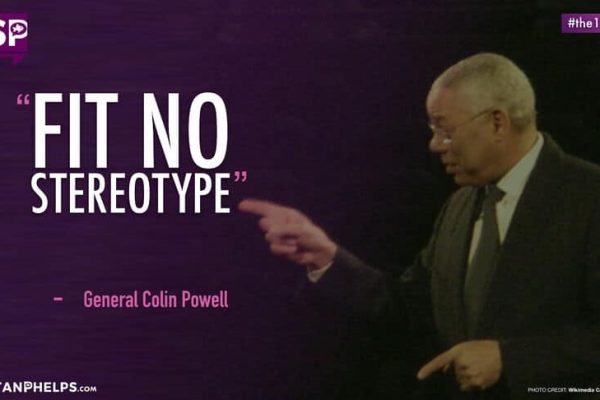
Remembering Colin Powell. Former Four Star General, Chairman of the Joint Chiefs, and US Secretary of State passed away as a result of complications due to COVID 19 at the age of 84.

His presence was large and his legacy will live on. Here are five lessons from the man in his words:

1. “Fit no stereotype.”

2. “If you are going to achieve excellence in big things, you develop the habit in little matters.”

3. “Surround yourself with people who take their work seriously, but not themselves, those who work hard and play hard.”

4. “No battle plan survives contact with the enemy.”

5. “My own experience is use the tools that are out there. Use the digital world. But never lose sight of the need to reach out and talk to other people who don’t share your view. Listen to them and see if you can find a way to compromise.”

What would you add about the legacy of Colin Powell?

Follow me on Twitter or LinkedIn.

Stan Phelps

Stan Phelps walks the walk. He stands out in the sea of sameness by modeling his own Differentiated Experience (DX) message: Differentiation isn’t just about what you say, it’s about what you do and, more importantly, how and why you do it. Stan leverages his unique collection of 5,000+ case studies on customer, employee, and brand experience to engage audiences with informative learning-based experiences. He believes purposeful DX wins the hearts of employees and customers, and differentiation ultimately boosts loyalty, retention, referrals, and results.

Find Stan’s in-person and virtual keynotes, workshops, and Goldfish tank programs at StanPhelps.com.

Squid Game was rejected for over 10 years because people thought it was too complex and not commercial enough.

Writer Hwang Dong-hyuk was rejected by all the studios. Living with his mother and grandmother at the time, he was forced to sell his laptop due to financial hardship and put the screenplay on the shelf.

Then Netflix took a bet on Dong-hyuk a decade later. Game on. They didn’t greenlight the idea, they pink-lighted.

“At the time, it seemed very unfamiliar and violent [to the other studios]” shared Hwang. “Thanks to Netflix, there was no limit and I was given creative freedom to work as I wanted to.”

Netflix didn’t try to water down Squid Game. They took an idea that seemed flawed and double-downed on it to make it flawsome. Originally, Squid Game was meant to be a feature film. The idea was lopsided into a series.

The once rejected script has now gone on to become the #1 show in 90 countries. Not by correcting a flaw or toning down an idea, but by illuminating it in pink.

No risk it, no bisquit. According to reporting in Bloomberg, “Netflix spent $21.4 million for the nine-episode series, which debuted four weeks ago, and the firm expects “Squid Game” to bring in more than 40 times that amount in “impact value,” or $891 million.

Follow me on Twitter or LinkedIn.

Stan Phelps

Stan Phelps walks the walk. He stands out in the sea of sameness by modeling his own Differentiated Experience (DX) message: Differentiation isn’t just about what you say, it’s about what you do and, more importantly, how and why you do it. Stan leverages his unique collection of 5,000+ case studies on customer, employee, and brand experience to engage audiences with informative learning-based experiences. He believes purposeful DX wins the hearts of employees and customers, and differentiation ultimately boosts loyalty, retention, referrals, and results.

Find Stan’s in-person and virtual keynotes, workshops, and Goldfish tank programs at StanPhelps.com.
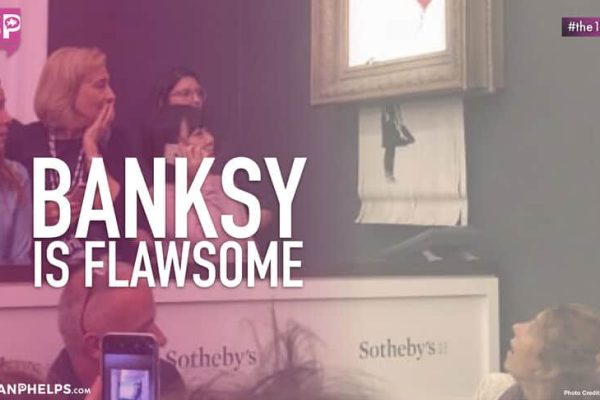
Three years ago, the enigmatic graffiti artist Banksy stunned the art world. Moments after the gavel was struck for the winning $1.4 million bid at Sotheby’s, the painting “The Girl with the Baloon” began to shred.

A shredding device was secretly hidden within the frame. More than half of the painting was sliced into thin strips. Oops. According to the artist, the shredder allegedly malfunctioned. The entire painting was meant to be sliced. Here’s the link to the video. “In rehearsals, it worked every time.”

The woman who was the anonymous winning bidder has now renamed the piece, “Love is in the Bin.” Next month the flawsome piece of artwork will again go up for auction. It is estimated that the painting could be sold for over $8 million. Its flaw has made it awesome.

One owner of a similar Banksy print shredded it in an effort to increase its value.

$8 million might be a steal for the first original artwork ever to be created live at auction. I bet it will fetch more.

Last year during the pandemic a Banksy piece called “Game Changer” sold for $23 million at Christie’s. The piece depicted nurses as superheroes. The proceeds were donated by the artist to the University Hospital in Southampton.

Is a Banksy worth it? Or are people just buying the name?

As part of a 31-day residency in 2013, the artist sold original artworks in New York’s Central Park alongside other street vendors. Priced at only $60, the works drew little interest from passersby. Only seven pieces were sold.

A year later, a New Zealand woman who was visiting New York put her two pieces up for sale. Her $120 investment ended up netting $214,000. That’s an 1,800x return.

What can we learn as marketers from Banksy?

Banksy leverages the following three principles in the FLAWSOME framework:

Lopsiding – it’s not a mistake that Banksy chose “Girl with a Baloon” for the stunt. It is his best-known work. It originally surfaced back in 2002 in London. There are a limited number of signed prints of the work. Double and triple down on what makes you unique and different. In 2014, Justin Bieber had “Girl with a Baloon” tattooed on his arm.

Antagonizing – Banksy has never been shy about antagonizing some people. This effort was focused on criticizing certain elements of the art world. In the words of Matthew Israel, the piece is “entirely at odds with the aims of the auction house, where the condition of an artwork is paramount and the knowledge and expertise about it is core to its authority and value.” How could they have missed this?

Opposing – aren’t artists meant to crave the spotlight? One could say all graffiti artists remain anonymous to avoid prosecution. But Banksy has withheld his identity for nearly 20 years. He or she… remains steadfast, “If you want to say something and have people listen then you have to wear a mask. If you want to be honest then you have to live a lie.”

Takeaway – Flaunt imperfection

Follow me on Twitter or LinkedIn.

Stan Phelps

Stan Phelps walks the walk. He stands out in the sea of sameness by modeling his own Differentiated Experience (DX) message: Differentiation isn’t just about what you say, it’s about what you do and, more importantly, how and why you do it. Stan leverages his unique collection of 5,000+ case studies on customer, employee, and brand experience to engage audiences with informative learning-based experiences. He believes purposeful DX wins the hearts of employees and customers, and differentiation ultimately boosts loyalty, retention, referrals, and results.

Find Stan’s in-person and virtual keynotes, workshops, and Goldfish tank programs at StanPhelps.com.
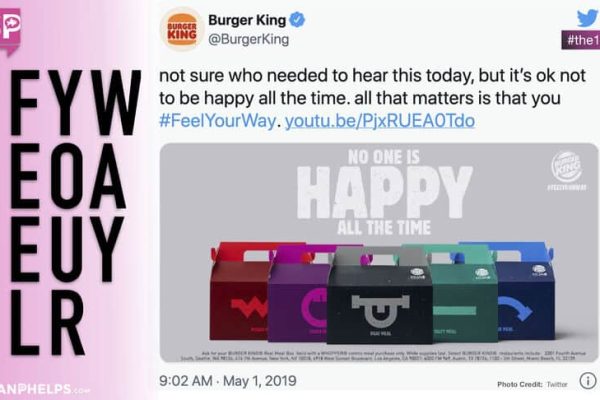
“not sure who needed to hear this today, but it’s ok not to be happy all the time. all that matter is that you #FeelYourWay

This was a tweet from Burger King back in 2019. It introduced a range of boxed deals called “Real Meals.” This swipe at the McDonald’s Happy Meal included five varieties:

– the Pissed Meal
– the Blue Meal
– the Salty Meal
– the YAAAS Meal
– the DGAF (Don’t Give a F*ck) Meal

I wasn’t familiar with YAAAS. The Urban Dictionary defines it as, “A word that occurs when you can’t express how you feel about someone or something, usually followed by admiring that someone or something and being super excited also.”

This limited-time “Real Meal” offer was tied into Mental Health Awareness Month. Each of the Real Meals included a Whopper, fries, and a drink.

David Rendall and I featured this case study in Pink Goldfish 2.0 as an example of (dis)owning your flaws.

In a joint announcement, Mental Health America CEO Paul Gionfriddo shared, “Burger King is bringing much-needed awareness to this important and critical discussion – and letting its customers know that is OK to not be OK.”

The launch featured a print advertisement showing a montage of people in various emotional states, using the line: “No one is happy all the time. And that’s OK.”

Not everyone was thrilled with the campaign. For example, the co-founder of “The Daily Wire” Ben Shapiro commented, “This is a hell of an ad for depression eating.”

With a widespread backlash in the traditional press and on social media, Burger King caved and eliminated the Real Meals.

David and I think that, if there is a criticism of the program, it’s the limited way Burger King executed it. They should have ramped up the meals, instead of cutting them. The Real Meals were only available in five markets. They could be purchased in Seattle, New York City, Los Angeles, Austin, and Miami Beach, but only at specific stores.

We would have loved to see them make this a permanent offering. McDonald’s’s offers Happy Meals, Burger King could have given us permission to be unhappy, at every restaurant, every day. 

This message is hitting close to home today. Nearby at the University of North Carolina at Chapel Hill classes are canceled last week. This is in response to a suicide and an attempted suicide.

UNC Chancellor Kevin M. Guskiewicz shared last week, which also happened to be #worldmentalhealthday

“As chancellor, a professor and a parent, my heart breaks for all those whose suffering goes unnoticed. I encourage every student to use this time [Wellness Day] to rest and to check in with each other …. Reach out to a friend, a classmate, or colleague and ask them, ‘honestly, how are you doing?”

My message to Burger King. You should have eaten your own food and DGAF about the critics. Bring back the Real Meals. Because it’s still OK not to feel OK all the time.

Follow me on Twitter or LinkedIn.

Stan Phelps

Stan Phelps walks the walk. He stands out in the sea of sameness by modeling his own Differentiated Experience (DX) message: Differentiation isn’t just about what you say, it’s about what you do and, more importantly, how and why you do it. Stan leverages his unique collection of 5,000+ case studies on customer, employee, and brand experience to engage audiences with informative learning-based experiences. He believes purposeful DX wins the hearts of employees and customers, and differentiation ultimately boosts loyalty, retention, referrals, and results.

Find Stan’s in-person and virtual keynotes, workshops, and Goldfish tank programs at StanPhelps.com.
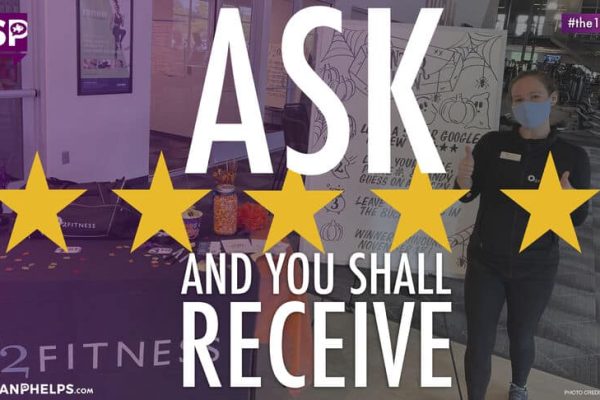
Want more 5-star reviews? You only have to do 3 things…

1. It starts with intention – be intentional about it. Be review-worthy by providing a great experience and make reviews a priority.

2. Be sincere – share the importance and don’t be afraid to ask for reviews when engaging with customers.

3. Hit the easy button – make it easy for your customers to provide those reviews. And don’t spread out the love. Lopside your efforts on your most important platform.

CASE IN POINT:

Last week I delivered a couple of books to my client O2 Fitness. I visited the University Drive club in Durham and had an opportunity to catch up with GM Katherine Smith. The 30,000 square foot club has 856 Google reviews. The majority of those reviews came in the last year… during a global pandemic.

I asked Katherine about the outsized number of five-star reviews. Very quickly I learned this wasn’t by chance. Katherine and the team are super-intentional about Google reviews. They know the importance. Here are three reasons why they rock according to TRG Marketing:

1. Google Reviews are a big credibility boost to your business and you don’t need to spend a dime.

2. Google Reviews increase your online exposure and help with SEO, especially local SEO.

3. Google Reviews are a good way to better understand what you are doing right and/or wrong as a business.

Katherine shared that they aren’t afraid to ask for reviews. She and other team members will often receive positive feedback from members. In addition to acknowledging and being thankful for attaboy or attagirl, they take a moment to mention Google Reviews. And here is the key. They mention how important the reviews are.

Lastly, O2 Fitness University Drive makes it easy for members to leave the review. Once a member agrees, the staff will give them a business card with instructions on how to leave the review. That card makes it easy and serves as a reminder of the commitment.

EATING MY OWN DOG FOOD

Two or three times a year I will reach out to my most recent clients. As a keynote speaker and workshop facilitator, I know my reviews on eSpeakers are important. eSpeakers powers the National Speakers Association directory and it contains over 13,000 speakers, trainers, entertainers, authors, and consultants.

Speaking is a word of mouth business. But if people are finding you on a directory, reviews are a differentiator. I have 152 verified reviews on eSpeakers. I believe that’s the most of any speaker on the platform.

How do I do it?

1. I’m intentional about it, 2. I’m not afraid to ask, and 3. I make it easy for my clients to provide a review.

Follow me on Twitter or LinkedIn.

Stan Phelps

Stan Phelps walks the walk. He stands out in the sea of sameness by modeling his own Differentiated Experience (DX) message: Differentiation isn’t just about what you say, it’s about what you do and, more importantly, how and why you do it. Stan leverages his unique collection of 5,000+ case studies on customer, employee, and brand experience to engage audiences with informative learning-based experiences. He believes purposeful DX wins the hearts of employees and customers, and differentiation ultimately boosts loyalty, retention, referrals, and results.

Find Stan’s in-person and virtual keynotes, workshops, and Goldfish tank programs at StanPhelps.com.

1 17 18 19 20 21 48
A simple illustration of a purple fish facing right on a plain background.

I've had the pleasure of working with teams at:

Three purple fish silhouettes swimming to the right on a dark background.

Find Your Best-Match Program

With over 18 possible keynote speaking presentations, workshops, and GOLDFISH TANK programs available to meet your ever-evolving needs, I’ve created this 2-minute, 6-question quiz to help you understand which program is best for you and your audience.

Meet Your Presenter

Through keynote speaking presentations, hands-on workshops, and GOLDFISH TANK programs, I empower you to power loyalty and growth.

Hi, I’m Stan Phelps. I work with organizations that want to increase loyalty, drive sales, and promote positive word-of-mouth by creating differentiated experiences.

As an author, keynote speaker, and workshop facilitator, my in-person and virtual programs stand out in a sea of sameness because I model my own message of differentiated experience (DX).

I leverage my unique collection of more than 5,500 case studies on customer, employee, and brand experience to engage audiences with practical ideas that inspire action.

A person wearing glasses and a gray quarter-zip sweater stands outdoors in front of a building with a triangular glass roof at dusk.

Every time we do business together, Something amazing happens in the world!

Through my partner B1G1, each program gives back to create global IMPACT

Two students in blue uniforms smile while washing their hands at an outdoor tap.

When we complete a GOLDFISH TANK, we give 1001 days of clean water to school children

Collage of three images: a person washing hands, a child drawing with colored pencils, and a group of people sitting outdoors with some raising their hands.

When we complete a GLOBAL engagement, we give 365 days of clean water access in Peru, 120 days of learning aids in Malaysia, and 50 days of business training for women in Malawi

Hand placing a brick on a surface with text: "One Book = One Brick" and an Amazon logo.

When someone downloads a GOLDFISH eBook, we give one brick toward building school facilities in Cambodia