
Stan Phelp's Blog

The Goldfish Chronicles

Sharing insights on customer experience, employee engagement, and brand strategy.

City Winery is a study in differentiation. Michael Dorf created a live music venue centered around wine in 2006. It is a great example of the Pink Goldfish of Opposing.

Opposing brands are unlike other brands. They are contradictory and dissimilar. They operate in a way that is incompatible with everyone else in a given category.

Two weeks ago I had a chance to visit the new Pier 57 location in New York City. I caught up with friend and Chief Growth Officer Jack Laschever for a tour. This was my second time to one of their venues. I had the honor of speaking for AMA Nashville years ago at their Music City location.

Never been? Imagine walking into a working winery in the middle of a big city. Add in an intimate music venue with a cool bar/restaurant and you’ve got City Winery.

Founder Dorf has strong roots in both venues and concert promotion. He was a founder of the Knitting Factory and a pioneer in streaming concerts. Michael shared the insight that launched the concept with Billboard,

“We thought of going for a sort of older demographic who have disposable income and are very underserved. These audiences don’t want to stand, they want to sit, they want to be treated in a much more refined way and many of them are pressed for time. So we’ve created a luxury concert experience. We’re really only the game in town putting on a show at the level that we’re putting it on and taking a kind of Danny Meyer restaurant approach to the customer experience for a show.”

Opposing is rooted in being opposite. Opposite is defined as “contrary or radically different in some respect common to both, as in nature, qualities, direction, result, or significance.” To be opposites, two things need to be both very different and also have something in common. There’s something that unites them but something else that completely separates them. 

City Winery is like something you know, but its different. It’s sit, not stand for a concert. It’s intimate, not cavernous like an arena. Not dinner then a show, rather it’s dinner with a show. It’s a winery, not in the countryside, but in the middle of a big city. It’s wine from a keg and a tap as opposed to a uncorked bottle.

Is it working? Yes.

City Winery now has locations in eight markets. In addition to New York, you can experience intimate concerts while enjoying locally made wine and good food in Boston, Chicago, Philadelphia, Nashville, Atlanta, and DC.

It hasn’t been all wine and roses. They had to close the Napa Valley location at the end of 2015. Perhaps there is a lesson there. Stick to opposing. Because as my coauthor David Rendall (a fellow Milwaukeean like Dorf) says,

“Sometimes the opposite of a good thing… is also a good thing.”

Follow me on Twitter or LinkedIn.
Stan Phelps

Stan Phelps walks the walk. He stands out in the sea of sameness by modeling his own Differentiated Experience (DX) message: Differentiation isn’t just about what you say, it’s about what you do and, more importantly, how and why you do it. Stan leverages his unique collection of 5,000+ case studies on customer, employee, and brand experience to engage audiences with informative learning-based experiences. He believes purposeful DX wins the hearts of employees and customers, and differentiation ultimately boosts loyalty, retention, referrals, and results.

Find Stan’s in-person and virtual keynotes, workshops, and Goldfish tank programs at StanPhelps.com.
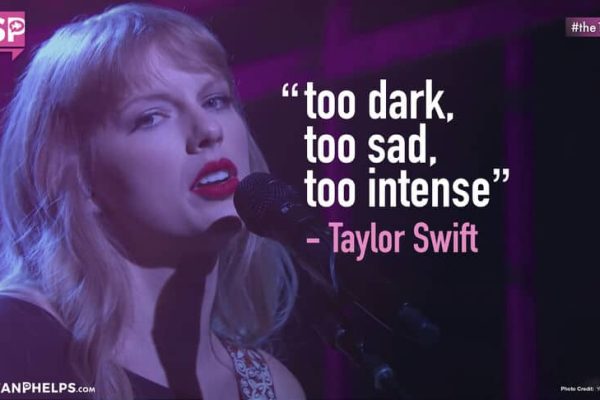
Taylor Swift described her song “All too well” as “too dark, too sad, too intense.” Swift performed the 10-minute (Taylor version) of the song this past weekend on SNL. It’s an instant classic.

The song was accompanied by a short film written and directed by Swift. “All too well” is a 10-minute ballad about a scarf and a failed relationship. Reading between the Thanksgiving, maple latte, and age references, it is about a short-lived relationship with actor Jake Gyllenhaal.

The original song and the new version are both examples of the Pink Goldfish of Lopsiding. Lopsiding is about being unbalanced, imperfect, and odd.

Unbalanced? Antonyms for unbalanced include: crazy, insane, and unsound. Those don’t sound like a recipe for success. But they are. Lopsiding is about amplifying, not reducing, potential flaws.  

Flaws such as “that song is too dark” or “too long, no one will listen to a 10-minute song” or “those details are way too personal.”

Swift wrote the song while on the rebound at age 21. It was originally 10-minutes. A 21-year-old Taylor Swift couldn’t release it then. She shared with Jimmy Fallon, “Ten minutes is absurd.”

When someone tells you that you are doing “too” of something, perhaps it’s time to turn up the dial even more. In the words of Harvard Business School Professor Youngme Moon, “True differentiation is rarely a function of well-roundedness; it is typically a function of lopsidedness.” 

Taylor’s fans (known as Swifties) are rabid. They crave the real stories of her life and relationships shared in her songs. Swift has never said the song is about Gyllenhaal, but she drops clues like bread crumbs in the original liner notes.

Swift shared with Rolling Stone on a podcast, “I truly can’t believe it now when I play it live and everybody in the crowd knows every word. That’s one of the most beautiful things about this album for me when I look back on it: Like, wow, I really didn’t pick that one.”

Takeaway: Sometimes too much of a good thing ends up being legendary.

Follow me on Twitter or LinkedIn.

Stan Phelps

Stan Phelps walks the walk. He stands out in the sea of sameness by modeling his own Differentiated Experience (DX) message: Differentiation isn’t just about what you say, it’s about what you do and, more importantly, how and why you do it. Stan leverages his unique collection of 5,000+ case studies on customer, employee, and brand experience to engage audiences with informative learning-based experiences. He believes purposeful DX wins the hearts of employees and customers, and differentiation ultimately boosts loyalty, retention, referrals, and results.

Find Stan’s in-person and virtual keynotes, workshops, and Goldfish tank programs at StanPhelps.com.

Remembering my late Father on Veteran’s Day. Dad taught me the two most important elements of communication.

A bit of background:

John Phelps enlisted in the United States Army Air Force at the age of 17. After finishing basic training in early 1948, he was sent to school in Fort Monmouth, New Jersey, to become a member of the United States Signal Corps.

Never heard of the Signal Corps?

While serving as a medical officer in Texas in 1856, Albert James Myer proposed that the Army use his visual communications system called aerial telegraphy. The system known as “wig-wag” was adopted in June 1860 and the Signal Corps was born.

In 1863, it became official and Congress authorized a regular Signal Corps for the duration of the Civil War. Myer began to train others as part of the professional military signal service.

The Signal Corps has always been an innovator in communication. In 1946, its Project Diana successfully bounced radar signals off the moon, paving the way for space and satellite communications.

Dad graduated Signal Corps school at Fort Monmouth in New Jersey. After he got a plum assignment at Hickam Air Field in Hawaii.

I’ll never forget my Dad sharing how he sailed from San Francisco to Honolulu on a large destroyer. The water was choppy and before the ship made it under the Golden Gate Bridge, my Dad and others started to feel queasy. Soon as my Dad would describe it, they were leaning over the rail and “feeding the fish.” One of the Navy sailors walked by gave the group a little chiding, “What’s a matter, got a weak stomach?” My Dad shot back, “No, not weak. I’m throwing it out there with the best of them.”

The base in Oahu was next to Pearl Harbor. See photo. As a radio repairman, one of his main jobs was to test the strength and readability of radio signals.

Specifically, they were judging the volume and clarity of the signal.

The scale for both volume and clarity was from 1-5. One represented the worst and five was the best. If both strength (volume) and clarity were excellent, the receiver would reply “five by five.” That was shorthand for “I understand you perfectly.”

We reference this scale today when we say “loud and clear.”

I believe the two biggest elements of communication are volume and clarity. Volume is your ability to engage and rise above distraction. Clarity is the ability to organize your message in a way that makes it rememberable.

Are you communicating Loud and Clear? 

RIP John Phelps, Sr. Love you Dad.

Follow me on Twitter or LinkedIn.

Stan Phelps

Stan Phelps walks the walk. He stands out in the sea of sameness by modeling his own Differentiated Experience (DX) message: Differentiation isn’t just about what you say, it’s about what you do and, more importantly, how and why you do it. Stan leverages his unique collection of 5,000+ case studies on customer, employee, and brand experience to engage audiences with informative learning-based experiences. He believes purposeful DX wins the hearts of employees and customers, and differentiation ultimately boosts loyalty, retention, referrals, and results.

Find Stan’s in-person and virtual keynotes, workshops, and Goldfish tank programs at StanPhelps.com.
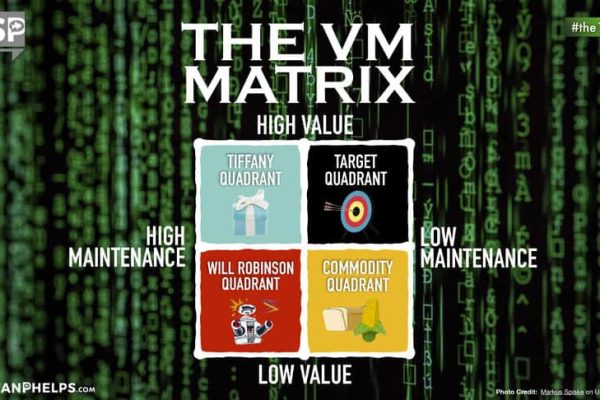
Do you know the VM Matrix for customer experience?

The V stands for value and the M for maintenance. These two elements have the biggest impact on CX in my opinion.

I ascribe to the definition of Customer Experience shared by my friend and fellow speaker Mike Wittenstein. CX is the following equation:

Everything that your product or service does for your customers (Value)
– Minus everything that your business processes do to your customers (Maintenance)
__________________________________
= The result of the equation is how the experience makes your customer feel

Why VALUE and MAINTENANCE? This scientific approach was based on my dating theory in college. When you thought about someone whom you’d like to date, you’d ultimately want someone who was high value … and low maintenance. If you don’t understand what maintenance is, that means you’re probably HIGH MAINTENANCE.

Let’s explore both concepts starting with VALUE:

In business, price represents what you pay. And price is only relevant to the value received. Value is what you get. What are the elements of value?

VALUE is the what/why of experience
– Beyond the product or service, what are the tangible and intangible benefits that you receive?
– Did the brand go above and beyond to exceed expectations to honor the relationship?
– Did they give that little unexpected extra to surprise and delight?

Value is crucial in terms of both differentiation and word of mouth. To quote Seth Godin, “The thing that makes something remarkable isn’t usually directly related to the original purpose of the product or service. It’s the extra stuff, the stylish bonus, the design or the remarkable service or pricing that makes people talk about it and spread the word.”

Now, let’s tackle MAINTENANCE:

Maintenance is the who/how of experience. 
– What is the onboarding or buying experience like?
– Does the company make things turnkey or simple?
– Are they responsive to problems/issues?

At the end of the day, you take all the value received and weigh it against the business processes you were subjected to. In our on-demand world, the effort you have to expend can dramatically impact the experience. 

Takeaway: It’s all about a feeling. Because your brand is no longer just what you just tell people it is. It’s the differentiation that your customer experiences, how they FEEL about that experience, and most importantly… what they tell others about their experience. Are you on-target?

Follow me on Twitter or LinkedIn.

Stan Phelps

Stan Phelps walks the walk. He stands out in the sea of sameness by modeling his own Differentiated Experience (DX) message: Differentiation isn’t just about what you say, it’s about what you do and, more importantly, how and why you do it. Stan leverages his unique collection of 5,000+ case studies on customer, employee, and brand experience to engage audiences with informative learning-based experiences. He believes purposeful DX wins the hearts of employees and customers, and differentiation ultimately boosts loyalty, retention, referrals, and results.

Find Stan’s in-person and virtual keynotes, workshops, and Goldfish tank programs at StanPhelps.com.

Being humble pays in business. Entrepreneurs who demonstrated humility were more able to get funding from investors.

The Wall Street Journal shared the findings of a recent study published in the Academy of Management Proceedings Journal. Big thanks to my brother-in-law Micky Baehr for sharing the article.

The research found that “Early-stage entrepreneurs who display signs of humility with investors are nearly twice as likely to reach the next step of the funding process as ones who don’t.”

Wait… isn’t exposing weakness and vulnerability a flaw?

“Humility is not a weak trait,” says Ivana Vitanova. Vitanova is an associate professor of finance at Lyon and co-author of the journal article.

She shows how a perceived flaw reveals a corresponding strength. Vitanova continues, “Rather, it reflects a strong person who knows that when there is something he cannot do, he will ask others for advice and appreciate their knowledge.”

In “Pink Goldfish 2.0,” David Rendall and I call this honesty and openness Exposing. It is the E in the F.L.A.W.S.O.M.E. framework.

Good friend and fellow speaker Jeff Nischwitz (he/his/him) calls this ‘getting naked’ in his new book “Snow Globe Leadership.” Think about a snow globe, the magic only happens when you shake things up and challenge the status quo.

Jeff believes, “Naked is the perfect word because this critical foundation is vulnerability, the most terrifying and misunderstood concept in business and leadership today.”

Jeff asserts the key to being vulnerable is to be human. “We all know that none of us are perfect, yet many of us function with a goal to be perfect, to never make mistakes, to always have the answers (the right answers), and to always have it together.”

How do you do it? Nischwitz shares a handful of thought-starters in Snow Globe Leadership:

1. Not always having all the answers
2. Allowing space for other ideas
3. Sharing your uncertainties
4. Being open to feedback
5. Asking for help or support

Takeaway: Brené Brown defines vulnerability as emotional risk, exposure, uncertainty. Are you willing to be humble and open?

Follow me on Twitter or LinkedIn.

Stan Phelps

Stan Phelps walks the walk. He stands out in the sea of sameness by modeling his own Differentiated Experience (DX) message: Differentiation isn’t just about what you say, it’s about what you do and, more importantly, how and why you do it. Stan leverages his unique collection of 5,000+ case studies on customer, employee, and brand experience to engage audiences with informative learning-based experiences. He believes purposeful DX wins the hearts of employees and customers, and differentiation ultimately boosts loyalty, retention, referrals, and results.

Find Stan’s in-person and virtual keynotes, workshops, and Goldfish tank programs at StanPhelps.com.
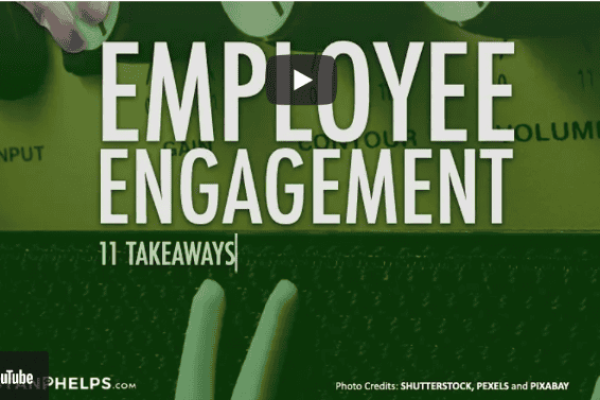
Are you prepared for the Great Resignation? Retention is the new black. Here are 11 Takeaways on Employee Engagement from Green Goldfish 2.0:

1. It starts with engaged employees. Satisfied employees lead to satisfied customers. Long-term employees lead to long-term relationships with customers. 

2. You need to go “beyond dollars.” Studies show financial compensation is not a strong long-term motivator for employees. Money can be more of a hindrance than a help.

3. Leadership and intent matters. 75 percent of people voluntarily leaving jobs don’t quit their jobs … they quit their bosses. 

4. Caring counts, even in small amounts. Of 75 possible drivers of engagement the ONE that was rated as the most important was the extent to which employees believed that their senior management had a sincere interest in their well-being. 

5. Focus on what you can control—creating a great work environment. Do the little things to show that you care for your employees.

6. Research suggests that supporting and incentivizing staff improves motivation and engagement, which in turn impacts productivity. Take care of employees first with an inside-out approach.

7. The 15 types of Green Goldfish can be broken into the Three B’s:
Building: Creating a stable environment where people can thrive
Belonging: Enabling high functioning teams and recognizing their efforts
Becoming: Empowering employees to learn, give back, and take control of their destiny 

8. First impressions rule. Research shows that employees make the critical decision to stay or leave within the first six months. When new hires participate in an onboarding program, organizations can “maximize retention, engagement, and productivity.” 

9. Recognition resonates in the workplace. It can power engagement and productivity. In the words of Angela Maiers, “YOU MATTER. These two words can change your mood, change your mind, and have the power to change lives and the world if we understand and leverage them in the right way.” 

10. Start small, start now. Start small when adding a signature extra and add more gradually. The best brands are those who boast a whole school of Green Goldfish for their employees. 

11. Go Green. A Green Goldfish is defined as any time a business purposely goes above and beyond to provide a little something extra to differentiate the experience and honor the relationship with its employees. 

What are your one or two signature differentiators in employee experience?

Instead of being a “me too,” what is the one special thing your company does that is superior and distinctive in the eyes of your employees? 

What is that little something extra that is tangible, valuable, and talkable? 

What’s Your Green Goldfish?

Follow me on Twitter or LinkedIn.

Stan Phelps

Stan Phelps walks the walk. He stands out in the sea of sameness by modeling his own Differentiated Experience (DX) message: Differentiation isn’t just about what you say, it’s about what you do and, more importantly, how and why you do it. Stan leverages his unique collection of 5,000+ case studies on customer, employee, and brand experience to engage audiences with informative learning-based experiences. He believes purposeful DX wins the hearts of employees and customers, and differentiation ultimately boosts loyalty, retention, referrals, and results.

Find Stan’s in-person and virtual keynotes, workshops, and Goldfish tank programs at StanPhelps.com.
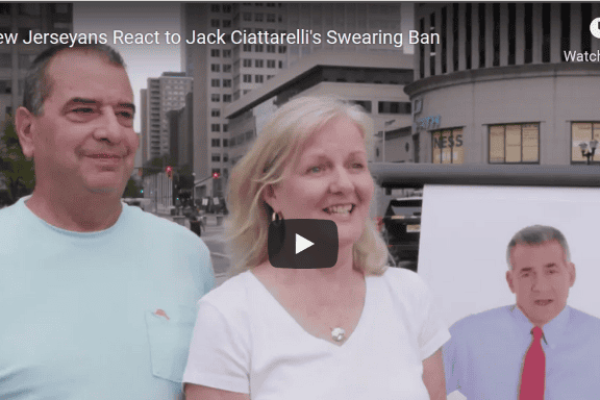
In 1994, New Jersey Gubernatorial Candidate Jack Ciattarelli led a ban on swearing. Are you f#*king kidding me?

Nope.

The measure actually passed the Raritan borough council in a 5-0 vote.

Did this sh*t ordinance get enforced?

Nope.

The local police chief opposed the measure and decided the department would not enforce it because it violated free speech rights. 

Fast forward 27 years and Ciattarelli is facing incumbent Phil Murphy today.

During the run-up to the election, the New Jersey State Democratic Committee created a “man on the street” commercial about the swearing ban. See video below. They asked New Jerseyans if they knew about Jack and the silly ordinance.

The reactions are hilarious. “Are you sh*tting me?”, “What an a**hole!”, “What the F*ck!”

The last one is classic with an indignant tone, “This is f*cking New Jersey!”

New Jersey may not have invented swearing, but its residents have elevated it to an art form.

As David Rendall and I shared in Pink Goldfish 2.0,

“Swearing is a way to attract people who align with your approach and repel the people who don’t. Look no further than Gary Vaynerchuk.”

For Jersey-born and bred Gary, swearing is about being who you authentically are. “I’m not cursing to disrespect anybody. This is how I’m comfortable in communicating.” And he is unapologetic, “I am willing to deal with the ramifications of me being my full self.”

New Jerseyans are not afraid of telling you how they feel.

Will Ciattarelli be successful in his bid for Governor? It doesn’t look promising. A recent poll has Murphy leading by 11 points. If he wins, Murphy will be the first Democratic governor to be reelected in New Jersey since Brenden Byrne in 1977. 

Takeaway – Know your audience and don’t take things personally. I’ll never forget a lesson I learned while working in New Jersey for three summers in college and grad school. My boss Jim Poling asked if I knew what a New Jersey compliment was. I shrugged my shoulders and he enlightened me,

“When someone from New Jersey doesn’t tell you that you’re f*cking up, you know you are doing a good job.”

Follow me on Twitter or LinkedIn.

Stan Phelps

Stan Phelps walks the walk. He stands out in the sea of sameness by modeling his own Differentiated Experience (DX) message: Differentiation isn’t just about what you say, it’s about what you do and, more importantly, how and why you do it. Stan leverages his unique collection of 5,000+ case studies on customer, employee, and brand experience to engage audiences with informative learning-based experiences. He believes purposeful DX wins the hearts of employees and customers, and differentiation ultimately boosts loyalty, retention, referrals, and results.

Find Stan’s in-person and virtual keynotes, workshops, and Goldfish tank programs at StanPhelps.com.
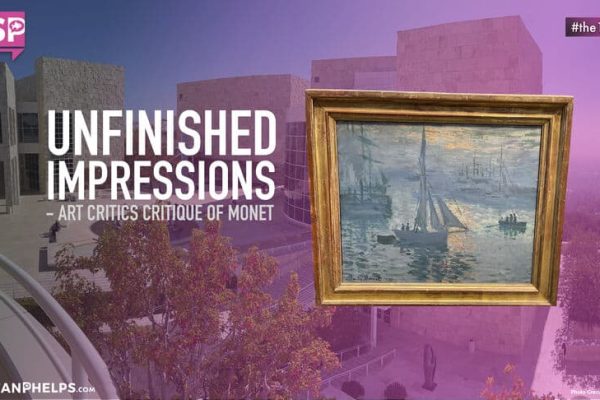
Monet sucks. That was the consensus of critics. The rapid, sketch-like execution shocked the art world in the 19th century.

Yesterday, I visited the J. Paul Getty Museum in Los Angeles. This was the third amazing museum I’ve had the opportunity to experience in the last 30 days. The others were the Denver Art Museum and the Whitney in New York.

Back to Claude Monet. The Getty has “Sunrise (Marine)” on display. The painting below is breathtaking. It depicts the early morning light, diffused by fog and smoke, on the shimmering water of the French Harbor of Le Havre.

“Sunrise” was one of the works that sparked the birth of Impressionism. The term was born out of another Monet painting titled, “Impressions of a Setting Sun.”

Critics bristled against the early works in the movement. Because they were different. They considered the works unfinished impressions rather than full-fledged pictures. To deviate from the standard is also seen as wrong and dangerous, so the critics responded with disdain and mockery.

It can be risky to stick out. Because of this, we tend to give up on being truly different. Instead, we just do what the competition is doing. 

As a freshman at Marist College, I hadn’t declared my major. This gave me the opportunity to take a variety of courses. One was an 8:15 a.m. class called “Arts and Values.” This would be my first introduction to Impressionism and spark my love for art.

I remember learning about Édouard Manet. He quickly became one of my favorites in the Impressionist movement. In 1863, Manet’s work was rejected for the annual Paris Salon, along with Camille Pissarro and James McNeill Whistler. Admission to the Salon was critical to the success of an artist. The Salon jury tended to be conservative and favored near-photographic but idealized realism.

Undaunted, Manet and friends pushed back. The protests were loud enough to reach Napoleon III.

Sensitive to public opinion, his office issued a statement: “Numerous complaints have come to the Emperor on the subject of the works of art which were refused by the jury of the Exposition. His Majesty, wishing to let the public judge the legitimacy of these complaints, has decided that the works of art which were refused should be displayed.”

With that declaration, the Salon des Refusés (Exhibition of Rejects) was born. According to Wikipedia, “Visitors pushed to get into the crowded galleries where the refused paintings were hung, and the rooms were full of the laughter of the spectators… But the critical attention also legitimized the emerging avant-garde.”

There would be another two Salons of the Refusés in both 1874 and 1875.

Those who laugh last, laugh best.

When the fourth edition happened in 1886, the popularity of the Paris Salon had declined for those who were more interested in Impressionism.

To steal a line from the late Mahatma Gandhi, “First they ignore you, then they laugh at you, then they fight you, then you win.”

Follow me on Twitter or LinkedIn.

Stan Phelps

Stan Phelps walks the walk. He stands out in the sea of sameness by modeling his own Differentiated Experience (DX) message: Differentiation isn’t just about what you say, it’s about what you do and, more importantly, how and why you do it. Stan leverages his unique collection of 5,000+ case studies on customer, employee, and brand experience to engage audiences with informative learning-based experiences. He believes purposeful DX wins the hearts of employees and customers, and differentiation ultimately boosts loyalty, retention, referrals, and results.

Find Stan’s in-person and virtual keynotes, workshops, and Goldfish tank programs at StanPhelps.com.
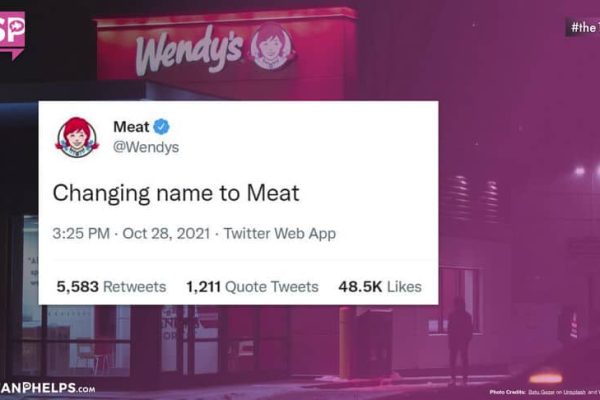
The Wendy’s Company changed its name on Twitter. They are now “MEAT.” LOL.

This tweet from last Thursday parodies the Facebook name change to META. It’s just one example of how the brand has leveraged a Pink Goldfish approach to social media. Thanks to Scott Monty for bringing it to my attention on LinkedIn.

Wendy’s is not alone. In the words of Katie McCall on Rival IQ,

“Many brands in the fast-food industry are embracing good old-fashioned roasting to stay relevant and top of mind among consumers, particularly the typically hard to impress Gen Z. Originally reserved for improvisational comedians, fast food restaurants are now roasting competitors and consumers in the form of quick-witted comebacks and sassy responses, and no one does it better than the self-proclaimed ‘First Lady of Fast Food,’ Wendy herself.”

The tweets by Wendy’s are an example of what David Rendall and I call microweirding. Little things you can do to express either more of what makes you weird or less of what is considered normal. After all, aren’t corporate tweets meant to be reserved, respectful, and measured.

Embracing this creative approach to brand expression doesn’t come naturally. It requires a cocktail of factors:

1. Trust
2. Empowerment
3. Speed
4. Consistency

These are muscles that don’t flex easily in corporate life. And you don’t build this creative strength without repetition.

I experienced this back in October of 2012. I had the privilege of working on a campaign with OREO. The agency I was working for (Synergy) built a glass-enclosed office in the middle of Times Square. The experience was the culmination of an iconic 100-day social media campaign celebrating a century of this iconic cookie treat. Each day the brand would tweet a different version of an OREO.

A few of the examples included…

– a vanilla Oreo became a burger-like treat, filled with beef brown, lettuce green, and tomato red layers of icing; the cookie had commemorated Labor Day.

– a fin-shaped Oreo was perched in a glass full of faux milk.

– a multi-layered Oreo, each layer a color of the rainbow the day after San Francisco’s Gay Pride Parade.

Associate brand manager Danielle Brown shared to ClickZ.com at the time, “We’re thinking about what’s the next generation of a real-time campaign.” That comment was prescient.

Less than four months later, OREO would tweet in real-time during the Super Bowl. The lights went out during the 2013 game and the iconic “YOU CAN STILL DUNK IN THE DARK” tweet was born. That tweet doesn’t happen without the 100-day regimen.

Back to Wendy’s and its sass on Twitter. This departure from normal is beautifully captured in their Twitter bio: “We like our tweets the same way we like to make our hamburgers: better than anyone expects from a fast food joint.”

Follow me on Twitter or LinkedIn.

Stan Phelps

Stan Phelps walks the walk. He stands out in the sea of sameness by modeling his own Differentiated Experience (DX) message: Differentiation isn’t just about what you say, it’s about what you do and, more importantly, how and why you do it. Stan leverages his unique collection of 5,000+ case studies on customer, employee, and brand experience to engage audiences with informative learning-based experiences. He believes purposeful DX wins the hearts of employees and customers, and differentiation ultimately boosts loyalty, retention, referrals, and results.

Find Stan’s in-person and virtual keynotes, workshops, and Goldfish tank programs at StanPhelps.com.
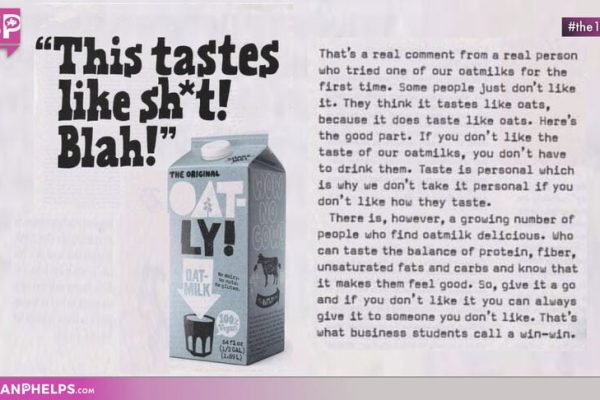
“This tastes like sh*t! Blah!” This is the headline of an actual advertisement from Oatly.

Oatly highlights a negative piece of customer feedback to make a point. Here is the copy from the ad:

“That’s a real comment from a real person who tried one of our oatmilks for the first time. Some people just don’t like it. They think it tastes like oats, because it does taste like oats. Here’s the good part. If you don’t like the taste of our oatmilks, you don’t have to drink them. Taste is personal which is why we don’t take it personal if you don’t like how they taste. There is, however, a growing number of people who find oatmilk delicious. Who can taste the balance of protein, fiber, unsaturated fats and carbs and know it makes them feel good. So, give it a go and if you don’t like it you can always give it to someone you don’t like. That’s what business students call a win-win.”

The full comment from the critical reviewer is, “This tastes like shit! Plant-based drinks don’t taste anything like cow’s milk.”

Oatmilk isn’t trying to be like regular cow milk. And that’s the point. It’s different. Swedish brand Oatly embraces it and exposes it by highlighting the negative.

Not familiar with Oatly? Oatly was founded by Swedish food scientist Rickard Öste in 1994. The brand remained obscure for two decades. Then new CEO, Toni Petersson began exposing the wastefulness and environmental impact of cow milk production in 2014. With new packaging and an antagonistic approach to marketing, the brand began to soar.

Today, being open and honest is a differentiator in business. As George Orwell, author of “1984,” once said, “in a time of universal deceit — telling the truth is a revolutionary act.” In other words, when everyone else is selling blue skies, you can distinguish your brand simply by being honest and transparent. The Pink Goldfish of Exposing is a powerful tool for standing out. 

Takeaway – This immortal quote from Thomas J. Watson, Jr. captures the essence of Exposing, “Follow the path of the unsafe, independent thinker. Expose your ideas to the danger of controversy. Speak your mind and fear less the label of ‘crackpot’ than the stigma of conformity.”

Follow me on Twitter or LinkedIn.

Stan Phelps

Stan Phelps walks the walk. He stands out in the sea of sameness by modeling his own Differentiated Experience (DX) message: Differentiation isn’t just about what you say, it’s about what you do and, more importantly, how and why you do it. Stan leverages his unique collection of 5,000+ case studies on customer, employee, and brand experience to engage audiences with informative learning-based experiences. He believes purposeful DX wins the hearts of employees and customers, and differentiation ultimately boosts loyalty, retention, referrals, and results.

Find Stan’s in-person and virtual keynotes, workshops, and Goldfish tank programs at StanPhelps.com.

1 16 17 18 19 20 48
A simple illustration of a purple fish facing right on a plain background.

I've had the pleasure of working with teams at:

Three purple fish silhouettes swimming to the right on a dark background.

Find Your Best-Match Program

With over 18 possible keynote speaking presentations, workshops, and GOLDFISH TANK programs available to meet your ever-evolving needs, I’ve created this 2-minute, 6-question quiz to help you understand which program is best for you and your audience.

Meet Your Presenter

Through keynote speaking presentations, hands-on workshops, and GOLDFISH TANK programs, I empower you to power loyalty and growth.

Hi, I’m Stan Phelps. I work with organizations that want to increase loyalty, drive sales, and promote positive word-of-mouth by creating differentiated experiences.

As an author, keynote speaker, and workshop facilitator, my in-person and virtual programs stand out in a sea of sameness because I model my own message of differentiated experience (DX).

I leverage my unique collection of more than 5,500 case studies on customer, employee, and brand experience to engage audiences with practical ideas that inspire action.

A person wearing glasses and a gray quarter-zip sweater stands outdoors in front of a building with a triangular glass roof at dusk.

Every time we do business together, Something amazing happens in the world!

Through my partner B1G1, each program gives back to create global IMPACT

Two students in blue uniforms smile while washing their hands at an outdoor tap.

When we complete a GOLDFISH TANK, we give 1001 days of clean water to school children

Collage of three images: a person washing hands, a child drawing with colored pencils, and a group of people sitting outdoors with some raising their hands.

When we complete a GLOBAL engagement, we give 365 days of clean water access in Peru, 120 days of learning aids in Malaysia, and 50 days of business training for women in Malawi

Hand placing a brick on a surface with text: "One Book = One Brick" and an Amazon logo.

When someone downloads a GOLDFISH eBook, we give one brick toward building school facilities in Cambodia