
Stan Phelp's Blog

The Goldfish Chronicles

Sharing insights on customer experience, employee engagement, and brand strategy.

Want a great example of a personalized human touch in customer experience? Look no further that ROAD iD.

My friend Adriana Lee shared this with me earlier in the week:

“I wanted to give you an example of a company that provides great customer service, in case you are looking for new companies to include in your Purple Goldfish book series.

I purchased an ID bracelet to wear when I go on my long bike rides from Road iD. It’s nothing fancy and certainly not expensive, so I was surprised by the quality of the brochure that accompanied the bracelet when I received it. It was made out of thick stock paper. See the attached image of the brochure.

What I really liked about the brochure was that it included a little note from Steve, who supposedly engraved the contact information on my id bracelet, and a picture of Steve as a young boy and some fun facts about Steve. ROAD iD was trying to make a personal connection with me as a customer and I liked the way they did it. The brochure also states that if you contact them at the numbers they provide, that you will reach a real-life human being.”

Kudos to Edward Wimmer IV and the team at ROAD iD. Great example of following up and saying thanks after a transaction.

Little things like this brochure can make a big difference.

Follow me on Twitter or LinkedIn.
Stan Phelps

Stan Phelps walks the walk. He stands out in the sea of sameness by modeling his own Differentiated Experience (DX) message: Differentiation isn’t just about what you say, it’s about what you do and, more importantly, how and why you do it. Stan leverages his unique collection of 5,000+ case studies on customer, employee, and brand experience to engage audiences with informative learning-based experiences. He believes purposeful DX wins the hearts of employees and customers, and differentiation ultimately boosts loyalty, retention, referrals, and results.

Find Stan’s in-person and virtual keynotes, workshops, and Goldfish tank programs at StanPhelps.com.
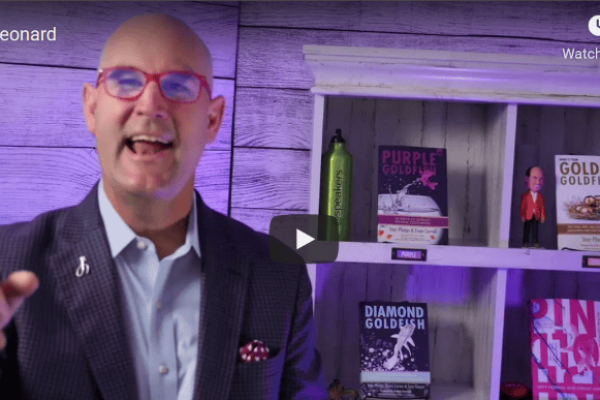
Here is a snippet from my talk about the power of word of mouth. It is the story of Stew Leonard Sr.

I started the Purple Goldfish Project and began a quest to find 1,001 examples.

I didn’t have to go far for inspiration.

Just down the hill from my house was the most profitable grocery store per square foot in the world according to Guinness World Records.

It’s called StewLeonards.

If there is a pinnacle example for this concept of a Purple Goldfish, it would be Stew Leonards.

Who is Stew Leonard?

Stew grew up the son of a dairy farmer in Connecticut. In the 1960s, he began working for the family business.
Clover Farms delivered milk to customers’ homes.

Two events would alter the trajectory of his life and the business.

The first was the decline in demand for milk delivery.

The second was that the family dairy farm was lost to the State. Connecticut invoked eminent domain, taking the farm to build a new highway.

Like being thrown into a global pandemic…. Stew was forced to pivot.

The result was the opening of his first dairy store in 1969.

During the first year the store was open, Stew was asked by the local elementary school principal to speak at a Career Day.

The principal wanted him to talk about the dairy business.

Stew didn’t really see the appeal for kids, but she pressed on and he reluctantly agreed.

That Friday morning, he drove to the school.

As Stew pulled into the parking lot, he immediately knew he was in trouble.

There was a fire truck parked in front of the school with kids climbing on it.

It didn’t get any better when he walked in.

Stew immediately saw a room with an Air Force officer showing a movie about airplanes.

A few classrooms down was a police officer.
He was showing a packed classroom various police equipment and weapons.

Stew proceeded to walk all the way down the hall and found his classroom.

There was a sign on the door: THE MILK BUSINESS

Stew walked into the room to find only 3 kids sitting inside….two of which were the sons of his produce manager.

For the next 30 minutes, Stew talked about the dairy business.

At the end, he thanked the kids.

Stew then reached into his pocket and handed them each a coupon for a free ice cream.

The kids left and Stew waited to present his second session.

He waited and waited…

After 10 minutes, no kids.

After 15 minutes passed, not one kid had arrived.

After 20 minutes though, the principal came rushing in and frantically exclaimed,

“STEW, I DON’T KNOW WHAT YOU TOLD THOSE KIDS, BUT WE HAVE TO MOVE YOUR NEXT PRESENTATION TO THE SCHOOL AUDITORIUM!”

This simple story underscores the power of unexpected extras and the effectiveness of word of mouth.

This event would shape Stew’s thinking and approach.

To this day, when you visit Stew Leonards and buy $100 or more in groceries, you get a coupon for a free ice cream.

Follow me on Twitter or LinkedIn.

Stan Phelps

Stan Phelps walks the walk. He stands out in the sea of sameness by modeling his own Differentiated Experience (DX) message: Differentiation isn’t just about what you say, it’s about what you do and, more importantly, how and why you do it. Stan leverages his unique collection of 5,000+ case studies on customer, employee, and brand experience to engage audiences with informative learning-based experiences. He believes purposeful DX wins the hearts of employees and customers, and differentiation ultimately boosts loyalty, retention, referrals, and results.

Find Stan’s in-person and virtual keynotes, workshops, and Goldfish tank programs at StanPhelps.com.
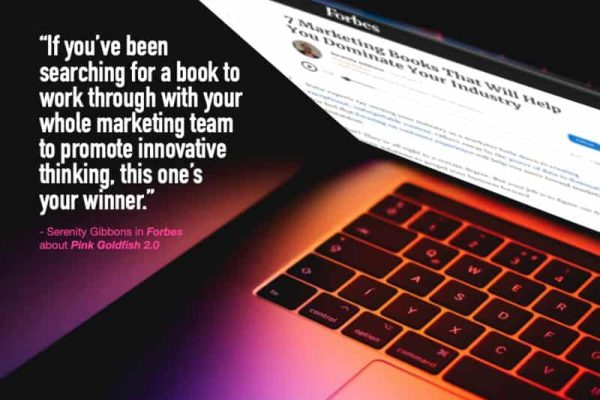
Honored that “Pink Goldfish 2.0” is considered “One of 7 Marketing Books That Will Help You Dominate Your Industry” by Forbes.

Big thanks to Serenity Gibbons for including David Rendall and me on the list.

We are in some great company. The other books and authors included are:

Drew Neisser — “Renegade Marketing: 12 Steps to Building Unbeatable B2B Brands”

Dan Gingiss — “The Experience Maker: How to Create Remarkable Experiences That Your Customers Can’t Wait to Share.” (just saw Dan present to AMA Triangle and he was fantastic)

Dorie Clark – “The Long Game: How to Be a Long-Term Thinker in a Short-Term World” (Congrats Dorie as this just became a Wall Street Journal bestseller)

Kimberly A. Whitler — “Positioning for Advantage: Techniques and Strategies to Grow Brand Value”

Jeff Perkins — “How Not to Suck at Marketing”

and (bonus points for the longest title)

Michael F. Schein — “The Hype Handbook: 12 Indispensable Success Secrets from the World’s Greatest Propagandists, Self-Promoters, Cult Leaders, Mischief Makers, and Boundary Breakers”

Here’s what Serenity shared about Pink Goldfish 2.0:

“Boring. It’s the one-word reason so many organizations fail to capture attention. Even if you have the greatest product in the universe, yawn-worthy advertising won’t earn you much traction. Pink Goldfish sets up a seven-point journey to true differentiation in your field. 

Forget perfection and ditch sameness. Instead, learn how to magnify your corporate uniqueness in the most irresistible way. After sitting down with this book, you won’t see your flaws in the same way. If you’ve been searching for a book to work through with your whole marketing team to promote innovative thinking, this one’s your winner.”

What are you waiting for?

Pick up a copy of “Pink Goldfish 2.0.” Link in the comments. Because in the words of Serenity, “Your next epiphany may only be a page away.”

Or reach out to David and me to schedule a keynote, workshop, or a Goldfish Tank program.

Follow me on Twitter or LinkedIn.

Stan Phelps

Stan Phelps walks the walk. He stands out in the sea of sameness by modeling his own Differentiated Experience (DX) message: Differentiation isn’t just about what you say, it’s about what you do and, more importantly, how and why you do it. Stan leverages his unique collection of 5,000+ case studies on customer, employee, and brand experience to engage audiences with informative learning-based experiences. He believes purposeful DX wins the hearts of employees and customers, and differentiation ultimately boosts loyalty, retention, referrals, and results.

Find Stan’s in-person and virtual keynotes, workshops, and Goldfish tank programs at StanPhelps.com.
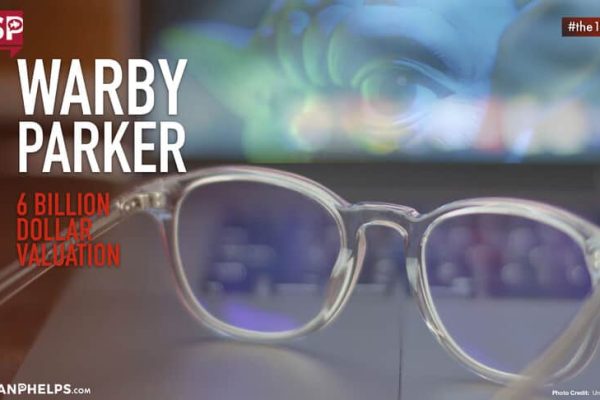
Warby Parker hit its first-year sales target three weeks after the company launched 11 years ago.  Two weeks ago, the company that started with $2,500 in capital listed on the NYSE. It now has a $6 billion valuation.

Background:
It all began in 2008 with four Wharton MBA students. Neil Blumenthal, Dave Gilboa, Andy Hunt, and Jeff Raider pondered why glasses were so expensive and why glasses weren’t sold online. Blumenthal came up with the idea while working at a nonprofit called VisionSpring.

VisionSpring trains women in the developing world to give eye exams and sell glasses. Blumenthal emailed his friends in the middle of the night proposing an online eyewear startup. The three were skeptical until feedback inspired the idea of letting customers try on five pairs of frames at home for free before buying any.

And the Warby Parker name?

That came thanks to Jack Kerouac and two of his journal characters, Warby Pepper and Zagg Parker. The company didn’t launch immediately as the founders were busy finishing their MBA’s. GQ contacted Blumenthal wanting to do a story, but at that time there wasn’t a company yet, and the website was unfinished.

On February 15, 2010, WarbyParker.com went live. Within 48 hours of GQ Magazine dubbing the company “the Netflix of eyewear,” the site was flooded with orders for $95 glasses. Blumenthal had to temporarily suspended the home try-on program.

Customers were placing orders long after inventory had run out because there was no “sold out” function on the website. The wait list was over 20,000-people long. And that was the way the company hit its first-year sales target in three weeks.

In the book “Red Goldfish,” Graeme Newell, CSP and I highlighted Warby Parker’s “Buy a Pair, Give a Pair” policy. Rather than donating the glasses outright, the company makes cash donations from its sales to VisionSpring,

VisionSpring trains low-income men and women to sell glasses in their communities for affordable prices, allowing them to earn a living. This helps ensure Warby Parker’s donations actually meet people’s needs and don’t displace local businesses. By 2019, Warby Parker had distributed more than 5 million pairs of glasses through 10,000 emerging market entrepreneurs.

Warby Parker’s Red Goldfish of “Buy a Pair, Give a Pair” fulfills both parts of the company’s purpose: “offer designer eyewear at a revolutionary price, while leading the way for socially conscious businesses.”

Congrats on the IPO Neil, Dave, Andy, and Jeff.

Follow me on Twitter or LinkedIn.

Stan Phelps

Stan Phelps walks the walk. He stands out in the sea of sameness by modeling his own Differentiated Experience (DX) message: Differentiation isn’t just about what you say, it’s about what you do and, more importantly, how and why you do it. Stan leverages his unique collection of 5,000+ case studies on customer, employee, and brand experience to engage audiences with informative learning-based experiences. He believes purposeful DX wins the hearts of employees and customers, and differentiation ultimately boosts loyalty, retention, referrals, and results.

Find Stan’s in-person and virtual keynotes, workshops, and Goldfish tank programs at StanPhelps.com.
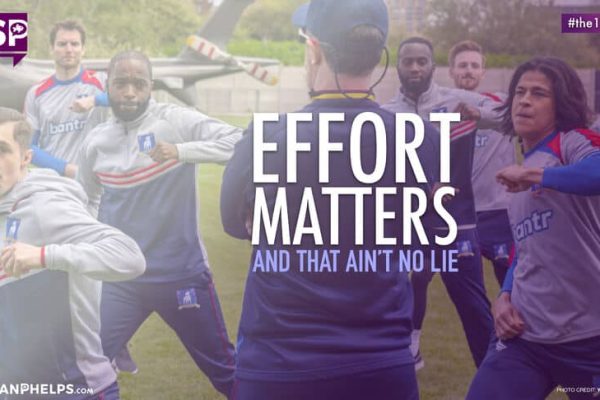
Ted Lasso shared a key CX and marketing insight this past week. Effort matters.

Didn’t see the episode? Let me set the scene from Season 2, Episode 11:

—-

The coaching staff is watching the players on the pitch.

Ted: They can’t maintain their lines. [Ted sighs] These guys are just not in sync.

Coach Beard: It’s okay.

Ted: Oh, hell no. No, no. Hey, hey. [Ted blows whistle]

Ted: No. No, no. Guys, come on. That ain’t gonna cut it. Y’all gotta be together on this, all right? [The scene reveals that Ted is trying to teach the team a 90s dance routine]

It’s like this. [He demonstrates his best N’Sync form] “You may hate me, but it ain’t no lie.” Yeah? Then the hands. “Bye, bye, bye.” All right? And watch my jumps. “Ain’t no lie.” See how I’m jumping? Like I’m a marionette. That’s why this song is on the album “No Strings Attached,” all right?

[The team murmurs in agreement]

Ted: Yes. Okay, good. Now, look, fellas, performing this at Doc’s going-away party ain’t gonna mean Bo Jackson diddly squat unless she can tell how hard we worked on it. You know what I mean? It ain’t the execution. That ain’t the gift. It’s the effort. Yeah? Okay? You see what I mean?

—-

Coach Lasso has just revealed the essence of lagniappe and Purple Goldfish Strategy. It’s not just execution. It is differentiation by added value and effort. Little things that show that you care. Either by adding value or reducing effort for customers. 

To quote Rory Sutherland, “The meaning and significance we attach to something is felt in direct proportion to the expense with which it is communicated.”

Sutherland calls this signaling in the book “Alchemy.” The effort is a signal to the customer that the company cares.

Takeaway: Effort matters. #BELIEVE

Follow me on Twitter or LinkedIn.

Stan Phelps

Stan Phelps walks the walk. He stands out in the sea of sameness by modeling his own Differentiated Experience (DX) message: Differentiation isn’t just about what you say, it’s about what you do and, more importantly, how and why you do it. Stan leverages his unique collection of 5,000+ case studies on customer, employee, and brand experience to engage audiences with informative learning-based experiences. He believes purposeful DX wins the hearts of employees and customers, and differentiation ultimately boosts loyalty, retention, referrals, and results.

Find Stan’s in-person and virtual keynotes, workshops, and Goldfish tank programs at StanPhelps.com.
Your flaws and imperfections are the things that make you awesome.

To illustrate this, I want to share a story that happened over 500 years ago.

In the 15th century, there was a Japanese Shogun named Ashikaga Yoshimasa.

He had a favorite tea bowl, much like you might have a favorite coffee mug. Something that has sentimental value and can’t be replaced.

One day, Ashikaga wasn’t paying attention and he knocked over his tea bowl.

It shattered into pieces and his heart sank.

Discouraged, he sent his favorite tea bowl out to be repaired.

When it came back two days later, it was fixed using ugly metal staples and black, coarse, nasty glue.

Ashikaga held it in his hands and felt utter disappointment. This wasn’t acceptable.

Ashikaga called in his best craftsmen from the Osaka region. He handed over the bowl and challenged them to find a more aesthetically pleasing method of repair.

The craftsmen went to work. They carefully took apart the previously fixed bowl. They removed the staples and the black coarse ugly glue.

After cleaning each piece, they began to use lacquer and gold to meticulously repair the cracks.

The entire process took two weeks.

The craftsmen returned and presented the tea bowl. Ashikaga’s heart leapt.

The shogun was extremely pleased with the result.

Born out of the efforts of these craftsmen came the art of Kintsugi.

Kintsugi in Japanese translates to “golden joinery.” It has become a metaphor for embracing your breaks and flaws. It espouses the idea that the broken is more beautiful than the pristine.

The gold is used to intentionally call attention to the breaks instead of concealing them.

Collectors became so enamored with the new art that some were accused of deliberately smashing valuable pottery so it could be repaired with the golden seams of kintsugi.

Here is the important takeaway from the art form of kintsugi:

Carefully tending to the cracks makes the object more beautiful,
not despite the flaws, but because of attention placed on them.

Own your flaws. Highlight and illuminate them, don’t cover them up.

Follow me on Twitter or LinkedIn.

Stan Phelps

Stan Phelps walks the walk. He stands out in the sea of sameness by modeling his own Differentiated Experience (DX) message: Differentiation isn’t just about what you say, it’s about what you do and, more importantly, how and why you do it. Stan leverages his unique collection of 5,000+ case studies on customer, employee, and brand experience to engage audiences with informative learning-based experiences. He believes purposeful DX wins the hearts of employees and customers, and differentiation ultimately boosts loyalty, retention, referrals, and results.

Find Stan’s in-person and virtual keynotes, workshops, and Goldfish tank programs at StanPhelps.com.
What’s the most common fear for humans?

It’s speaking. According to Forbes, “The fear of public speaking is the most common fear and prevents many people from achieving their potential.”

A shocking 74 percent of Americans have fears and anxiety toward public speaking.

Our number two fear—dying.

Does this make any sense?

In the brilliant words of comedian Jerry Seinfeld, “For the average person, if you have to be at a funeral, you would rather be in the casket than doing the eulogy.”

The fear of speaking is called glossophobia.

Some may feel a slight nervousness at the thought of public speaking, while others experience full-on panic and fear. Why?

Because our brain has a hard time distinguishing between actual risk (loss of life) and perceived risk (threat to our identity).

Our brains are wired to respond to threat in a particular way—regardless of the actual threat.

To my knowledge, no one has literally died giving a presentation.

But to be candid, even for an experienced presenter, these feelings of nervousness and excitement never completely go away.

You can’t unwire or unlearn biology.

Mark Twain made light of this when he said, “There are only two types of speakers in this world…. The nervous . . . and the liars.”

Overcoming these feelings and becoming great at presenting is the focus of Silver Goldfish.

Follow me on Twitter or LinkedIn.

Stan Phelps

Stan Phelps walks the walk. He stands out in the sea of sameness by modeling his own Differentiated Experience (DX) message: Differentiation isn’t just about what you say, it’s about what you do and, more importantly, how and why you do it. Stan leverages his unique collection of 5,000+ case studies on customer, employee, and brand experience to engage audiences with informative learning-based experiences. He believes purposeful DX wins the hearts of employees and customers, and differentiation ultimately boosts loyalty, retention, referrals, and results.

Find Stan’s in-person and virtual keynotes, workshops, and Goldfish tank programs at StanPhelps.com.
Follow me on Twitter or LinkedIn.

Stan Phelps

Stan Phelps walks the walk. He stands out in the sea of sameness by modeling his own Differentiated Experience (DX) message: Differentiation isn’t just about what you say, it’s about what you do and, more importantly, how and why you do it. Stan leverages his unique collection of 5,000+ case studies on customer, employee, and brand experience to engage audiences with informative learning-based experiences. He believes purposeful DX wins the hearts of employees and customers, and differentiation ultimately boosts loyalty, retention, referrals, and results.

Find Stan’s in-person and virtual keynotes, workshops, and Goldfish tank programs at StanPhelps.com.
Making sense of Info-sense.

Info-sense is “the ability to utilize data to really understand customers as people and personalize their service.”

Coined by Trend-Watching.com, this sixth-sense capability will enable companies to learn more about customer’s individual needs in real-time.

Companies who embrace info-sense can provide customers with exactly what they need right when they need it.

This concept isn’t new. Here’s a story from the early 1980s:

The year is 1981, the same year the very first US Space Shuttle rocketed to space from the Florida coast.

A few weeks after that launch, a sixteen-year-old named Michael, then a high school student, took a summer job selling newspaper subscriptions for The Houston Post.

The Houston Post was the evening newspaper. Michael started his new job as a salesman.

He was a given a basic piece of technology . . . the telephone.

As for data, the newspaper gave its salespeople a list of new phone numbers issued by the telephone company.

Michael was instructed to “smile and dial”, effectively cold calling prospective customers.

Michael soon noticed two common threads. New subscribers tended to be people who either . . . had just moved into new homes . . . . or who had just married.

Armed with this realization, Michael hired two high school friends to go around the city and find as many people getting new mortgages and uncover couples who were getting married.

He then created a personalized letter to these prospects. The letter congratulated them for the new home or new marriage and spoke to the benefits of subscribing to the Houston Post.

The result:

That summer Michael sold thousands of subscriptions. He earned $18,000 that summer in commissions and became the highest-paid salesperson at the paper. To put that into perspective, that was more than his high school economics teacher made the entire school year.

Why did this work so well?

Michael had uncovered a key insight. He had spent time understanding his customer and their needs. By knowing more about his ideal customer, Michael was able to eliminate the guesswork and, knowing his prospect would likely convert, spend more time connecting with them on a personal level.

Two years later Michael would head off to the University of Texas. During his second year in his dormitory room, Michael would start a company focused on creating custom-built direct-to-consumer PC’s.

That Michael was . . . Michael Dell.

That company is . . . Dell Computers.

The lesson that Michael learned is even truer today than it was in 1981. Technology has paved the way for every company to know more about their customers and build deeper relationships with them.

I call this concept of leveraging technology, data, and analytics to enhance the customer experience a Blue Goldfish.

Follow me on Twitter or LinkedIn.

Stan Phelps

Stan Phelps walks the walk. He stands out in the sea of sameness by modeling his own Differentiated Experience (DX) message: Differentiation isn’t just about what you say, it’s about what you do and, more importantly, how and why you do it. Stan leverages his unique collection of 5,000+ case studies on customer, employee, and brand experience to engage audiences with informative learning-based experiences. He believes purposeful DX wins the hearts of employees and customers, and differentiation ultimately boosts loyalty, retention, referrals, and results.

Find Stan’s in-person and virtual keynotes, workshops, and Goldfish tank programs at StanPhelps.com.
Rob Gronkowski makes history. And that makes him “SPECIAL.”
 
Gronk became the first non-USAA member to promote the military-affiliated insurance company USAA.

In a recent 30-second spot by Publicis, “Robert” calls USAA and asks for “up to 30%” off his auto insurance
coverage.
 
He wants to take part in the SafePilot program but gets denied when he can’t supply his number.
 
Number 87 can’t do it, because Gronk isn’t a member.
 
USAA only serves members of the military and their families. The tagline for the spot, “It’s Still Only for the Military Community.”
 
Think about it for a second…
 
This insurance company just spent nearly $5 million in media, plus another million-plus in production . . . to tell people like Gronkowski they can’t get access to USAA.
 
In Pink Goldfish 2.0, David Rendall and I call this flawsome strategy WITHHOLDING.
 
It’s a brave play, because most brands are trying to grow. Offer more features, more products, more services, and
serve more people.
 
But maybe that’s not the only way.

Withholding is about creating limitations, restrictions, boundaries, and constraints. That sounds obviously
negative.
 
Don’t great brands offer freedom? Don’t customers want services to be unlimited? Shouldn’t the best organizations be everywhere all the time? Even if we don’t serve everyone, we certainly want more customers, don’t we?
 
Not necessarily.
 
Here’s a little BACKGROUND ON USAA:
 
What’s with the acronym?
 
The United States Army Automobile Association was founded in 1922 in San Antonio by a group of 25 U.S. Army officers. They were trying to solve a problem as they were unable to secure auto insurance because of the perception that they, as military officers, were a high-risk group.
 
Two years later, they dropped the Army out of the name when other commissioned officers from the other branches were allowed to join. They also swapped out States. The acronym for United Services Automobile Association was born.
 
Focused initially on “reliable” and “economical” auto insurance, USAA has since expanded to offer banking, insurance, and brokerage services. They now proudly serve both past and present members of the Armed Forces, officers and enlisted, and their families. 
 
MORE WITHHOLDING
 
How do you normally get insurance? You sit down with an agent and review your options. Not with USAA. They pioneered direct to consumer using their own employees.
 
For the first 40+ years it was by mail. The next 30+ years was by phone. And online sales were added just over 20+
years ago via its website.
 
TAKEAWAY – LESS is sometimes MORE. By reducing options or completely eliminating them, brands can stand out, differentiate themselves, and become SPECIAL. 

Follow me on Twitter or LinkedIn.

Stan Phelps

Stan Phelps walks the walk. He stands out in the sea of sameness by modeling his own Differentiated Experience (DX) message: Differentiation isn’t just about what you say, it’s about what you do and, more importantly, how and why you do it. Stan leverages his unique collection of 5,000+ case studies on customer, employee, and brand experience to engage audiences with informative learning-based experiences. He believes purposeful DX wins the hearts of employees and customers, and differentiation ultimately boosts loyalty, retention, referrals, and results.

Find Stan’s in-person and virtual keynotes, workshops, and Goldfish tank programs at StanPhelps.com.

1 18 19 20 21 22 48
A simple illustration of a purple fish facing right on a plain background.

I've had the pleasure of working with teams at:

Three purple fish silhouettes swimming to the right on a dark background.

Find Your Best-Match Program

With over 18 possible keynote speaking presentations, workshops, and GOLDFISH TANK programs available to meet your ever-evolving needs, I’ve created this 2-minute, 6-question quiz to help you understand which program is best for you and your audience.

Meet Your Presenter

Through keynote speaking presentations, hands-on workshops, and GOLDFISH TANK programs, I empower you to power loyalty and growth.

Hi, I’m Stan Phelps. I work with organizations that want to increase loyalty, drive sales, and promote positive word-of-mouth by creating differentiated experiences.

As an author, keynote speaker, and workshop facilitator, my in-person and virtual programs stand out in a sea of sameness because I model my own message of differentiated experience (DX).

I leverage my unique collection of more than 5,500 case studies on customer, employee, and brand experience to engage audiences with practical ideas that inspire action.

A person wearing glasses and a gray quarter-zip sweater stands outdoors in front of a building with a triangular glass roof at dusk.

Every time we do business together, Something amazing happens in the world!

Through my partner B1G1, each program gives back to create global IMPACT

Two students in blue uniforms smile while washing their hands at an outdoor tap.

When we complete a GOLDFISH TANK, we give 1001 days of clean water to school children

Collage of three images: a person washing hands, a child drawing with colored pencils, and a group of people sitting outdoors with some raising their hands.

When we complete a GLOBAL engagement, we give 365 days of clean water access in Peru, 120 days of learning aids in Malaysia, and 50 days of business training for women in Malawi

Hand placing a brick on a surface with text: "One Book = One Brick" and an Amazon logo.

When someone downloads a GOLDFISH eBook, we give one brick toward building school facilities in Cambodia