
Stan Phelp's Blog

The Goldfish Chronicles

Sharing insights on customer experience, employee engagement, and brand strategy.

FEES are a four-letter-word. Domino’s is attacking delivery companies such as Uber Eats and DoorDash with FREES.

They are giving away $50 million in free food through November. One out of every 14 customers will receive a free food item with their order.

According to their website, “Other food delivery apps charge customers with hidden city or service fees. Not Domino’s. We charge customers one straightforward delivery fee because we believe that level of transparency is what customers want and deserve.”

This is an example of the Purple Goldfish of Throw-ins. The most classic form of lagniappe, throw-ins are one of the easiest types of Purple Goldfish to implement. 

A throw-in is not only what you provide as an extra, it is also what you don’t charge for.

Want an example that takes this to new heights? Well, at least 35,000 feet.

SOUTHWEST ELIMINATES FEES

Southwest Airlines stands for “freedom” in air travel. Following up on the successful “Bags Fly Free program,” Southwest has mastered eliminating fees:

Here is a rundown of how they treat fees:
– No checked bag fees for up to two bags
– No change fees. Saving customers upwards of $150
– No fuel surcharge fees
– No snack fees
– No aisle or window seat fees
– No curbside check-in fees
– No phone reservation fees

Domino’s is calling out these delivery companies, not just by touting their lack of fees, but by handing out little extras. 50 million reasons to get deliver through Domino’s.

Question – is this a smart strategy from Domino’s?

Follow me on Twitter or LinkedIn.
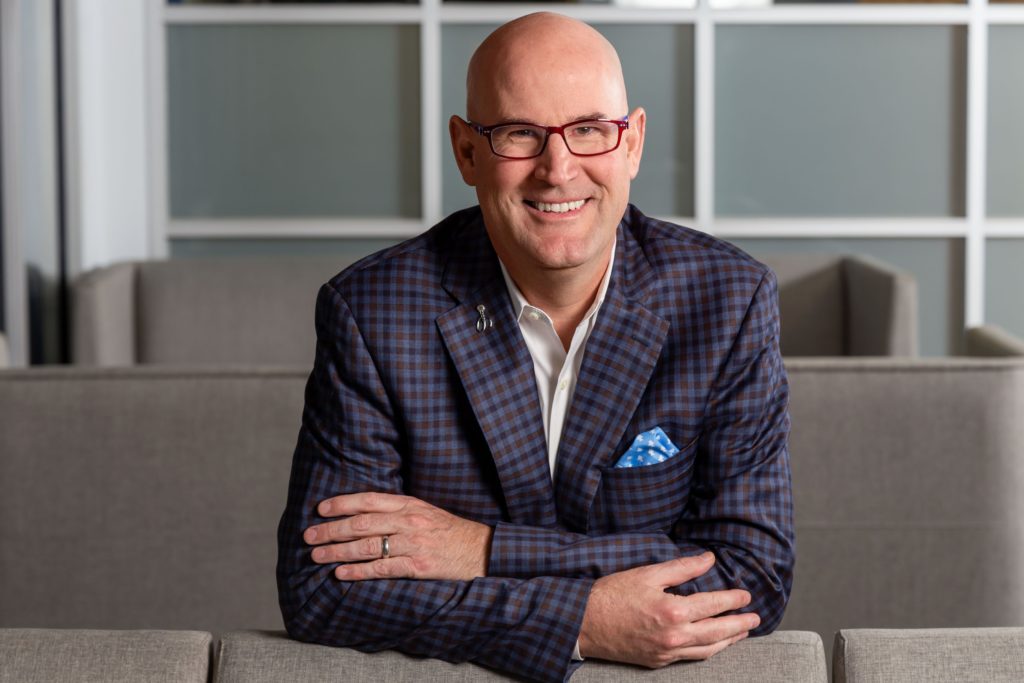
Stan Phelps

Stan Phelps walks the walk. He stands out in the sea of sameness by modeling his own Differentiated Experience (DX) message: Differentiation isn’t just about what you say, it’s about what you do and, more importantly, how and why you do it. Stan leverages his unique collection of 5,000+ case studies on customer, employee, and brand experience to engage audiences with informative learning-based experiences. He believes purposeful DX wins the hearts of employees and customers, and differentiation ultimately boosts loyalty, retention, referrals, and results.

Find Stan’s in-person and virtual keynotes, workshops, and Goldfish tank programs at StanPhelps.com.
There was once an old joke about law school. At the first day of class, the Dean would look out at the 1L’s and say,

“Look to the right of you and then look to the left of you . . . one of you won’t be here in three years.”

That same reasoning applies today.

One out of every three people eligible to get the vaccine have decided for one reason or another not to get the free vaccine.

If you are in line at the grocery store, there is a strong chance that you or the person in front or behind you in line have decided currently not to get vaccinated.

Yesterday, I had a friend share an article with me. The reason she shared it was because of the Pink Goldfish approach it took.

The article was titled, “The Drug That Cracked COVID.”

When I say article, it was more like a novella. At 9,492 words, it told the amazing story of five doctors on a crusade against the establishment. They had found the miracle drug. It was low-cost and had won a Nobel Prize in 2015. Big pharma wants to blacklist it.

Not knowing why she shared the article, I replied to my friend:

“Have you gotten vaccinated? Tell me you are not pinning your hopes of staying out of the hospital and dying on a horse dewormer?”

What I didn’t realize is that my friend is firmly in the anti-vaccination camp.

We began a dialogue of respectful messages. Over the course of many comments, I heard 10 reasons not to get vaccinated.

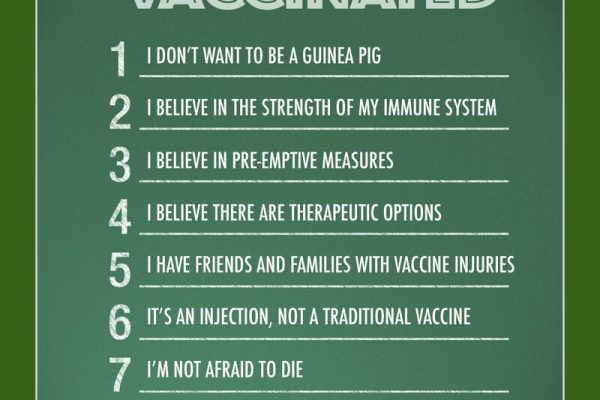
A few were personal: I trust my immune system, there are therapeutic options, there are pre-emptive measures, and I’m not afraid to die.

I shared to my friend that it just wasn’t about her:

“I hope you don’t get the virus. Like Joe Rogan, you probably don’t need the vaccine to survive this. More importantly, I hope you don’t get it and unknowingly pass it along to someone who has comorbidities.” 

Not getting the vaccine is kind of like deciding you are going to drive your car 90 mph on a city street with no rearview mirror. You are healthy, you’ve got a seatbelt and airbags, so you’ll most likely survive if you get into a wreck.

But in order to drive 90 mph, you are inevitably going to take risks. The challenge is that you can’t see those cars you pass. You might cause a multi-car accident. One out of six people in that accident is going to face serious illness or death.

Or you might cause someone to swerve to avoid you. They, unfortunately, jump the curb and sideswipe a grandparent and their grandkids.

If you are healthy, don’t get it for you. Get it for those that can’t get the vaccine or for those still at risk of dying if they get a breakthrough infection.

In the words of the Pope, “It is the moral choice because it is about your life but also the lives of others.”

We’ve lost over 650,000 people in this country. That’s like having two 9/11s each week since this started. Over 3,500 have been healthcare first responders. The sad thing is that we now have the ability to stop the planes each week.

Follow me on Twitter or LinkedIn.

Stan Phelps

Stan Phelps walks the walk. He stands out in the sea of sameness by modeling his own Differentiated Experience (DX) message: Differentiation isn’t just about what you say, it’s about what you do and, more importantly, how and why you do it. Stan leverages his unique collection of 5,000+ case studies on customer, employee, and brand experience to engage audiences with informative learning-based experiences. He believes purposeful DX wins the hearts of employees and customers, and differentiation ultimately boosts loyalty, retention, referrals, and results.

Find Stan’s in-person and virtual keynotes, workshops, and Goldfish tank programs at StanPhelps.com.

“This must be the work of Lord Vader!”

This was the response from the LEGO Group when a customer reached out about a missing bag of pieces for his set.

And it wasn’t an ordinary set. Jason Aten shared the story of how John purchased the Star Wars Mos Eisley set in Inc. Magazine. It contains over 3,000 pieces and retails for $350. The instruction manual is 400 pages.

[Mos Eisley is a walk in the park compared to the Millennium Falcon. That 7,541-piece Star Wars set will set you back $800]

John is an AFOL (an adult fan of LEGO). I read once that one out of every four sets of LEGO is purchased by adults for adults.

He reached out to Customer Service and received the following response:

“Dear John, 
Thanks for getting in touch with us and providing that information! I am so sorry that you are missing bag 14 from your Mos Eisley Cantina! This must be the work of Lord Vader.
Fear not, for I have hired Han to get that bag right out to you. 
Have a bricktastic day and may the force be with you.”

Jason put it best in the article, “…it might be the best customer service email I’ve ever seen. Not only did it apologize for the mistake, and clearly explain how LEGO would make it right, it did it with a sense of personality. That might be the most impressive part of the entire email.”

This response from customer service is true to the LEGO name. LEGO is a portmanteau for the two Danish words of leg godt. Leg godt means “play well.” Well played indeed.

Takeaway: HANDLING MISTAKES is one of 10 types of Purple Goldfish. We all make mistakes in business. How we deal with them is the real question. It’s important to not only correct the problem but to go above and beyond to make things right. Little things can make the biggest difference.

Follow me on Twitter or LinkedIn.

Stan Phelps

Stan Phelps walks the walk. He stands out in the sea of sameness by modeling his own Differentiated Experience (DX) message: Differentiation isn’t just about what you say, it’s about what you do and, more importantly, how and why you do it. Stan leverages his unique collection of 5,000+ case studies on customer, employee, and brand experience to engage audiences with informative learning-based experiences. He believes purposeful DX wins the hearts of employees and customers, and differentiation ultimately boosts loyalty, retention, referrals, and results.

Find Stan’s in-person and virtual keynotes, workshops, and Goldfish tank programs at StanPhelps.com.

Your appearance matters when presenting. It shouldn’t, but it does. We judge people in a split-second. Over 80% of those judgments come down to just two factors. Fellow speaker Chris Malone explains the phenomenon,

“Early humans developed a kind of genius for making two specific kinds of quick judgments: What are the intentions of other people toward me? And how capable are they of carrying out those intentions? Social psychologists call these two categories of perception WARMTH and COMPETENCE, and they drive most of our emotions and behavior toward other people.”

Before a word comes out when presenting, people have made judgments. How you dress drives those perceptions. You don’t get a second chance to make a first impression. Once that impression is made, our brain begins the process of looking for clues to confirm that initial bias.

So, what’s the solution?

Simple, you Dress to the Nines. The origin of the phrase is unclear. I prefer the Old English version. The saying “dressed to the eyes,” was often written as “dressed to then eyne.” According to Mental Floss, “The thinking goes that someone at some point heard ‘then eyne’ and mistook it for ‘the nine’ or ‘the nines.”

How are you dressing to the eyes to reinforce warmth + competence?

Follow me on Twitter or LinkedIn.

Stan Phelps

Stan Phelps walks the walk. He stands out in the sea of sameness by modeling his own Differentiated Experience (DX) message: Differentiation isn’t just about what you say, it’s about what you do and, more importantly, how and why you do it. Stan leverages his unique collection of 5,000+ case studies on customer, employee, and brand experience to engage audiences with informative learning-based experiences. He believes purposeful DX wins the hearts of employees and customers, and differentiation ultimately boosts loyalty, retention, referrals, and results.

Find Stan’s in-person and virtual keynotes, workshops, and Goldfish tank programs at StanPhelps.com.
We have a shot at normal. Last month, the Pfizer COVID-19 has received full approval from the FDA.

What does that NORM need to be going forward?

In my opinion, we need to make vaccination or a vaccination exemption a REQUIREMENT going forward for many activities.

To be clear, a requirement is different from a mandate. A mandate means mandatory. This isn’t what I’m advocating for.

A requirement allows for personal choice. Don’t feel compelled the decision to get the vaccine if you are not comfortable. But to quote one of my favorite lyrics from Rush. From the song “Free Will” …

“Even if you choose not to decide, you still have made choice.”

Decide not to get the vaccine or a vaccination exemption and you have also made a choice. That choice is to not be allowed to go to places where a vaccine is required:

– If your employer requires a vaccine, you can’t go back to the office or interact in-person with customers. You can work remotely.

– If bars and restaurants require a vaccine, you can’t dine inside. You can order take out.

– If a store requires a vaccine, you can’t shop. You can order online for delivery.

– If airlines require a vaccine, you can’t fly. You can drive instead.

– If a concert, a sporting venue, or a conference requires a vaccine, you can’t attend that show, game, or event. Watch it on TV or online instead.

– If your college or university requires a vaccine, you can’t attend in person. You can do your studies online.

If we have a shot at normal, we need employers, educators, and entertainers to step up and require vaccinations going forward.

Follow me on Twitter or LinkedIn.

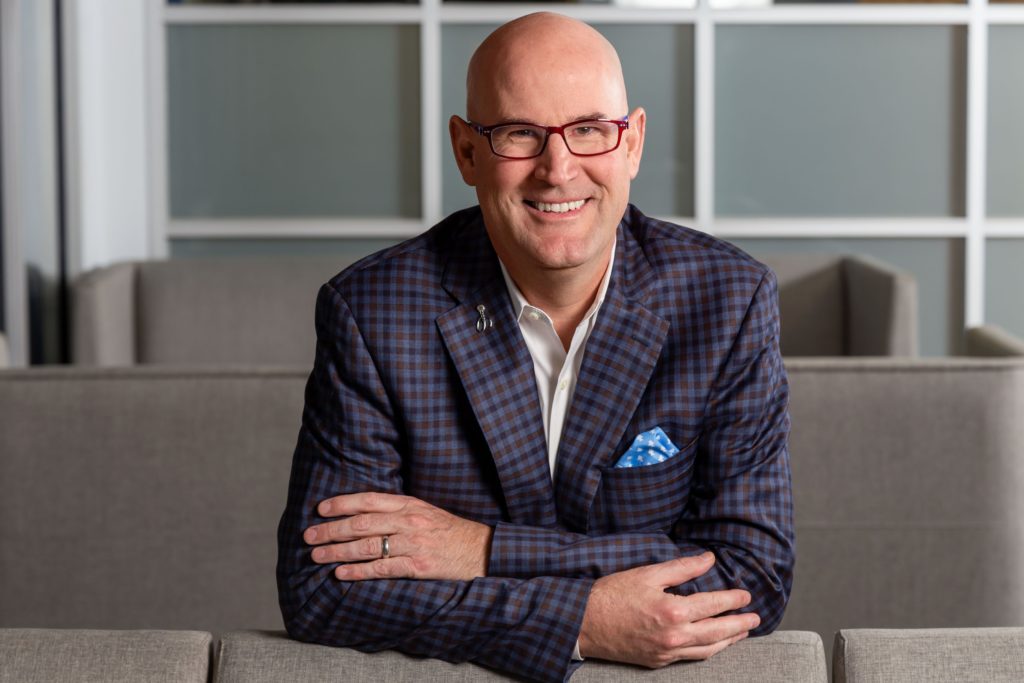
Stan Phelps

Stan Phelps walks the walk. He stands out in the sea of sameness by modeling his own Differentiated Experience (DX) message: Differentiation isn’t just about what you say, it’s about what you do and, more importantly, how and why you do it. Stan leverages his unique collection of 5,000+ case studies on customer, employee, and brand experience to engage audiences with informative learning-based experiences. He believes purposeful DX wins the hearts of employees and customers, and differentiation ultimately boosts loyalty, retention, referrals, and results.

Find Stan’s in-person and virtual keynotes, workshops, and Goldfish tank programs at StanPhelps.com.
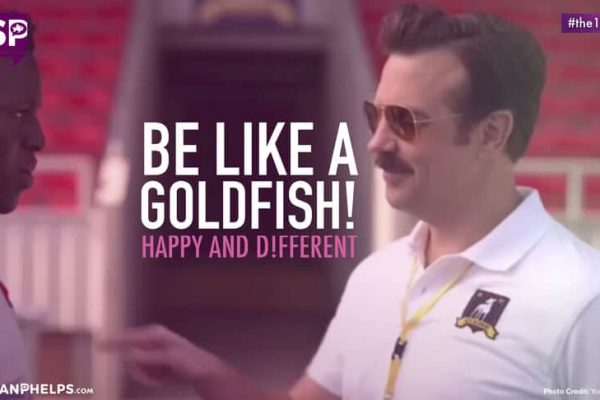
What’s the happiest animal on Earth? Coach Ted Lasso poses this question to Sam Obisanya.

Haven’t seen the show? For background, Sam is a young Nigerian right-back for AFC Richmond. He’s struggling to find his footing and he’s hard on himself after making mistakes on the soccer field.

Lasso shares, “It’s a goldfish. You know why?”

Sam is puzzled and shakes his head side-to-side.

Coach continues, “Got a ten-second memory… Be a goldfish, Sam.”

The takeaway from Coach Lasso is don’t dwell on a bad play. Forget it and concentrate on the next play.

Want a technique to implement this thinking?

Daniel Pink shared a technique from reading Olympic softball player Jennie Finch’s book, “Throw Like a Girl” in his Pinkcast.

Finch shared how a sports psychologist placed a tiny toilet in the dugout.
Whenever a player would strike out or make a fielding error, she’d come back to the dugout and flush the tiny toilet. That action symbolized the flushing away of the mistake. Dan suggests buying a toilet on Etsy and placing it on your desk. The next time you make a mistake, you click the handle and just flush it away.

Is a short memory like a goldfish a key to being happy?

I love this comment on YouTube from Fussas, “Genuinely amazing advice… the moment I started to put effort into this approach was when I became consistently happy rather than consistently depressed. There’s still moments of sadness of course, but learning to just move past those without spending emotional and physical energy on things you cannot change.”

Speaking of change, does a goldfish also hold the key to being different?

The average goldfish is just over three inches in length. That’s the length of your thumb. The largest goldfish in the world are over 15 inches.

5 times larger! How is that even possible? It turns out the growth of a goldfish (and your business) is based on 5 factors:

1. Size of the bowl or pond – bigger the bowl or pond, the greater the growth. In business, the bowl or pond is the “Market” you serve.

2. Number of other goldfish – more goldfish, the harder the growth. In business, those other goldfish are your “Competition.”

3. Quality of water – the clearer the water and abundance of nutrients, the greater the growth. In business, the water is the “Economy.”

4. First 120 days of life – the better they do as “fry,” the more growth later in life. In business, this is how you do as a “Start-up.”

5. Genetic makeup – the stronger your genes and the more you are separated from other goldfish, the larger the growth. In business, genetic makeup is “Differentiation.”

Assuming you’ve already been in business for four months, do you have any control over the market, your competition, or the economy?

NO, NO, and NO.

Takeaway: Be like a goldfish. The only thing you have control over is your business’s genetic make-up or how you differentiate the experience you build around your product or service.  

Follow me on Twitter or LinkedIn.

Stan Phelps

Stan Phelps walks the walk. He stands out in the sea of sameness by modeling his own Differentiated Experience (DX) message: Differentiation isn’t just about what you say, it’s about what you do and, more importantly, how and why you do it. Stan leverages his unique collection of 5,000+ case studies on customer, employee, and brand experience to engage audiences with informative learning-based experiences. He believes purposeful DX wins the hearts of employees and customers, and differentiation ultimately boosts loyalty, retention, referrals, and results.

Find Stan’s in-person and virtual keynotes, workshops, and Goldfish tank programs at StanPhelps.com.
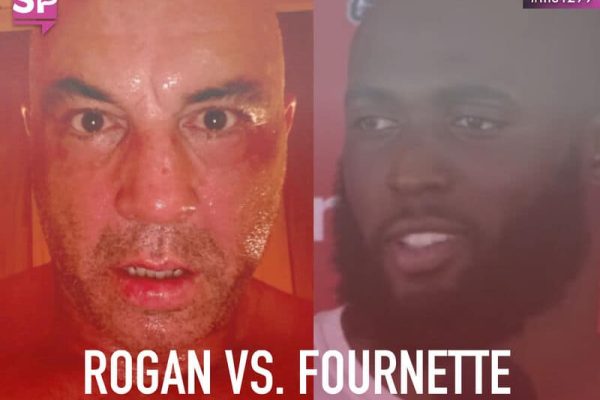
Joe Rogan versus Leonard Fournette on the UFC… The Unvaccinated Fight Club.

In this corner, let’s start with Leonard Fournette.

Fournette is a running back that plays for the reigning Super Bowl Champion Tampa Bay Buccaneers.

Back in July, Fournette tweeted, “Vaccine I can’t do it.”

Last week, the Bucs announced that the entire team and organization is 100% vaccinated. Fournette is part of that group.

What changed?

The potential repercussions for an outbreak could be fatal to a team with playoff aspirations.

According to the NFL, if a game cannot be rescheduled during the 18-week season in 2021 due to a COVID outbreak among unvaccinated players, the team with the outbreak will FORFEIT and be credited with a loss for playoff seeding.

According to ESPN, Fournette shared,

“It’s something I wanted to do, trying to put the team [out of] harm’s [way]. People are still catching it, but it makes it a lot better to have the shot. We need every hand in here for these next couple big games we’ve got coming up.”

In the far corner, we have Joe Rogan.

Last week comedian Joe Rogan was in Tampa for a show. Rogan performed there as well as Orlando and Ft. Lauderdale.

For background, Florida has banned any mask or vaccine mandates. As a result, it is currently experiencing its highest-ever surge in virus infections. There are more than 15,000 hospitalized and the death rate is considerably higher than any other state in the country.

Rogan started to feel ill over the weekend after returning home to Austin. This Wednesday he announced that he tested positive for COVID. Rogan has been against vaccinations, especially for young people.  

Rogan, in his words on Instagram, threw the “kitchen sink” at the virus. He took:

– monoclonal antibodies
– Prednisone
– a vitamin and NAD IV drips
– Ivermectin

That last one is interesting.

Ivermectin is primarily used as a veterinary deworming agent. The FDA has warned Covid-19 patients against taking the drug, which has repeatedly been shown as ineffective for them in clinical trials. They tweeted recently,

“You are not a horse. You are not a cow. Seriously, y’all. Stop it.”

Rogan recovered, “A wonderful heartfelt thank you to modern medicine for pulling me out of this so quickly.”

He’s OK, but I wonder about the people Joe could have infected? I also wonder about the millions of unvaccinated average Joe’s who listen to his podcast.

Can they throw the “kitchen sink” at the virus? The NAD drip alone (not covered by insurance) can be $750 per treatment.

Did Rogan just get lucky? He’s a healthy 54-year-old with no comorbidities.

Other anti-vax on-air personalities haven’t been so fortunate:

– 61-year-old radio host Phil Valentine derided vaccines died of COVID. He had been taking Ivermectin at the time.

– On his deathbed, 65-year-old Florida radio-host Dick Farrel changed his tune, telling his friends to get vaccinated.

Takeaway – Be a team player. Don’t be a Dick. Get vaccinated.

Follow me on Twitter or LinkedIn.

Stan Phelps

Stan Phelps walks the walk. He stands out in the sea of sameness by modeling his own Differentiated Experience (DX) message: Differentiation isn’t just about what you say, it’s about what you do and, more importantly, how and why you do it. Stan leverages his unique collection of 5,000+ case studies on customer, employee, and brand experience to engage audiences with informative learning-based experiences. He believes purposeful DX wins the hearts of employees and customers, and differentiation ultimately boosts loyalty, retention, referrals, and results.

Find Stan’s in-person and virtual keynotes, workshops, and Goldfish tank programs at StanPhelps.com.

Did politician Chris Christie unlock the key to vaccine hesitancy?

FACT: 40% of people who voted for Trump said they did not plan to get the vaccine compared with 8% of people who voted for Biden.

Earlier this year the de Beaumont Foundation decided to find out why.

The NPR program “This American Life” reported on the effort and the results of the focus group (see episode link in the comments).

The Foundation recruited Frank Luntz, the pollster and Fox pundit. Luntz has had his finger on the pulse of the Republican electorate for decades. The focus group was recruited (all voted for Trump and expressed vaccine hesitancy) and it took place over Zoom.

Luntz warmed up the panel, “When you hear the word COVID, what word or phrase comes to mind?”

The replies:
“Controversy, Government manipulation, a hyped-up version of the flu.”

Luntz then brought in a handful of guests intended to persuade: Dr. Tom Frieden, Senator Bill Cassidy (also a doctor), Kevin McCarthy, Congressman Brad Wenstrup (also a doctor).

The panelists were unmoved.

This last guest was former Governor Chris Christie.

Christie didn’t give a speech, he told a story:

“I want to talk about three different experiences that I’ve had with COVID. And the point I want to try to make is how random it is…

I went into what was supposed to be the safest place in America, the White House (for presidential debate prep). And there were 7 people in the Map Room for about 16 hours over four days together. And of those 7 people, 6 of them got COVID. In the place that was the safest, most tested place in America…

And all of us got it at a bit of a different severity. And by randomness, I mean, I was the sickest of everybody, and had the longest hospitalization.

The next sickest person was the president. But the next sickest person after that was Hope Hicks, who was the youngest and most fit person in that room. Someone who, you know, ran four to five miles every day, in her early 30s, and was the most fit. She was out of it for a good 10 days, and never had to be hospitalized. But called me during it, and told me it was the sickest she’d ever been…

Two other people in my family, a 64-year-old cousin, who was a smoker. And so she had some potential problem, got it. Felt OK in the beginning, wound up hospitalized. Her husband, 63, no preexisting conditions, great shape. In fact, was still working every day as an active longshoreman on the docks in New Jersey. He got sick as well. Caught it presumably from his wife. They both wound up being hospitalized. And two weeks ago, they both passed away…

I understand why people are skeptical. But you know what? The scientists and the doctors are saying this is the right thing to do. So since I don’t know anything about medicine, I’m going to follow their advice.”

According to producer David Kestenbaum, “After Chris Christie, it was like they were in a different world.” They had all moved.

Takeaway: Facts tell, stories sell.

Follow me on Twitter or LinkedIn.

Stan Phelps

Stan Phelps walks the walk. He stands out in the sea of sameness by modeling his own Differentiated Experience (DX) message: Differentiation isn’t just about what you say, it’s about what you do and, more importantly, how and why you do it. Stan leverages his unique collection of 5,000+ case studies on customer, employee, and brand experience to engage audiences with informative learning-based experiences. He believes purposeful DX wins the hearts of employees and customers, and differentiation ultimately boosts loyalty, retention, referrals, and results.

Find Stan’s in-person and virtual keynotes, workshops, and Goldfish tank programs at StanPhelps.com.
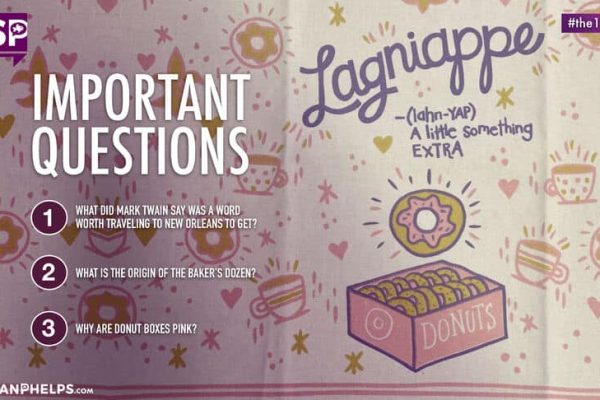
Friday Trivia Trifecta: 1. What did Mark Twain say was a word worth traveling to New Orleans to get? 2. What’s the origin of the Baker’s Dozen? 3. Why are donut boxes pink?

Background: Good friend and fellow speaker Tom Triumph was in New Orleans two weeks ago. In addition to delivering a Vistage workshop, Tom spent some time walking around the Crescent City. He visited one of my favorite shops called Fleurty Girl and brought home a gift for me. See the tea towel pictured below.

I absolutely adore it. It contains three things I love. The word that spawned my Goldfish Series of books, a 13th donut, and a pink donut box. Let’s unpack each:

1. What was the word that Mark Twain said was “worth traveling to New Orleans to get.”

It is a word that exemplifies the idea of doing a “little something extra” in business. That word is lagniappe. Pronounced LAHN-YAP, it is a creole word meaning “the gift” or “to give more.” The practice originated in Louisiana in the 1840s whereby a merchant would give a customer a little something extra at the time of purchase. It is a signature personal touch by the business that creates goodwill and promotes word of mouth.

2. Where did the practice of giving the 13th donut come from?

Buy a dozen donuts and get the 13th for free. Is this lagniappe? Kind of…

In order to understand the reasoning behind a baker’s dozen, we need to travel back to its origin in England. It dates back to the 13th century. During this time, there was a perceived need for regulations to avoid fraudulent activity.

The Assize (Statute) of Bread and Ale was instituted to regulate the price, weight, and quality of the bread and beer manufactured and sold in English towns and villages. Bakers who were found to have shortchanged customers could be liable for severe punishment. The worst of which was having your hand chopped off with an ax. To guard against the punishment, the baker would give 13 for the price of 12 to be certain of not being known as a cheat.

The irony is that the statute deals with weight and not quantity. The merchants created the “baker’s dozen” to change perception. They understood that one of the 13 could be lost, burnt, or ruined in some way while still leaving the customer with an actual dozen. The baker wasn’t doing it to honor the relationship initially. It was an act of self-preservation to protect their hands.

3. Why are donut boxes pink?
 
We owe the bubblegum pink boxes to Cambodian Americans in Los Angeles.
A Pink box first appeared in the 1980s. According to Food & Wine, “the new doughnut shops popping up sought to buy boxes that were cheaper than the white ones chains used, and (supplier) Westco had the answer: leftover pink cardboard stock. The “9-9-4,” as it’s apparently called in the industry, fit a dozen doughnuts perfectly. Pink boxes stuck around because thousands could be produced at a much cheaper price than their white predecessors.”

Follow me on Twitter or LinkedIn.

Stan Phelps

Stan Phelps walks the walk. He stands out in the sea of sameness by modeling his own Differentiated Experience (DX) message: Differentiation isn’t just about what you say, it’s about what you do and, more importantly, how and why you do it. Stan leverages his unique collection of 5,000+ case studies on customer, employee, and brand experience to engage audiences with informative learning-based experiences. He believes purposeful DX wins the hearts of employees and customers, and differentiation ultimately boosts loyalty, retention, referrals, and results.

Find Stan’s in-person and virtual keynotes, workshops, and Goldfish tank programs at StanPhelps.com.

Abraham Lincoln almost died of a virus. Hours after delivering the Gettysburg Address in November of 1863, the Republican President fell ill.

He suffered weakness, fever, and a headache on the train ride back to Washington. Within a few days, Lincoln developed widespread pustular lesions.

Medical historians assert that Lincoln contracted smallpox after exposure to the variola virus.

His personal valet caught the virus and died. Lincoln himself was sick for almost four weeks and thankfully recovered.

He got lucky. On average, 3 out of every 10 people who got the variola virus and contracted smallpox died.

How would the course of American History have changed if Lincoln succumbed to smallpox?

According to the CDC, the finding of smallpox-like rashes on Egyptian mummies suggests that smallpox dates back at least 3,000 years. The earliest written description of a disease like smallpox appeared in China in the 4th century.

No one talks about smallpox today. Why?

Because in late 1975, three-year-old Rahima Banu from Bangladesh became the last person in the world to have naturally acquired the variola virus.

Many people consider smallpox eradication to be the biggest achievement in international public health.

How was it eradicated? Smallpox was eradicated because of vaccines.

The basis for vaccination began in 1796. It was based on an insight from English doctor Edward Jenner. Jenner noticed that milkmaids who had gotten cowpox were protected from smallpox.

Jenner guessed that exposure to cowpox could be used to protect against smallpox. To test his theory, Dr. Jenner took material from a cowpox sore on milkmaid Sarah Nelmes’ hand and shot it into the arm of James Phipps.

Months later, Jenner exposed Phipps several times to variola virus, but Phipps never developed smallpox.

More experiments followed, and, in 1801, Jenner published, “On the Origin of the Vaccine Inoculation.”

In this work, he summarized his discoveries and expressed hope that “the annihilation of smallpox, the most dreadful scourge of the human species, must be the final result of this [vaccine] practice.”

Lesson from Lincoln:

Abraham Lincoln went to Gettysburg to commemorate a battle that took the lives of 28,000 Confederate soldiers. In the last 18 months, over 28,000 residents of Pennsylvania have died of COVID.

Lincoln shared on the battlefield, “It is rather for us to be here dedicated to the great task remaining before us… that we here highly resolve that these dead shall not have died in vain.”

In the 1800s, the virus used to make the smallpox vaccine changed from cowpox to the vaccinia virus. According to the Journal of Medical Biography, Lincoln was not inoculated. If he had been vaccinated, he wouldn’t have fallen so sick and perhaps he would’ve saved the life of his valet.

The vaccine was scarce and few people were immunized in the 19th century. Lincoln had an excuse.

If you haven’t received a COVID vaccine today, what’s yours?

Follow me on Twitter or LinkedIn.

Stan Phelps

Stan Phelps walks the walk. He stands out in the sea of sameness by modeling his own Differentiated Experience (DX) message: Differentiation isn’t just about what you say, it’s about what you do and, more importantly, how and why you do it. Stan leverages his unique collection of 5,000+ case studies on customer, employee, and brand experience to engage audiences with informative learning-based experiences. He believes purposeful DX wins the hearts of employees and customers, and differentiation ultimately boosts loyalty, retention, referrals, and results.

Find Stan’s in-person and virtual keynotes, workshops, and Goldfish tank programs at StanPhelps.com.

1 20 21 22 23 24 48
A simple illustration of a purple fish facing right on a plain background.

I've had the pleasure of working with teams at:

Three purple fish silhouettes swimming to the right on a dark background.

Find Your Best-Match Program

With over 18 possible keynote speaking presentations, workshops, and GOLDFISH TANK programs available to meet your ever-evolving needs, I’ve created this 2-minute, 6-question quiz to help you understand which program is best for you and your audience.

Meet Your Presenter

Through keynote speaking presentations, hands-on workshops, and GOLDFISH TANK programs, I empower you to power loyalty and growth.

Hi, I’m Stan Phelps. I work with organizations that want to increase loyalty, drive sales, and promote positive word-of-mouth by creating differentiated experiences.

As an author, keynote speaker, and workshop facilitator, my in-person and virtual programs stand out in a sea of sameness because I model my own message of differentiated experience (DX).

I leverage my unique collection of more than 5,500 case studies on customer, employee, and brand experience to engage audiences with practical ideas that inspire action.

A person wearing glasses and a gray quarter-zip sweater stands outdoors in front of a building with a triangular glass roof at dusk.

Every time we do business together, Something amazing happens in the world!

Through my partner B1G1, each program gives back to create global IMPACT

Two students in blue uniforms smile while washing their hands at an outdoor tap.

When we complete a GOLDFISH TANK, we give 1001 days of clean water to school children

Collage of three images: a person washing hands, a child drawing with colored pencils, and a group of people sitting outdoors with some raising their hands.

When we complete a GLOBAL engagement, we give 365 days of clean water access in Peru, 120 days of learning aids in Malaysia, and 50 days of business training for women in Malawi

Hand placing a brick on a surface with text: "One Book = One Brick" and an Amazon logo.

When someone downloads a GOLDFISH eBook, we give one brick toward building school facilities in Cambodia