
Stan Phelp's Blog

The Goldfish Chronicles

Sharing insights on customer experience, employee engagement, and brand strategy.

BrewDog isn’t your ordinary craft brewer. The Scottish microbrewer rocks the Pink Goldfish of micro-weird. Here are a handful of the things that make them eminently talkable:

1. Crew T-shirts – over the last few years, Brewdog had featured actual negative reviews on staff shirts. “Went to BrewDog bar. Clearly they spend a lot of money making it look like it barely survived a fire.” Some of the shirts are vicious, “Over priced pish. F#cking awful. What a company. Complete hipster paradise.”

2. Shower beers – In 2018, BrewDog launched DogHouse Hotels. The first craft beer hotel. Of course, they are dog-friendly. But my favorite is the minibar next to the shower. Because . . . beer tastes better in the shower.

3. Near beer bar – Early in 2020, the BrewDog AF Bar became the world’s first alcohol-free beer bar. Based in central London, it offers 15 taps of draft alcohol-free craft beer.

4. Beer Advent Calendar – this year the brewery offered the best of BrewDog in one box. A craft beer advent calendar allowed you to unwrap 24 bottles including 14 new beers for 2021, 6 new this Christmas, and 4 online exclusives.

5. Road-kill beer – interested in trying a 55% ABV beer. It takes over seven months to brew. It’s super-limited and expensive. But the thing that makes it really micro-weird is that the bottle is encased in a squirrel. See pic in the comments. Why taxidermy squirrels? According to BrewDog, “We wanted to do something that was at the same time beautiful and disturbing, something that made a statement and tried to make people stop and think about all of the possibilities that beer actually has.”

Micro-weirding is using minuscule actions to differentiate your brand and customer experience. The lesson is that you can set your brand apart without some cohesive master plan; you can be just a tiny bit weird.

And just because something is micro-weird, doesn’t mean it has a micro-impact. The difference between ordinary and extraORDINARY is sometimes just that little weird something extra.

Follow me on Twitter or LinkedIn.
Stan Phelps

Stan Phelps walks the walk. He stands out in the sea of sameness by modeling his own Differentiated Experience (DX) message: Differentiation isn’t just about what you say, it’s about what you do and, more importantly, how and why you do it. Stan leverages his unique collection of 5,000+ case studies on customer, employee, and brand experience to engage audiences with informative learning-based experiences. He believes purposeful DX wins the hearts of employees and customers, and differentiation ultimately boosts loyalty, retention, referrals, and results.

Find Stan’s in-person and virtual keynotes, workshops, and Goldfish tank programs at StanPhelps.com.

TURNING POINT for COVID. 5 things you need to know about PAXLOVID, Pfizer‘s new game-changing pill treatment.

1. It keeps people out of the hospital – PAXLOVID reduced the risk of hospitalization by about 90% among people who started it within three days of having COVID symptoms. This will be a huge relief to our frontline workers and to the entire healthcare system.

2. 100% lifesaver – There were zero deaths among the patients who received it in the clinical trials. Zip. Nada. Nunca.

3. It’s a PILL people – 30 of them to be exact. Unlike monoclonal antibodies which need to be administered at the hospital, you can take three pills, twice a day, over five days at home while you recover watching Netflix. Kind of like a Z-pack.

4. Variantproof – PAXLOVID doesn’t attack the part of the virus that changes most with each new variant. Because it doesn’t mess with the spike protein, scientists expect the treatments will work even as the virus evolves. Take that Omicron!

5. Just in time for the New Year – Pfizer has projected that it will produce enough doses to treat 20 million people in the first half of next year. The US has agreed to buy 10 million of the treatments and it looks like Americans will probably not have to pay much, if anything, out of pocket.

Is it FOOLproof? No.

The key is to start the pill regimen within three to five days of experiencing COVID symptoms and a positive test. I imagine the same people who were anti-vax … will most likely pass on the pill. Those people are still going to tax our health system and benefit those in funeral services.

But unlike the vaccine, the pill regimen can be implemented once you test positive. If they have a “COME TO JESUS” moment, there is a lifeline.

TAKEAWAY – PAXLOVID has the potential to turn COVID into an ordinary respiratory disease, similar to the common cold or flu. It will reduce deaths and keep people out of the hospital.

What does this turning point mean to you?

For me, it means opening up travel and in-person events in 2022. I’ve been thankful for the opportunity to do virtual programs over the last 21+ months. But as someone who speaks about creating a differentiated experience (DX), nothing replaces being “in the room” where it happens. If you know someone who is a meeting planner and/or an association executive, please share this post with them.

Follow me on Twitter or LinkedIn.

Stan Phelps

Stan Phelps walks the walk. He stands out in the sea of sameness by modeling his own Differentiated Experience (DX) message: Differentiation isn’t just about what you say, it’s about what you do and, more importantly, how and why you do it. Stan leverages his unique collection of 5,000+ case studies on customer, employee, and brand experience to engage audiences with informative learning-based experiences. He believes purposeful DX wins the hearts of employees and customers, and differentiation ultimately boosts loyalty, retention, referrals, and results.

Find Stan’s in-person and virtual keynotes, workshops, and Goldfish tank programs at StanPhelps.com.
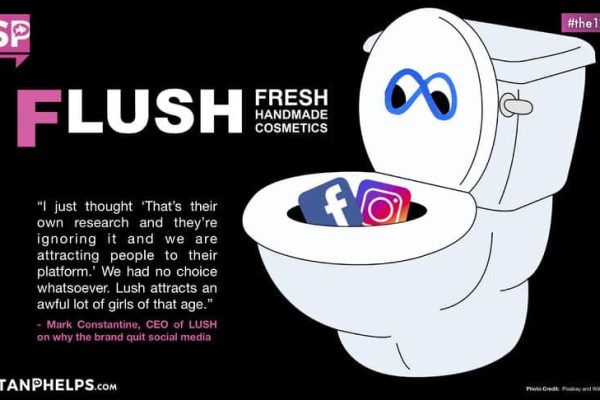
On Black Friday, Lush Cosmetics quit social media. Lush flushed over 10.6 million followers on Instagram and Facebook alone. Talk about a meta-morphis.

Why? Frances Haugen is the reason. She blew the whistle on Facebook’s own research. The research suggested that Instagram made body image issues worse for teenage girls.

Co-Founder and CEO Mark Constantine told The Guardian, “I just thought ‘That’s their own research and they’re ignoring it and we are attracting people to their platform.’ We had no choice whatsoever. Lush attracts an awful lot of girls of that age.”

This is a great example of the Pink Goldfish of Withholding. Facebook and Instagram weren’t the only platforms impacted. Snapchat and TikTok also made the chopping block.

Thanks to my Yellow Goldfish co-author Rosaria Cirillo Louwman for the heads up on the move from the UK-based fresh handmade cosmetics brand.

I applaud Lush for this major move. You can’t talk about being caring and ethical… and then put your head in the sand. I especially think that the timing of this can’t be ignored. It’s easy to be bold when things are going gangbuster. Last year Lush saw sales drop 20% and they lost $60 million.

Caveats – Back in 2019 Lush decided to stop posting on social media. It’s like the old joke about quitting smoking, “It’s easy to quit… I’ve done it 60 times.” I”m going to give Lush a pass on not permanently quitting the first time. A once-in-a-century pandemic necessitated the need to connect directly with consumers when stores were closed. They also aren’t going cold turkey. The brand plans to stay active on Twitter and YouTube.

The Pink Goldfish of Withholding is about limitations, restrictions, boundaries, and constraints. That sounds obviously negative. Shouldn’t the best organizations be everywhere all the time? Maybe not.

Lush made this move on Black Friday. Since 2015, REI has closed its stores and its website on the biggest day in retail. They call it #OptOutside. It was a purposeful move to separate itself from other retailers. Instead of hitting the mall, the company wants customers to hit the trail. They are encouraging their employees and customers to go for a hike.

“We really want this to be a day when people are outdoors, spending time with their families,” says Jerry Stritzke, REI’s former CEO.

How has this deviation from traditional retailers affected their business? Sales, profits, and revenues keep increasing every year. Being closed on the biggest shopping day hasn’t hurt them. Instead, it has helped them and maybe made the world a better place. 

Lush may be inspired by REI. Their final post on social included the following request, “stop scrolling and be somewhere else instead.”

Follow me on Twitter or LinkedIn.

Stan Phelps

Stan Phelps walks the walk. He stands out in the sea of sameness by modeling his own Differentiated Experience (DX) message: Differentiation isn’t just about what you say, it’s about what you do and, more importantly, how and why you do it. Stan leverages his unique collection of 5,000+ case studies on customer, employee, and brand experience to engage audiences with informative learning-based experiences. He believes purposeful DX wins the hearts of employees and customers, and differentiation ultimately boosts loyalty, retention, referrals, and results.

Find Stan’s in-person and virtual keynotes, workshops, and Goldfish tank programs at StanPhelps.com.
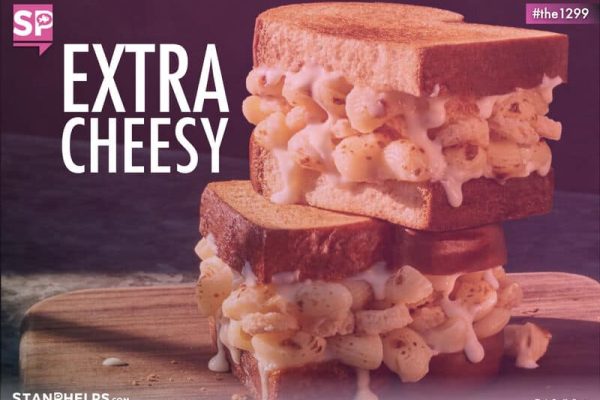
Warning: this post is extra cheesy.

Are you a grilled cheese fan? And I bet you like Mac & Cheese. Then you’d probably love Panera Bread‘s Grilled Mac & Cheese Sandwich.

Panera launched this lopsided piece of genius this Fall. The mac & cheese, made with a fontina and mozzarella cheese blend, is layered with parmesan crisps. All that oozy goodness is packed between two toasted pieces of thickly sliced Classic White Miche bread.

This isn’t the first time Panera has upgraded its staple Mac & Cheese. Last Fall they added broccoli into the mix. Then it paired with Michael Bolton to launch it through song.

Can it get any cheesier? YES

In the Harvard Business Review article, “Make Your Best Customers Even Better,” authors Eddie Yoon, Steve Carlotti, and Dennis Moore shared a story about Velveeta cheese.

In 2012, the processed cheese brand experienced its third consecutive year of declining sales. Whoops. What could Kraft do to reverse this trend?

1. Should they get new or lapsed customers to try the product? Perhaps use sampling and discounts.

2. Should they get infrequent purchasers to buy the product more consistently? Perhaps focus on recipes and coupons.

3. Or should they focus on customers who loved the product? Perhaps find ways to get them to buy more Velveeta products.

When the brand managers studied how the brand was being consumed, they were shocked. The research found the top 10% of Velveeta buyers account for over 50% of all profit for the product. And here was the kicker…. these consumers were not getting enough Velveeta in their lives.

Kraft decided to focus on this key segment of 2.4 million consumers. The results were anything but cheesy.

New product spin-offs totaling over $100 million in additional sales in the next 18 months were a game-changer. It shifted a paradigm for Kraft.

According to marketing director Greg Gallagher, “The previous thinking was that the quickest, easiest path to growth was to identify light users or lapsed users. But when we talked to superconsumers, we learned that in fact they wanted to use Velveeta more— they were starving for it.”

David Rendall and I feature the Velveeta example in our Lopsiding chapter in “Pink Goldish 2.0.” Lopsiding is about celebrating being unbalanced, unstable, and odd. Purposely taking the things that make you unique and then magnifying them, turning them up, exaggerating them, and then supersizing them. 

Sometimes a Pink Goldfish are products made with melted processed cheese or a grilled cheese and macaroni sandwich.

What are you lopsiding to drive differentiation?

Follow me on Twitter or LinkedIn.

Stan Phelps

Stan Phelps walks the walk. He stands out in the sea of sameness by modeling his own Differentiated Experience (DX) message: Differentiation isn’t just about what you say, it’s about what you do and, more importantly, how and why you do it. Stan leverages his unique collection of 5,000+ case studies on customer, employee, and brand experience to engage audiences with informative learning-based experiences. He believes purposeful DX wins the hearts of employees and customers, and differentiation ultimately boosts loyalty, retention, referrals, and results.

Find Stan’s in-person and virtual keynotes, workshops, and Goldfish tank programs at StanPhelps.com.
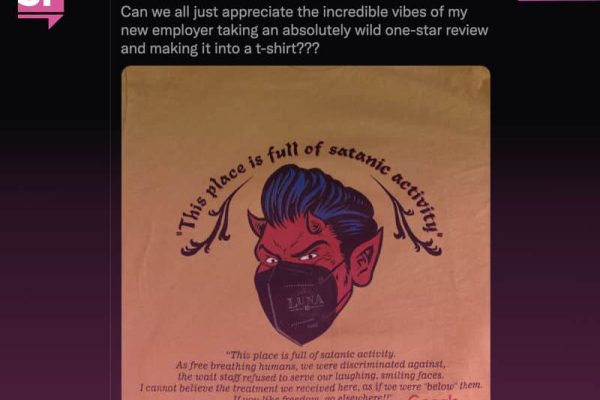
The devil isn’t just in the details. He’s in a T-shirt from a restaurant exposing a one-star review.

Thanks to my Pink Goldfish 2.0 co-author David Rendall for sharing this example from Luna Rotisserie. The restaurant is located in Carrboro, North Carolina (about 20-minutes from my office at the Frontier RTP).

Here’s what happened. A group visited the restaurant back in the Spring. Diners were required to wear masks given the state’s executive order. When asked to comply by staff, the group refused to wear masks indoors or eat outdoors maskless on Luna’s large outdoor patio.

Owner Shawn Stokes shared with Drew Jackson of The News & Observer that they left without sampling Luna’s empanadas or Peruvian chicken. “On their way out, the diners swore never to return and promised a scathing online review.”

Days later a one-star rating hit Google from Mama Loula, “This place is full of satanic activity. As free-breathing humans, we were discriminated against, the wait staff refused to serve our laughing, smiling faces. I cannot believe the treatment we received here, as if we were ‘below’ them. If you like freedom, go elsewhere!!”

Most businesses cringe at a one-star rating. They either ignore it, refute it, or try to damage control it by apologizing.

That’s not what the restaurant did. Here’s what Skyler Jay Keiter-Massefski shared on Twitter, “Can we all just appreciate the incredible vives of my new employer taking an absolutely wild one-star review and making it into a t-shirt???” The tweet went viral and now orders for the t-shirt are pouring in from around the world.

A dyslexic may see the word Santa instead of Satan. But you don’t have to have a learning disability to see how Luna leveraged this as a gift by exposing the review.

The brand futurist and author Simon Mainwaring believes “the keys to brand success are self-definition, transparency, authenticity, and accountability.”

The Pink Goldfish of Exposing harnesses the power of being straightforward, candid, and unapologetic. This flies in the face of traditional marketing that involves highlighting positive features, and repairing or obscuring any negative ones. 

LAST WORD: Good friend and fellow Past President of AMA Triangle Brian McDonald weighed in on the t-shirt tweet, “I like freedom especially when it’s a result from all of us working together for a better society vs. those that claim patriot status but are only defenders of #freeDUMB!”

Follow me on Twitter or LinkedIn.

Stan Phelps

Stan Phelps walks the walk. He stands out in the sea of sameness by modeling his own Differentiated Experience (DX) message: Differentiation isn’t just about what you say, it’s about what you do and, more importantly, how and why you do it. Stan leverages his unique collection of 5,000+ case studies on customer, employee, and brand experience to engage audiences with informative learning-based experiences. He believes purposeful DX wins the hearts of employees and customers, and differentiation ultimately boosts loyalty, retention, referrals, and results.

Find Stan’s in-person and virtual keynotes, workshops, and Goldfish tank programs at StanPhelps.com.
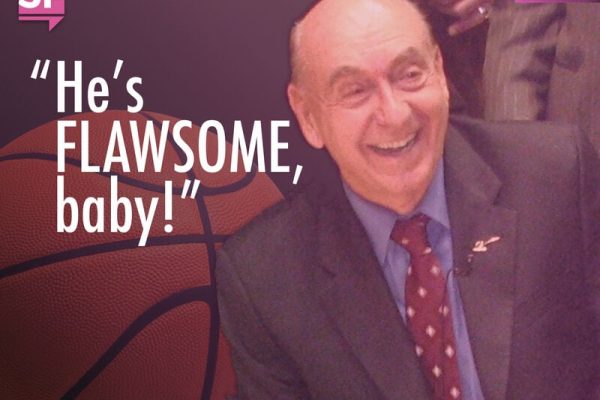
“We do not believe in ourselves until someone reveals that deep inside us something is valuable, worth listening to, worthy of our trust, sacred to our touch.”

This quote by author e.e. cummings exemplifies a story about Scotty Connal and Richard John Vitale.

Don’t know Dick? He’s better known as a Dickie V.

You probably know him as a broadcaster.

Dick grew up in Northern New Jersey and began coaching basketball in the Garden State back in 1958… at the elementary school level.

Success would get him to the high school ranks. He’d lead his alma mater to two state titles.

This propelled him to become an assistant coach at Rutgers. After two seasons in New Brunswick, Vitale would get hired as a head coach by the University of Detroit.

Over four seasons, he’d build the Titans into a powerhouse. His final season in 1977 included a 21-game win streak and a berth into the 32 team NCAA tournament.

The momentum continued. The Pistons called. But midnight was approaching and the glass slipper shattered during his time in the pro ranks. Vitale would win just 30 games his first season. A slow 4-8 start got him fired early into the 1979 campaign.

Vitale waited for his next coaching opportunity. Then Scotty Connal called.

Scotty was working at a fledgling cable network in Connecticut.

Vitale shuddered, “Absolutely no way. I know nothing about TV. I want to get back to where I belong and my spirit belongs.”

His wife Lorraine nudged him. She told Dick “go on TV and have some fun.” Vitale accepted the job at ESPN, but stipulated it was on a temporary basis.

It’d be easy to think Dickie V. was a natural. But he wasn’t a Diaper Dandy.

He’d miss his first production meeting and Vitale struggled on-air because he couldn’t stop talking. He talked over the play-by-play announcer. He talked during commercials. He talked when his producers were talking to him through his earpiece.

Some might have dismissed him as flawed. Others might’ve asked Vitale to tone it down. Connal believed in Vitale. He reassured him, “You have a quality we can’t teach.” He saw that Dick’s enthusiasm was contagious.

“We do not believe in ourselves until someone reveals that deep inside us something is valuable, worth listening to.”

Thousands of games later, Vitale is synonymous with college basketball. His personality helped put the game on the map.

Vitale is Vitale. It isn’t an act on the air.

I got a chance to know Dickie V. working in Florida back in 1993 and 1994. I was working in tennis for IMG at a World TeamTennis franchise. Vitale’s daughters Terri and Sherri were top-ranked juniors who played at Notre Dame. Dickie V. would come to each match fired up and ready to go.

Last night, Dick called the Gonzaga vs. UCLA match-up. This battle of #1 vs. #2 was his first game back after being diagnosed with lymphoma. As a tireless advocate of the Jimmy V. Foundation, I have no doubt Vitale will battle cancer will the same enthusiasm.

Follow me on Twitter or LinkedIn.

Stan Phelps

Stan Phelps walks the walk. He stands out in the sea of sameness by modeling his own Differentiated Experience (DX) message: Differentiation isn’t just about what you say, it’s about what you do and, more importantly, how and why you do it. Stan leverages his unique collection of 5,000+ case studies on customer, employee, and brand experience to engage audiences with informative learning-based experiences. He believes purposeful DX wins the hearts of employees and customers, and differentiation ultimately boosts loyalty, retention, referrals, and results.

Find Stan’s in-person and virtual keynotes, workshops, and Goldfish tank programs at StanPhelps.com.
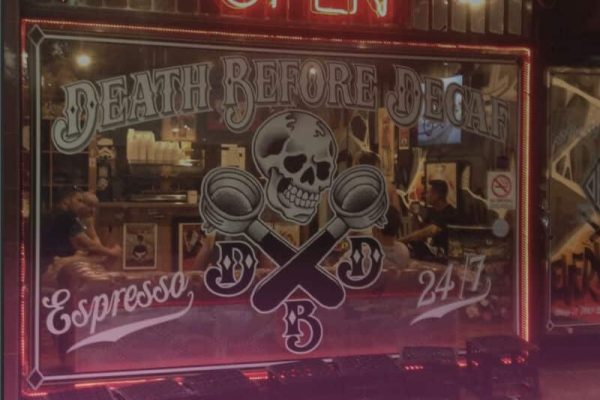
Death Before Decaf. It is not only a mantra, it is a coffee shop in Brisbane, Australia. Since 2014, it has been pouring some amazing coffee in the capital of Queenland. Pouring it on is perhaps a better description.

The shop has lopsided both its hours and decor. Need a jolt? Death Before Decaf (DBD) pulls shots of espresso 24/7. It’s “Always Open” mantra is appreciated by regulars.

Expect to hear some tunes while waiting at DBD. Heavy metal is on the menu. Not everyone loves it. In a 4-star Google review Jacob Forest writes,

“Great coffee but the staff are a bit rude and the heavy death metal they always blast is enough to cause a stroke at 7am, please stop.”
 
The response from the owner is unapologetic, “Jacob, please stop. You happened to come in that one time that Michael Bublé wasn’t playing. At least the coffee was great. 👍”

Thanks to Frederick Marcoux for giving me the heads up on DBD. He loves it so much, Frederick ships its beans to Perth.

Frederick isn’t alone. The business has over 1,000 reviews on Google and a 4.7 rating. That’s very impressive.

Let’s get back to the 24/7 Pink Goldfish. It is an example of what Rory Sutherland would call signaling.

In the book “Alchemy,” Sutherland recalls the story of a neighborhood coffee shop near his London home. The first two sets of owners failed, yet the third had created a thriving business. The only discernable difference was the presence of tables, chairs, and a windscreen they placed each day in front of the shop.

Sutherland shares, “I think we subliminally deduce that any place that goes to the trouble of erecting chairs on the street will serve coffee that, at the very least, is unlikely to be terrible. That seems a silly use of mental energy-surely the way to determine whether the coffee is good is to buy one and find out? ‘I knew the coffee was going to be good because of the chairs,’ sounds like a very silly sentence, but hold on a moment–maybe, using psycho-logic and a bit of social intelligence, we can identify a connection…

He continues, “For a start, someone who invests in new chairs and goes to the trouble of placing them on the pavement every day is not lazy, and has also invested in their business. Furthermore, they seem to expect their business to be a success–had they not, they would not have undertaken the expense. The chairs don’t promise perfection, but they are a reliable indicator of at least reasonable quality. The business owner who buys the windbreak and the chairs has probably also invested in a decent Gaggia machine, proper milk and coffee beans–and in training staff. It suggests the owner, rather than playing the short game of immediate profit maximization, is playing the long game, building a reputation and a loyal customer base–, which will mean a cappuccino that is palatable at the very least.”

The “Always Open” aspect of DBD is a signal. How are you lopsiding certain aspects of your business to stand out?

Follow me on Twitter or LinkedIn.

Stan Phelps

Stan Phelps walks the walk. He stands out in the sea of sameness by modeling his own Differentiated Experience (DX) message: Differentiation isn’t just about what you say, it’s about what you do and, more importantly, how and why you do it. Stan leverages his unique collection of 5,000+ case studies on customer, employee, and brand experience to engage audiences with informative learning-based experiences. He believes purposeful DX wins the hearts of employees and customers, and differentiation ultimately boosts loyalty, retention, referrals, and results.

Find Stan’s in-person and virtual keynotes, workshops, and Goldfish tank programs at StanPhelps.com.
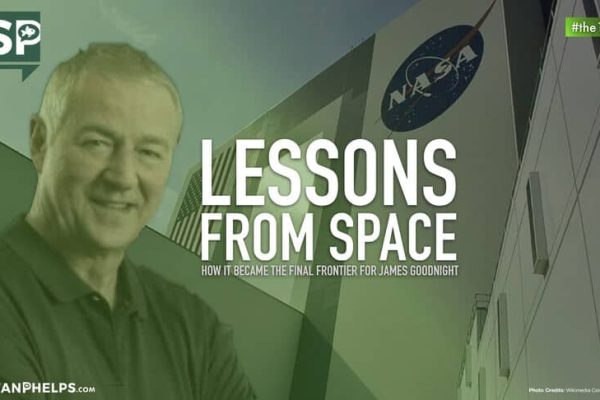
It started as a young college graduate. James received a job working for NASA on the Apollo space program in the late 60s. Beat the Russians and put a man on the moon. It must have seemed like a dream job.

Until it wasn’t…

What he found was a toxic work environment. People didn’t communicate and any semblance of trust was absent.

Employees had to use timecards. There were metal detectors to make sure employees weren’t stealing.

It was even worse when he saw how the executives were treated. They enjoyed special parking areas, break rooms, and a cafeteria.

James must’ve felt like a minion.

He watched executives enjoy good “free” coffee, while he and his coworkers had to dump a quarter into a vending machine for brown swill.

The experience would leave a mark. Space would become his final frontier.

Discouraged, James would head back to NC State and begin his doctoral studies in statistics. Upon graduating he’d take a position on the faculty. He’d take part in a USDA research project to create a general-purpose statistical analysis system for analyzing agricultural data.

In 1976, the statistical analysis system (SAS) software had 100 clients. He and three other faculty would spin out and create a company. James would take the role of CEO.

From the outset, he wanted to make SAS a fun place to work with the work itself being the biggest reward, an environment that would harness creativity, providing all of the resources employees would need.

From its earliest days, employees tell stories of piling into Dr. Jim Goodnight’s station wagon and going down the street for pizza. SAS would pick up the tab whenever they added another 100 customer sites to their list.

Remembering the culture at NASA, his focus became treating people the way he’d like to be treated. That if you treat people like they matter… they will.

As we deal with “The Great Resignation,” perhaps we can learn from James. He knew that annual turnover can be as high as 30% in his industry. And that filling empty positions can cost anywhere from 2x to 5x an employee’s salary. SAS turnover was typically 3 to 4%.

It’s simple according to Dr. Goodnight. He says, “You have two choices. You can spend money on employees or headhunters and training, and it’s about the same amount of money. So why not spend it on the employees?”

And it takes more than just a paycheck to keep their people happy.

Dr. James Goodnight believes that money should not be the key motivator for team members. People who care primarily about the money can easily be bought.

SAS has been recognized annually as one of Fortune‘s Great Places to Work since the list’s inception in 1998. Last year, Goodnight was awarded a CEO Great Place to Work For All Leadership Award.

His entire approach can be summed up by an employee’s quote in Fast Company, “You’re given the freedom, the flexibility, and the resources to do your job. Because you’re treated well, you treat the company well.”

Follow me on Twitter or LinkedIn.

Stan Phelps

Stan Phelps walks the walk. He stands out in the sea of sameness by modeling his own Differentiated Experience (DX) message: Differentiation isn’t just about what you say, it’s about what you do and, more importantly, how and why you do it. Stan leverages his unique collection of 5,000+ case studies on customer, employee, and brand experience to engage audiences with informative learning-based experiences. He believes purposeful DX wins the hearts of employees and customers, and differentiation ultimately boosts loyalty, retention, referrals, and results.

Find Stan’s in-person and virtual keynotes, workshops, and Goldfish tank programs at StanPhelps.com.
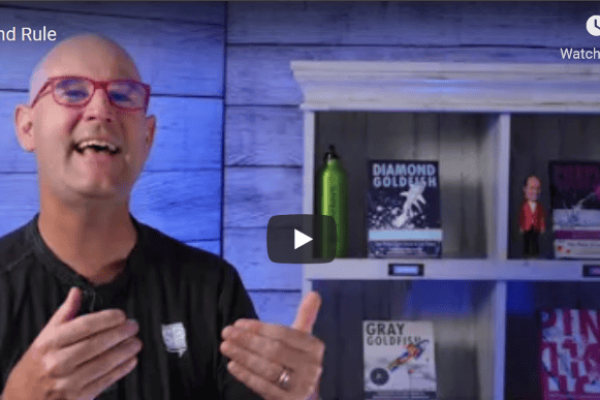
The Diamond Rule is the 4.0 version of business. This video explores the rule and the 1.0, 2.0, and the 3.0 versions for background.

Version 1.0 is The Silver Rule

The Silver Rule is “do no harm.” As stated by Zigong, a disciple of Confucius, “What I do not wish others to do unto me, I also wish not to do unto others.”

The problem with Silver is that it’s not prescriptive. It doesn’t tell you how to treat others. It merely shares what not to do.

Version 2.0 is The Golden Rule      

Throughout nearly every culture and religion, the Golden Rule has become [no pun intended] the gold standard of human dynamics.

The Golden Rule is simply “treating others the way you would like to be treated.”

Unfortunately, in sales and managing relationships, the Golden Rule is a bad rule. Because not everyone is like you.

Version 3.0 is The Platinum Rule      

It simply is “treating others the way that they want to be treated.”

Grounded in emotional intelligence, the Platinum Rule asks you to accommodate the feelings of others.           

The Platinum Rule is more outward-facing in its approach.
The focus shifts from “this is what I want, so I’ll give everyone the same thing” to “let me first understand what they want . . . and then I’ll give it to them.”

One of the challenges when completely focusing on the other person is that we can overlook how we’re feeling and reacting to a situation.   

Version 4.0 is The Diamond Rule

The Diamond Rule takes the Platinum Rule to the next level.

Treating someone the way they want to be treated is tricky enough under normal circumstances—but what happens when things start to get heated?

In the immortal words of former boxing heavyweight champion Mike Tyson, “Everyone has a plan until they get punched in the mouth.”

Pressure can trigger a biological response that causes us to act in an unpredictable and irrational manner.

The Diamond Rule combines elements of both Gold and Platinum.

Said simply, the Diamond Rule is “the art of managing yourself under pressure and addressing the needs of others to avoid their triggers.”        

Practicing the Diamond Rule requires two elements:

1. You have to see your own predictable behavioral style when pressure hits, and

2. You need the capability to assess prospects/clients relative to four different, predictable behavioral styles based primarily on how people respond biologically to pressure.

As a combination of the Golden Rule and the Platinum Rule, it requires you to consider and satisfy your own instinctive concerns and needs while simultaneously addressing the needs of others.

When you adhere to the Diamond Rule, you rise above the pressure.

This makes you stand out as unique and better in the eyes of your client, dramatically increasing your ability to be more effective and win more business.

Follow me on Twitter or LinkedIn.

Stan Phelps

Stan Phelps walks the walk. He stands out in the sea of sameness by modeling his own Differentiated Experience (DX) message: Differentiation isn’t just about what you say, it’s about what you do and, more importantly, how and why you do it. Stan leverages his unique collection of 5,000+ case studies on customer, employee, and brand experience to engage audiences with informative learning-based experiences. He believes purposeful DX wins the hearts of employees and customers, and differentiation ultimately boosts loyalty, retention, referrals, and results.

Find Stan’s in-person and virtual keynotes, workshops, and Goldfish tank programs at StanPhelps.com.
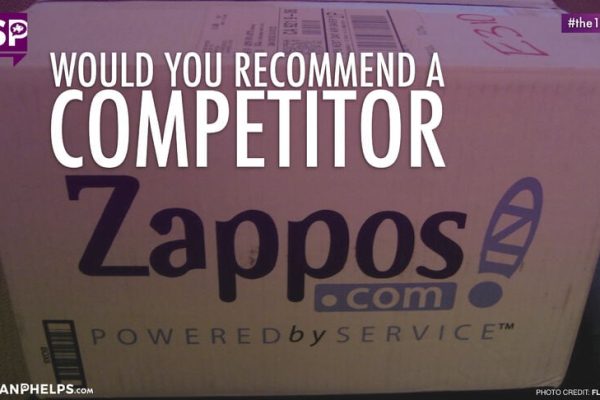
WOULD YOU RECOMMEND A COMPETITOR?

The Zappos Family of Companies does. In Purple Goldfish 2.0, we share an example of this from Joe Gascoigne. In his words:

“As for an example, one that springs to mind is that if you try to order shoes from Zappos and they do not have the shoes you want in stock, they will actually recommend a nearby store that does. It seems counter-intuitive, but I think it really builds trust and it obviously works well for them.”

According to an interview with the late Tony Hsieh in Chief Marketer, he refused to see customer service as an expense. Rather, it’s an investment:

“Our business is based on repeat customers and word of mouth. There’s a lot of value in building up our brand name and what it stands for. We view the money that we spend on customer service as marketing money that improves our brand.”

Here is another great example from an article in Footwear News: According to Jerry Tidmore, who manages Zappos’ help-desk concierge service:

“One of the craziest stories was that of a customer who checked in to the Mandalay Bay hotel and forgot her shoes.” According to Tidmore, the guest called Zappos, where she had originally purchased the style, looking for a replacement, but they didn’t have any in stock. So, the company found a pair in the right size at the mall, bought them and delivered them to the hotel—all for free.”

When was the last time you obliterated a customer or client’s expectations?

How can you “Zappos” someone’s expectations the next time you deal with them?

Follow me on Twitter or LinkedIn.

Stan Phelps

Stan Phelps walks the walk. He stands out in the sea of sameness by modeling his own Differentiated Experience (DX) message: Differentiation isn’t just about what you say, it’s about what you do and, more importantly, how and why you do it. Stan leverages his unique collection of 5,000+ case studies on customer, employee, and brand experience to engage audiences with informative learning-based experiences. He believes purposeful DX wins the hearts of employees and customers, and differentiation ultimately boosts loyalty, retention, referrals, and results.

Find Stan’s in-person and virtual keynotes, workshops, and Goldfish tank programs at StanPhelps.com.

1 15 16 17 18 19 48
A simple illustration of a purple fish facing right on a plain background.

I've had the pleasure of working with teams at:

Three purple fish silhouettes swimming to the right on a dark background.

Find Your Best-Match Program

With over 18 possible keynote speaking presentations, workshops, and GOLDFISH TANK programs available to meet your ever-evolving needs, I’ve created this 2-minute, 6-question quiz to help you understand which program is best for you and your audience.

Meet Your Presenter

Through keynote speaking presentations, hands-on workshops, and GOLDFISH TANK programs, I empower you to power loyalty and growth.

Hi, I’m Stan Phelps. I work with organizations that want to increase loyalty, drive sales, and promote positive word-of-mouth by creating differentiated experiences.

As an author, keynote speaker, and workshop facilitator, my in-person and virtual programs stand out in a sea of sameness because I model my own message of differentiated experience (DX).

I leverage my unique collection of more than 5,500 case studies on customer, employee, and brand experience to engage audiences with practical ideas that inspire action.

A person wearing glasses and a gray quarter-zip sweater stands outdoors in front of a building with a triangular glass roof at dusk.

Every time we do business together, Something amazing happens in the world!

Through my partner B1G1, each program gives back to create global IMPACT

Two students in blue uniforms smile while washing their hands at an outdoor tap.

When we complete a GOLDFISH TANK, we give 1001 days of clean water to school children

Collage of three images: a person washing hands, a child drawing with colored pencils, and a group of people sitting outdoors with some raising their hands.

When we complete a GLOBAL engagement, we give 365 days of clean water access in Peru, 120 days of learning aids in Malaysia, and 50 days of business training for women in Malawi

Hand placing a brick on a surface with text: "One Book = One Brick" and an Amazon logo.

When someone downloads a GOLDFISH eBook, we give one brick toward building school facilities in Cambodia