
Stan Phelp's Blog

The Goldfish Chronicles

Sharing insights on customer experience, employee engagement, and brand strategy.

He’s back. Is Better.com CEO Vishal Garg better now?

Vishal infamously fired 900 employees last month. He shared on Zoom, “If you’re on this call you are part of the unlucky group that is being laid off.”

It wasn’t just that he was monotone and emotionless when swinging the ax. It was reported that after the call he openly complained to team members that many of those let go had been working two-hour days and likening them to thieves.

This behavior wasn’t atypical for the Founder. He once compared his employees to “DUMB DOLPHINS.” Employees might fare better than former business partners. Vishal once threatened his former friend and business partner Raza Kahn during a deposition, “[I’m] going to staple him against a fucking wall and burn him alive.”

Still, doesn’t everyone deserve a second chance? I think so.

According to Better, Vishal has spent the last few weeks examining his management style, reflecting on the values of the company, and working with an executive coach.

Christian Chapman, RN, an underwriting trainer who was fired last month by Vishal shared with The New York Times, “Business is people, product and processes. I think Vishal should develop the third leg of business, which is the people.”

That’s not just good advice for Vishal Garg, that’s “better” advice for every leader.

Follow me on Twitter or LinkedIn.
Stan Phelps

Stan Phelps walks the walk. He stands out in the sea of sameness by modeling his own Differentiated Experience (DX) message: Differentiation isn’t just about what you say, it’s about what you do and, more importantly, how and why you do it. Stan leverages his unique collection of 5,000+ case studies on customer, employee, and brand experience to engage audiences with informative learning-based experiences. He believes purposeful DX wins the hearts of employees and customers, and differentiation ultimately boosts loyalty, retention, referrals, and results.

Find Stan’s in-person and virtual keynotes, workshops, and Goldfish tank programs at StanPhelps.com.

Kit Kats are flawsome. There is no such thing as a perfect Kit Kat. It turns out that Kit Kats are made of Kit Kats. What?

Nestlé (Global) and The Hershey Company (US) take the imperfect Kit Kats and mash them into a paste. That paste is used to fill in between the three wafers.

That means that every imperfect Kit Kat was already filled with other imperfect Kit Kats. So according to weird-facts.org, “Every time you eat a Kit Kat, you’re basically eating layers of Kit Kats within Kit Kats within Kat Kits.

To parrot the words of George W. Bush, “No Kit Kat Left Behind.”

EMBARRASSING ADMISSION
I can remember sitting at the kitchen table with my Mom and older sister at age 8. I shared with them that I thought swiss cheese was a rip-off. In my view, the company was punching out the holes. And then they were putting the holes back into the pot to make more cheese. Needless to say, my family would never let me live that theory down. Turns out I would’ve been right if I was talking about Kit Kats.

What’s your favorite candy bar? Kit Kats have overtaken Snickers as my favorite. Here’s my go-to tip for enjoying both. Elsa-style…. FROZEN.

If Snickers got its name from the favorite horse of the Mars family, where did the name Kit Kat come from?

The use of the name Kit Kat goes back to the 18th century when mutton pies known as a Kit Kat were served at meetings of the political Kit-Cat Club in London. The club was owned by pastry chef Christopher Cat.

Confectioner Rowntree trademarked the name 111 years ago. It would take another 24 years before the company would launch the traditional four-fingered bar we recognize today.

What prompted the creation? A worker at the factory in York put a suggestion in a recommendation box. He advocated for a snack that “a man could take to work in his pack.”

Here are a few interesting progressions for the brand:
– The packaging was initially blue. It became red after WWII.
– The iconic slogan, “Have a Break, Have a Kit Kat” was coined by Donald Gilles, an ad man at J. Walter Thompson London in 1957.
– The “Gimme a break” jingle created in 1986 is a top-ten earworm according to University of Cincinnati researcher James Kellaris.

One last thing that makes Kit Kats flawsome. It’s how they’ve lopsided the flavors in Japan. Nestlé has introduced 36 flavors. Some are interesting like ginger ale, soy sauce, green tea, wasabi, and sake.  The Japanese often bought buy the bars as good-luck gifts. The name the Japanese phrase “Kitto Katsu”, roughly translating as “surely win.” A flawsome winner indeed.

Follow me on Twitter or LinkedIn.

Stan Phelps

Stan Phelps walks the walk. He stands out in the sea of sameness by modeling his own Differentiated Experience (DX) message: Differentiation isn’t just about what you say, it’s about what you do and, more importantly, how and why you do it. Stan leverages his unique collection of 5,000+ case studies on customer, employee, and brand experience to engage audiences with informative learning-based experiences. He believes purposeful DX wins the hearts of employees and customers, and differentiation ultimately boosts loyalty, retention, referrals, and results.

Find Stan’s in-person and virtual keynotes, workshops, and Goldfish tank programs at StanPhelps.com.

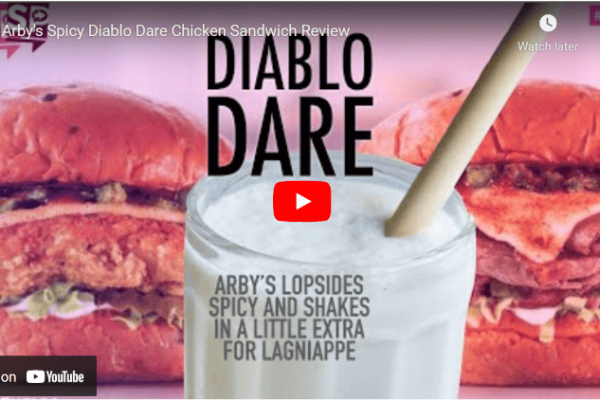
[Video] Arby’s lopsides spicy with the Diablo Dare. Lagniappe: this brisket or chicken sandwich comes with a free milkshake.
What happens when a Pink and Purple Goldfish collide? Here’s my review.

Follow me on Twitter or LinkedIn.

Stan Phelps

Stan Phelps walks the walk. He stands out in the sea of sameness by modeling his own Differentiated Experience (DX) message: Differentiation isn’t just about what you say, it’s about what you do and, more importantly, how and why you do it. Stan leverages his unique collection of 5,000+ case studies on customer, employee, and brand experience to engage audiences with informative learning-based experiences. He believes purposeful DX wins the hearts of employees and customers, and differentiation ultimately boosts loyalty, retention, referrals, and results.

Find Stan’s in-person and virtual keynotes, workshops, and Goldfish tank programs at StanPhelps.com.
Recognition matters. Studies show that 43% of highly engaged employees receive feedback at least once a week compared to only 18% of employees with low engagement.

Recognition resonates in the workplace. 35% of workers frequent recognition of accomplishments as the most effective non-monetary reward. Thanking people for their hard work and commitment is key to making them feel appreciated.

I can distinctly remember having a conversation with a law school classmate named John. John was from South Carolina. He was sharing his thoughts about his summer job working in a law office in Columbia, SC. I asked him if he’d considered staying on full-time after school, he shook his head,

“No way.”

When I prodded further, John revealed that he had an issue with the partner that was managing him.

“He doesn’t give any attaboys.”

Attaboys…. I had never heard that word before, but no explanation was needed. John felt that his work wasn’t appreciated or recognized.

Recognition fuels a sense of worth and belonging in individuals.
 
Shift your thinking. Most leaders take an “if, then” approach to recognition. Instead, view encouragement and recognition as a driver of high performance.
 
Here is some encouraging news. It’s not just about the money, honey. Research confirms that the cost of recognition awards has only minimal impact on employee perception of appreciation. 57% reported that the most meaningful recognition was free.

Just look at some of these quotes to judge the impact:
 
• “I received a handwritten thank you in the mail from my manager and my CEO. I smiled like an idiot.” – Bill A.
 
• “I got a bonus with a handwritten note. I read the note several times; even took a picture of it. Bonus was good, too, but no picture.” – David H.

Takeaway – Don’t just make it a priority. Heed the advice of productivity guru Dave Crenshaw and schedule it. Schedule time in your calendar each week to focus on recognition. Write a few notes or make a few phone calls.

Follow me on Twitter or LinkedIn.

Stan Phelps

Stan Phelps walks the walk. He stands out in the sea of sameness by modeling his own Differentiated Experience (DX) message: Differentiation isn’t just about what you say, it’s about what you do and, more importantly, how and why you do it. Stan leverages his unique collection of 5,000+ case studies on customer, employee, and brand experience to engage audiences with informative learning-based experiences. He believes purposeful DX wins the hearts of employees and customers, and differentiation ultimately boosts loyalty, retention, referrals, and results.

Find Stan’s in-person and virtual keynotes, workshops, and Goldfish tank programs at StanPhelps.com.
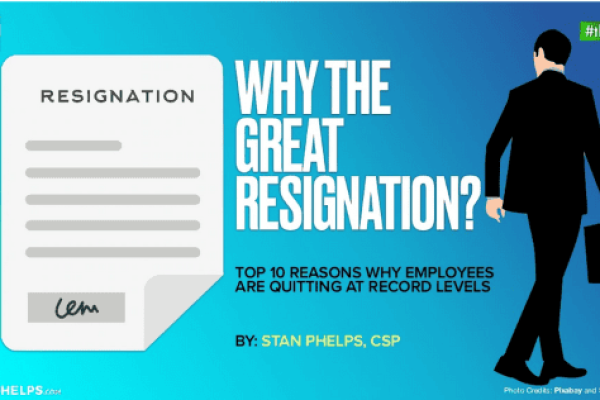
Why “The Great Resignation?” The Top 10 reasons why employees are quitting at record levels.

Nearly 3% of the workforce quit their jobs in October. That’s over 4 million resignation letters. And it is just shy of the record set the month before.

Last month I speculated on the top 5 reasons on LinkedIn. That post received nearly 200 comments. Many suggested additional reasons. So, here are the top 10 contributing reasons and 3 factors that I believe are negligible…

1. Horrible Bosses – 70% of workers who voluntarily resign don’t quit their job… they quit their boss. 

Here was a comment from the CEO of SHRMJohnny C. Taylor, Jr.,

“People don’t leave jobs, they leave bad managers and bad cultures. The pandemic has shown many of us what truly matters, and what truly matters is PEOPLE. Employees want to feel valued and appreciated. They want to feel like they belong. And it’s time for workplace leaders to step up.”

2. Lack of freedom – Many workers have been remote over the last two years. They’ve gotten used to work-from-home. Namely less stress and greater flexibility. Now many are being mandated to go back to the office.

3. Friends – According to Gallup, “Those who [have a best friend at work] are seven times as likely to be engaged in their jobs.” The pandemic has weakened work relationships.

4. Peer Pressure – You can’t discount the “knock-on” effect of job-hopping. All of a sudden you start seeing coworkers or friends quitting in droves. You begin to question it yourself.

5. Generational – Millennials and GenZ are now the vast majority of workers. They don’t see work the same way as previous generations. Job hopping isn’t a black mark any longer.

6. Mo’ Money – In the words of Ray DuBeau Jr., “Money is the conduit that allows people to live their lives. Companies and industries that are offering above-market rates aren’t experiencing the great resignation.”

7. Start-Up Boom – Americans started 4.3 million businesses last year, a 24% increase from the year before and by far the most in the 15 years that the government has kept track. Applications are on a pace to be even higher this year.

8. Childcare – lack of it has forced workers, particularly women, from reentering the workforce.

9. Upskilling – According to Lon Graham, “During the pandemic, a lot of people enrolled in online classes, online training, and other skill-building activities. The one’s who did are now worth more to the marketplace and are leaving current jobs for the jobs they qualified themselves to get.”

10. Purpose – According to Margarita Andryushenko, “If an employee doesn’t feel like they’re making a difference or if the work they are doing actually matters, that’s a big deal-breaker right there. People want to feel connected and important to the work they’re doing.”

… and 3 reasons that aren’t valid in my view: Vaccine Mandates, Handouts, and Gig Work.

What other factors are contributing?

https://www.slideshare.net/9INCHMARKETING/the-great-resignation-the-top-10-reason-employees-are-quitting

Follow me on Twitter or LinkedIn.

Stan Phelps

Stan Phelps walks the walk. He stands out in the sea of sameness by modeling his own Differentiated Experience (DX) message: Differentiation isn’t just about what you say, it’s about what you do and, more importantly, how and why you do it. Stan leverages his unique collection of 5,000+ case studies on customer, employee, and brand experience to engage audiences with informative learning-based experiences. He believes purposeful DX wins the hearts of employees and customers, and differentiation ultimately boosts loyalty, retention, referrals, and results.

Find Stan’s in-person and virtual keynotes, workshops, and Goldfish tank programs at StanPhelps.com.
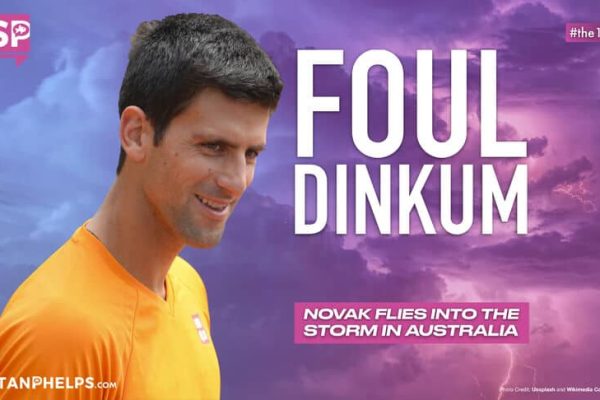
Novak Djokovic headed to Australia after receiving a medical exemption from the Australian Open. The World #1 and reigning champion announced the news on Instagram.

Novak is one of only five unvaccinated players out of 26 to receive an exemption into the first Grand Slam tournament of the year in Melbourne.

The reception in Australia of the news has been downright hostile. Its citizens and the federal government are kicking up their heels for a variety of reasons:

– They comply with restrictions. Melbourne has spent more time under COVID-19 lockdowns than any other city in the world. It’s 5 million residents have withstood over 250 days during six lockdowns.

– The country takes vaccinations seriously. As of today, 94.5% of Australians over the age of 16 have received at least one shot of the vaccine. Over 91% are fully vaccinated.

– COVID is spiking right now with Omicron. On Tuesday, Australia had a record daily tally of nearly 50,000 COVID cases. People are scrambling and waiting in hours-long lines for tests.

– Novak hasn’t disclosed the reason or excuse that has allowed him to be granted an exemption.

The last reason is the most important in my opinion. I lived in Australia for a year and can attest to an Australian phenomenon called the “Tall Poppy Syndrome.” This is the idea that everyone is as good as his or her mate. David Rendall and I wrote about it in “Pink Goldfish 2.0.” It is the cultural practice of mocking people who think highly of themselves. If you try to rise above others, you will get cut down.

With the exemption, Djokovic will not be required to quarantine and will enjoy the same freedoms in Melbourne as someone who is vaccinated.

Djokovic is typically a fan favorite in Australia. Nine of his record-tying 20 Grand Slam victories for the Serb have happened Down Under. But last year, his attempts to secure better quarantine conditions for players lacked tact and turned many Aussies against him. This exemption isn’t going to help.

There is an Australian saying that comes into play here. It’s called “fair dinkum.” Fair dinkum is used to emphasize or seek confirmation of the genuineness or truth of something. That’s what awaited Novak when he landed.

Prime Minister Scott Morrison has made it clear there will be “no special rules” for Djokovic, “If that evidence is insufficient, then he won’t be treated any different to anyone else and he’ll be on the next plane home.”

Right now as I type, Novak has been denied a Visa by the Government.

Will Novak share the reason behind his exemption? I wouldn’t count on it.

Djokovic recently described questions about his vaccination status as “inappropriate” in an interview with the Serbian outlet “Blic.” He shared, “Your editors can take what I have just said and turn it into a scandal. I do not want to be a part of that storm.”

Follow me on Twitter or LinkedIn.

Stan Phelps

Stan Phelps walks the walk. He stands out in the sea of sameness by modeling his own Differentiated Experience (DX) message: Differentiation isn’t just about what you say, it’s about what you do and, more importantly, how and why you do it. Stan leverages his unique collection of 5,000+ case studies on customer, employee, and brand experience to engage audiences with informative learning-based experiences. He believes purposeful DX wins the hearts of employees and customers, and differentiation ultimately boosts loyalty, retention, referrals, and results.

Find Stan’s in-person and virtual keynotes, workshops, and Goldfish tank programs at StanPhelps.com.
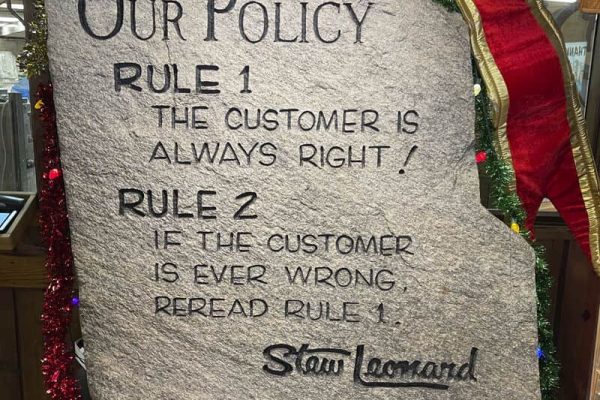
Is the customer always right?

At Stew Leonards, they always are. The world’s largest dairy store lives by two rules that are literally written in stone:

1. The Customer is Always Right
2. If the Customer is Ever Wrong… ReRead Rule 1

Today I stopped by the original store in Norwalk, Connecticut. I snapped a picture below of the iconic 6,000 pound stone at the entrance.

Then I had an eggnog ice cream in honor of its origin story.

Here’s an edited version from Stew’s website:

Two weeks after the grand opening in 1969, Stew, Sr. was standing at the front door of the store greeting customers.

Suddenly a customer came up to Stew and said, “YOUR EGGNOG IS SOUR!” and thrust into his hands a half-gallon carton.

Stew was indignant,

“My eggnog is sour, from my brand new dairy plant? Impossible! “You’re wrong! It can’t be sour. We’ve sold over 200 half-gallons of eggnog from this batch and you’re the only one who’s complained!”

The customer was so mad, veins were popping out in her neck. She said, “I don’t care how many cartons you sold, it’s sour and I want my money back!”

Eggnog was 95 cents per half-gallon so Stew reached into his pocket and gave the customer a dollar bill.

She snatched it out of his hand and stormed out. The last words he heard her say were…

“I’m never coming back to this store again!”

That night, Stew relayed the story to his wife, Marianne. Instead of a sympathetic ear, she became visibly upset,

“I don’t blame her at all,” said Marianne. “You didn’t listen to her. You contradicted her and practically called her a liar. I hope you are not going to run your store like other store managers, who think all customers are trying to put something over on them. They don’t trust us — but we fix them — WE JUST NEVER GO BACK!”

After thinking about it, Stew realized that he had everything in the world tied up into the dairy store. He could not afford to lose a single customer by telling them they were wrong. He realized that most customers were honest and wouldn’t try to take advantage of him.

However, if he tried to protect himself from the 1% who were dishonest, he’d end up penalizing the other 99% who were really good and honest!

Stew decided Marianne was right and that no customer was ever going to be wrong in my store again.

On his way to work one morning, Stew drove by a monument yard in Westport, where they were unloading granite. Suddenly, Stew got an idea. He stopped and bought a huge 3-ton slab. Then Stew had the rock delivered to the front door of his store and had their stonemason chisel the store’s new 2-rule policy into its face.

To this day, 52 years later, the rock still stands firm at each of Stew Leonard’s store entrances.

Every single team member knows of the eggnog story. They know that they can do anything in their power to make the customer happy.

Because happy customers not only come back, they bring their friends!

Stew Leonard, Jr. has now been at the helm since 1987. There are now six more stores in the tri-state area: Danbury and Newington, CT; Yonkers, Farmingdale, and East Meadow, NY; and in Paramus, NJ.

Stew Jr.’s attitude toward customer service can be traced back to his grandfather. Charles Leo Leonard, ran Clover Dairy, a small home-delivery dairy business that began in the 1920s.

Stew Jr. shared with Business News Daily,

“My grandfather didn’t know the difference between a friend and a customer. My father grew up in his footsteps. When he opened the retail store, he wanted it to be the same. He didn’t look at the people coming in as customers; he looked at them more like they were friends or neighbors…That’s the philosophy that was handed down. Treat the customer like a friend or a neighbor; somebody you really want to help out.”

Relationships over transactions. “People come in the store and they’re treated as part of the family. I think that’s very important for us. It’s a competitive advantage.”

Is this approach working?

Yes. The store earned an entry into “The Guinness Book of World Records” for having the greatest sales per unit area of any single food store in the US.

Follow me on Twitter or LinkedIn.

Stan Phelps

Stan Phelps walks the walk. He stands out in the sea of sameness by modeling his own Differentiated Experience (DX) message: Differentiation isn’t just about what you say, it’s about what you do and, more importantly, how and why you do it. Stan leverages his unique collection of 5,000+ case studies on customer, employee, and brand experience to engage audiences with informative learning-based experiences. He believes purposeful DX wins the hearts of employees and customers, and differentiation ultimately boosts loyalty, retention, referrals, and results.

Find Stan’s in-person and virtual keynotes, workshops, and Goldfish tank programs at StanPhelps.com.
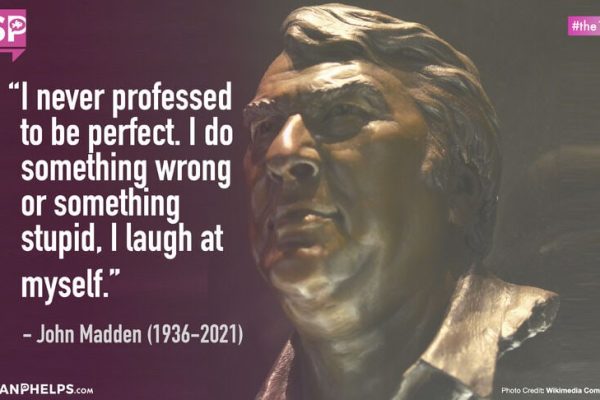
RIP John Madden. He was the first to say, “Football is Life!” Actually, he said, “Football is my life. It’s something I say proudly. But, it’s complicated.”

Madden was a trailblazer. Whether it was playing, coaching, broadcasting, or … video gaming, he did it the Madden way.

Let’s look at each:

Playing – John Madden once said, “The road to Easy Street goes through the sewer.” That summed up his playing career and road to coaching.

Madden played one season at the College of San Mateo before being given a football scholarship to the University of Oregon. He never saw a down as a Duck. Madden was redshirted because of an injury and had a knee operation. He then played for Grays Harbor College in the fall of 1956, before transferring to Cal Poly in San Luis Obispo. At Cal Poly, Madden played both offense and defense winning all-conference honors at offensive tackle.

If you are keeping score . . . that’s four schools. Did Madden invent the transfer portal 60+ years ago? Madden was drafted in the 21st round by the Philadelphia Eagles. In his first training camp, he suffered an injury to his other knee. His professional career was over before playing a down.

Coaching – Madden shared, “A coach is just a guy whose best class in grammar school was recess and whose best class in high school was P.E. I never thought I was anything but a guy whose best class was P.E.”

Madden would begin his coaching career at the collegiate level. After stints at Allan Hancock College and San Diego State, Madden would take a job as linebackers coach for the Oakland Raiders. After two seasons, Al David made him the Raiders’ head coach in 1969. At age 32, John Madden became the youngest head coach in the history of the league. He took the Al Davis, “Win baby!” mantra to heart. Madden would win 103 regular-season games and one Super Bowl before retiring at age 42.

Broadcasting – Madden’s colorful delivery won him critical acclaim and 12 Emmy Awards for Outstanding Sports Event Analyst. The man had his own lexicon with words such as “Whap!”, “Bang!” and “Doink!”‘ Madden would work as a broadcaster for CBS, NBC, ABC, and FOX. His enthusiastic use of the telestrator helped to popularize technology in sports. At one point, Madden made more money as a broadcaster than any player in the NFL.

Video games – Beginning in 1998, Madden lent his voice, personality, and name to the Madden NFL series of football video games, published by Electronic Arts (EA). He would view the game as an educational tool. My teenage boys don’t know Madden as the famed coach and broadcaster, they know him as the game only.

What I personally love about Madden was how he embraced his flaws. Whether it was being afraid of flying or making up words like turducken, those idiosyncrasies were the things that made him uniquely special. He never apologized for who he was and never professed to be perfect. We should all be a little more like Madden.

Follow me on Twitter or LinkedIn.

John Madden

Stan Phelps walks the walk. He stands out in the sea of sameness by modeling his own Differentiated Experience (DX) message: Differentiation isn’t just about what you say, it’s about what you do and, more importantly, how and why you do it. Stan leverages his unique collection of 5,000+ case studies on customer, employee, and brand experience to engage audiences with informative learning-based experiences. He believes purposeful DX wins the hearts of employees and customers, and differentiation ultimately boosts loyalty, retention, referrals, and results.

Find Stan’s in-person and virtual keynotes, workshops, and Goldfish tank programs at StanPhelps.com.

Patagonia is closing both its offices and retail stores between December 25th and January 1st. See the sign below. They share, “We’re giving our employees a break with some paid time off.”

Hat tip to the Founder of Girls Who Code Reshma Saujani for sharing it on LinkedIn with the caption, “This is why I love Patagonia.”

This is an instance of where the Pink Goldfish strategy of Withholding for customers intersects with the Green Goldfish of Time Away for employees.

If you want to recognize and reward your employees, then make it count. Time away is what they value the most. “Across all ages and cultures, time off was absolutely number one,” according to Cindy Ventrice, author of “Make Their Day! Employee Recognition that Works.”

Time away from the office is not only valued by employees, it’s regenerative. A recent Gallup survey shared that Americans work an average of 47 hours a week. That almost adds up to an extra full day of work every week. To make matters worse, Americans average just two weeks of vacation a year. Those 10 days put us dead last compared to all other developed countries. 

This week off is just the latest in a history of similar moves by Patagonia.

The California-based company attracts outdoorsy types with its athletic clothing brand and a laser-like focus on work-life balance. “Time away from the office isn’t just tolerated here, it’s required,” says Robert BonDurant, Patagonia’s former Vice President of Marketing.

Employees enjoy what the company calls “Let My People Go Surfing” time—a period during any workday where employees can head outdoors to get their creative juices flowing. Of course, they can’t abandon their duties or ditch a meeting, but popping out for an impromptu climb or bike ride is encouraged. At their HQ, the company has a unique boardroom. Not the one you are picturing right now. A dedicated room where employees can store their surfboards.

Patagonia also gives employees two weeks of full-paid leave to work for the green nonprofit of their choice. 

Takeaway – These time-away policies, which originated from Yvon Chouinard, an outdoor enthusiast who founded the company in 1974, are good for employee morale and invaluable to the company as a differentiator.

Follow me on Twitter or LinkedIn.

Stan Phelps

Stan Phelps walks the walk. He stands out in the sea of sameness by modeling his own Differentiated Experience (DX) message: Differentiation isn’t just about what you say, it’s about what you do and, more importantly, how and why you do it. Stan leverages his unique collection of 5,000+ case studies on customer, employee, and brand experience to engage audiences with informative learning-based experiences. He believes purposeful DX wins the hearts of employees and customers, and differentiation ultimately boosts loyalty, retention, referrals, and results.

Find Stan’s in-person and virtual keynotes, workshops, and Goldfish tank programs at StanPhelps.com.
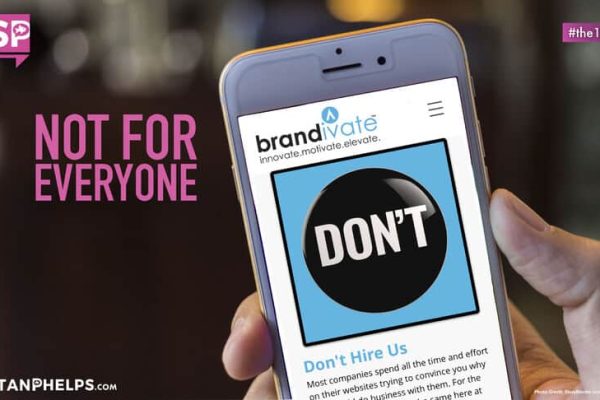
Would you be brave enough to put a “Don’t Hire Us” page on your website? That’s exactly what Bill Petrie, Kelsey Cunningham and the team at brandivate did. Here’s what that they shared:

_________________________

Don’t Hire Us

Most companies spend all the time and effort on their websites trying to convince you why you should do business with them. For the most part, we have done the same here at brandivate, with this page being the exception.
 
You see, we aren’t for everyone – no company is, despite what they may tell you. We know who we are and, even more, understand the type of clients where we can create the fastest and most positive impact. Unfortunately, this understanding also means we realize there are some clients that, well, aren’t for us: the ones who believe there’s an easy button, who aren’t ready to roll up their sleeves alongside us, and those who aren’t willing to use the tools we create for them. 

So, if any of the below apply to you, please don’t hire us. 

1. Happy with the status quo.

2. Resistant to new ideas.

3. Aren’t interested in working together to create a partnership.

4. Don’t believe laughter and fun should be part of the process.

5. Don’t want to stand apart from the competition.

6. Aren’t willing to invest in long, sustained growth.

However, if you’re ready to shift your view, stand out from the crowd, and grow your business by partnering with a creative, forward-thinking, and dynamic company, then brandivate is a perfect choice. To get started, click on the “let’s talk” button below, and we will set up a time to talk that works for you.

We aren’t for everyone, but we just might be right for you.

_____________________________

I love that this isn’t a standalone page. “Don’t Hire Us” is on the main menu for the site. This is a great example of the Pink Goldfish of Withholding.

Withholding is about limitations, restrictions, boundaries, and constraints. That sounds obviously negative.

Don’t great brands and agencies offer freedom? NO
Shouldn’t you bend over backward for the clients? NO
Shouldn’t you serve everyone? NO

Everyone wants more clients, don’t they? Not necessarily. You want more of the right clients.

Would you create one of these pages? What are you waiting for? To quote a set of lyrics from one of my favorite musicals:

John Laurens: “Burr, the revolution’s imminent. What do you stall for?”
Alexander Hamilton: “If you stand for nothing, Burr, what’ll you fall for?” Aaron Burr: “Alexander, please.”
Alexander Hamilton: “Burr, I’d rather be divisive than indecisive, drop the niceties.”

Takeaway: Nice is a four-letter-word. Be divisive. Take a stand against who you are not for.

Follow me on Twitter or LinkedIn.

Stan Phelps

Stan Phelps walks the walk. He stands out in the sea of sameness by modeling his own Differentiated Experience (DX) message: Differentiation isn’t just about what you say, it’s about what you do and, more importantly, how and why you do it. Stan leverages his unique collection of 5,000+ case studies on customer, employee, and brand experience to engage audiences with informative learning-based experiences. He believes purposeful DX wins the hearts of employees and customers, and differentiation ultimately boosts loyalty, retention, referrals, and results.

Find Stan’s in-person and virtual keynotes, workshops, and Goldfish tank programs at StanPhelps.com.

1 14 15 16 17 18 48
A simple illustration of a purple fish facing right on a plain background.

I've had the pleasure of working with teams at:

Three purple fish silhouettes swimming to the right on a dark background.

Find Your Best-Match Program

With over 18 possible keynote speaking presentations, workshops, and GOLDFISH TANK programs available to meet your ever-evolving needs, I’ve created this 2-minute, 6-question quiz to help you understand which program is best for you and your audience.

Meet Your Presenter

Through keynote speaking presentations, hands-on workshops, and GOLDFISH TANK programs, I empower you to power loyalty and growth.

Hi, I’m Stan Phelps. I work with organizations that want to increase loyalty, drive sales, and promote positive word-of-mouth by creating differentiated experiences.

As an author, keynote speaker, and workshop facilitator, my in-person and virtual programs stand out in a sea of sameness because I model my own message of differentiated experience (DX).

I leverage my unique collection of more than 5,500 case studies on customer, employee, and brand experience to engage audiences with practical ideas that inspire action.

A person wearing glasses and a gray quarter-zip sweater stands outdoors in front of a building with a triangular glass roof at dusk.

Every time we do business together, Something amazing happens in the world!

Through my partner B1G1, each program gives back to create global IMPACT

Two students in blue uniforms smile while washing their hands at an outdoor tap.

When we complete a GOLDFISH TANK, we give 1001 days of clean water to school children

Collage of three images: a person washing hands, a child drawing with colored pencils, and a group of people sitting outdoors with some raising their hands.

When we complete a GLOBAL engagement, we give 365 days of clean water access in Peru, 120 days of learning aids in Malaysia, and 50 days of business training for women in Malawi

Hand placing a brick on a surface with text: "One Book = One Brick" and an Amazon logo.

When someone downloads a GOLDFISH eBook, we give one brick toward building school facilities in Cambodia