
Stan Phelp's Blog

The Goldfish Chronicles

Sharing insights on customer experience, employee engagement, and brand strategy.

“Your brand is no longer what you tell people it is. It’s the differentiated experience [DX] your customer has, how they feel about it, and, most importantly, what they tell others about their experience.”

Great brands know their customers and create a differentiated experience that resonates. They understand that word of mouth is absolutely key to growth. They purposely stand out in a sea of sameness.

What are your one or two signature elements of DX? How are you amping up value or reducing maintenance? Instead of being a “me too,” what is the one special thing your company does that is superior and distinctive in the eyes of your customers? What’s that “little something extra” that is tangible, valuable, and talkable?

– What is your warm-chocolate-chip-cookie first impression like DoubleTree Hotels?

– What is your “Bags Fly Free” added value like Southwest Airlines?

– What is your free peanuts and bonus fries like Five Guys?

– What is your free shipping upgrade to overnight like Zappos?

Are you giving little unexpected extras? Are you ready to focus on the experience provided to current customers to drive differentiation? What’s Your Purple Goldfish?

Follow me on Twitter or LinkedIn.
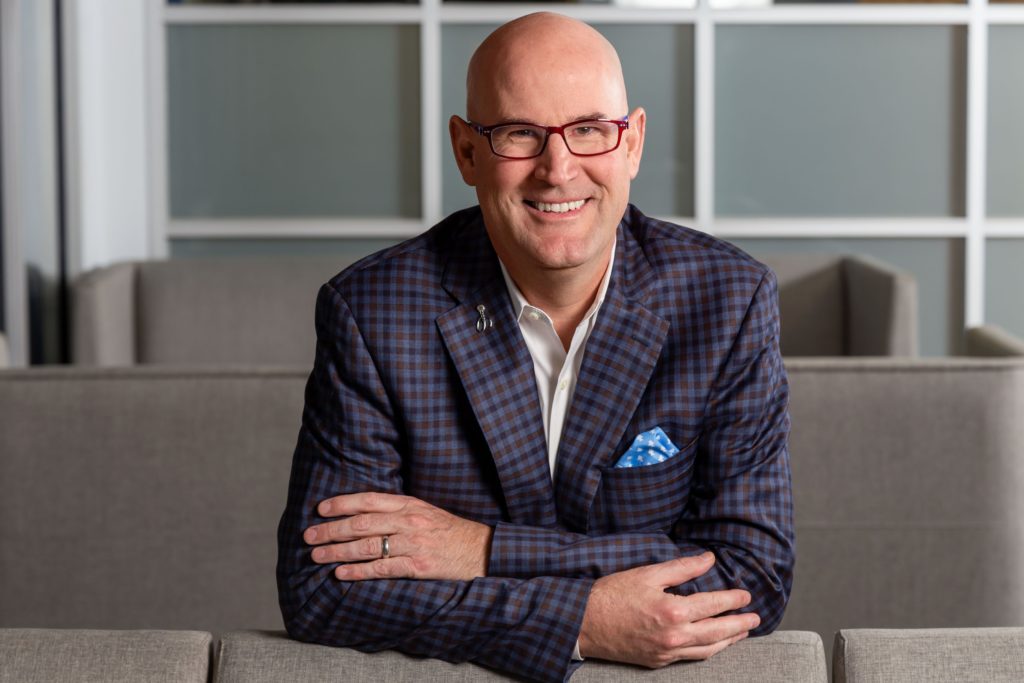
Stan Phelps

Stan Phelps walks the walk. He stands out in the sea of sameness by modeling his own Differentiated Experience (DX) message: Differentiation isn’t just about what you say, it’s about what you do and, more importantly, how and why you do it. Stan leverages his unique collection of 5,000+ case studies on customer, employee, and brand experience to engage audiences with informative learning-based experiences. He believes purposeful DX wins the hearts of employees and customers, and differentiation ultimately boosts loyalty, retention, referrals, and results.

Find Stan’s in-person and virtual keynotes, workshops, and Goldfish tank programs at StanPhelps.com.
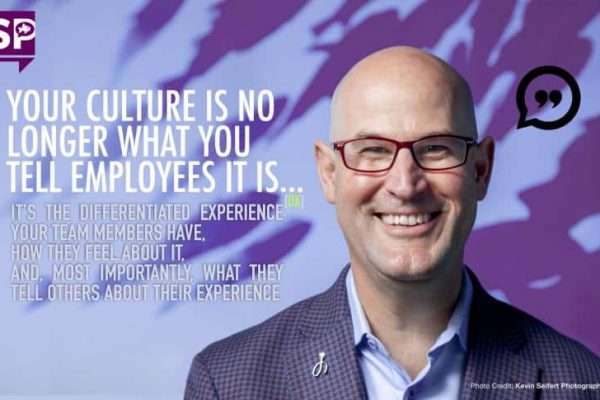
Note to the C-Suite: “Your culture is no longer what you tell employees it is. It’s the differentiated experience [DX] your team members have, how they feel about it, and most importantly, what they tell others about their experience.”

Some years ago, I crossed paths with a friend from college named Tom Coyne. Tom and I lived on the same floor our freshman year at Marist College. Tom captained the football team, brandishing a personality and a smile that lit up a room.

Tom was now a successful businessman, owning his own agency. COYNE PUBLIC RELATIONS was based in New Jersey, and boasted an impressive list of clients. Tom and his team have worked with iconic brands such as Disney, Campbell Soup, and Burger King.

While sitting down with Tom, I had the opportunity to ask him about his business philosophy. Tom relayed an approach that was both simple and prophetic:

“When I started the agency, my goal was not to be the biggest or to have the best clients. It was simply to become the best agency to work for. I knew if we were the best agency to work for, we would then attract the best people. And that if we retained the best people, the best clients would follow.”

How are you investing in culture and a differentiated employee experience?

Follow me on Twitter or LinkedIn.

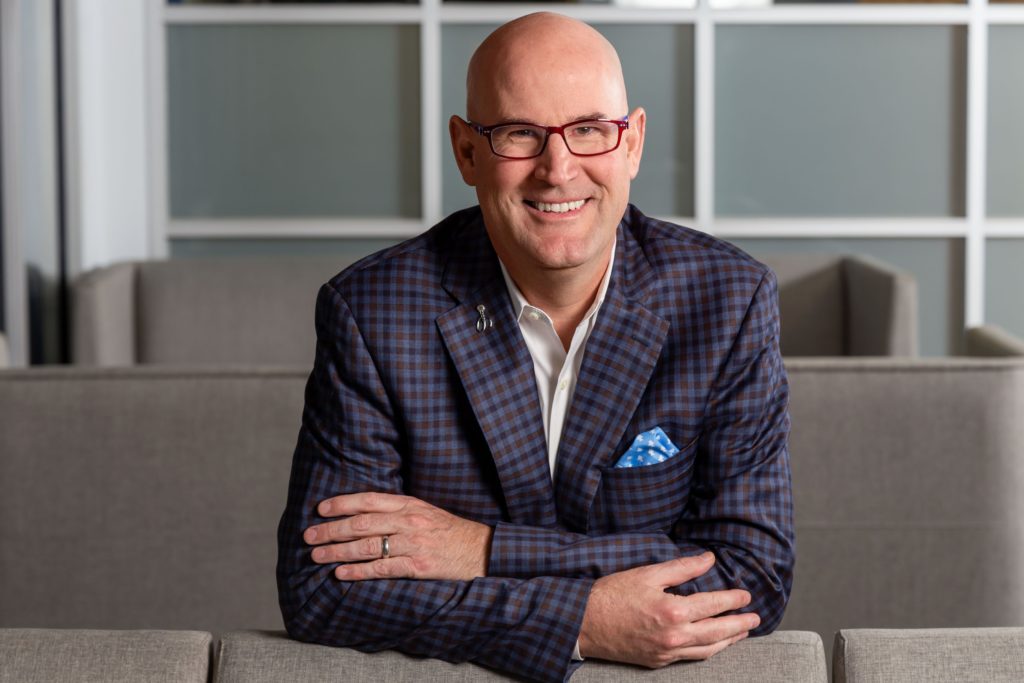
Stan Phelps

Stan Phelps walks the walk. He stands out in the sea of sameness by modeling his own Differentiated Experience (DX) message: Differentiation isn’t just about what you say, it’s about what you do and, more importantly, how and why you do it. Stan leverages his unique collection of 5,000+ case studies on customer, employee, and brand experience to engage audiences with informative learning-based experiences. He believes purposeful DX wins the hearts of employees and customers, and differentiation ultimately boosts loyalty, retention, referrals, and results.

Find Stan’s in-person and virtual keynotes, workshops, and Goldfish tank programs at StanPhelps.com.
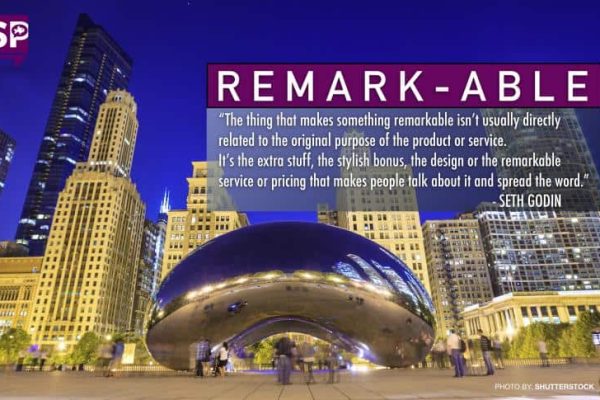
Seth Godin on being remarkable. “The thing that makes something remarkable isn’t usually directly related to the original purpose of the product or service. It’s the extra stuff, the stylish bonus, the design, or the remarkable service or pricing that makes people talk about it and spread the word.”

Word of mouth is absolutely key to your growth. What’s your strategy to become remark-able? If you have one, you are in a distinct minority. According to Jay Baer, “Fewer than 1% of all businesses have a defined word of mouth/referral strategy. Word-of-mouth is responsible for more customer acquisition than any other tactic, generally speaking, yet nobody has an actual plan for it. It’s shocking.”

How are you standing out in a sea of sameness? What are your one or two signature extras to create a differentiated experience (DX)?

CASE IN POINT: Talk to someone who has recently visited Chicago. Odds on they might tell you about visiting Cloud Gate in Millennium Park. Known as “The Bean” it contains 168 stainless steel plates welded together with no visible seams. Time Magazine describes it as “an essential photo opportunity, and more of a destination than a work of art.”

What is the one special thing your company does that is distinctive and talk-able?

Follow me on Twitter or LinkedIn.

Stan Phelps

Stan Phelps walks the walk. He stands out in the sea of sameness by modeling his own Differentiated Experience (DX) message: Differentiation isn’t just about what you say, it’s about what you do and, more importantly, how and why you do it. Stan leverages his unique collection of 5,000+ case studies on customer, employee, and brand experience to engage audiences with informative learning-based experiences. He believes purposeful DX wins the hearts of employees and customers, and differentiation ultimately boosts loyalty, retention, referrals, and results.

Find Stan’s in-person and virtual keynotes, workshops, and Goldfish tank programs at StanPhelps.com.
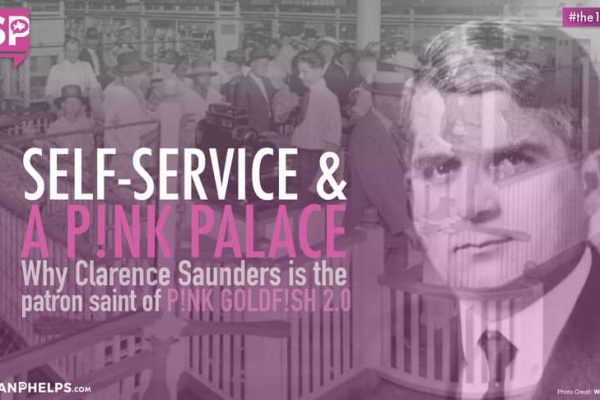
Last week the P!NK GOLDF!SH rolled into Memphis and we celebrated the patron saint of P!NK GOLDF!SH 2.0. His name is Clarence Saunders. 105 years ago Clarence challenged norms by doing less than all the other grocery stores.

We call this P!NK flawsome strategy “Withholding.”

Before 1916, groceries were sold at stores where a clerk would fetch goods for customers. They’d measure out flour, sugar, and ground coffee beans. Then the clerks added up the prices and write them in pencil on the back of the sacks.

This wasn’t just Mom and Pop shops. Even the big chain stores used clerks. Although the chain store model kept costs down, clerks were expensive.

Saunders defied normal and developed a self-serve model that cut these costs. Customers selected and transported their own items to checkout. Shoppers on that first day did see some employees stocking shelves, but according to the Tennessee Historical Quarterly, “They politely refused to select merchandise for visitors.”

As normal as this seems now, it was unheard of at the time.
By the end of that first year, there were nine locations around Memphis. Saunders called his unique stores Piggly Wiggly. Today, the chain has over 500 grocery stores in 17 states.

Why the weird name? According to the Piggly Wiggly website, “Someone once asked him [Saunders] why he had chosen such an unusual name for his organization, to which he replied, ‘So people will ask that very question.”

Being weird and different made Piggly Wiggly remarkable. Customers loved it.

Five years after opening the first Piggly Wiggly, the company had grown to over 600 stores. Buoyed by this success, Saunders began construction of a pink marble mansion in Memphis in the 1920s. He named it the “PINK PALACE.”

Unfortunately, Saunder would get involved in a campaign to counter a bear run on Piggly Wiggly stock in 1923. It crushed him financially and he was forced to give up the Pink Palace, resign as President, and give all of his stock in Piggly Wiggly to creditors.

David Rendall and I visited the Pink Palace last week. It is now the home to the Memphis Museum of Science & History – MoSH. We’ll raise our glass to the patron saint of P!NK GOLDF!SH 2.0

Follow me on Twitter or LinkedIn.

Stan Phelps

Stan Phelps walks the walk. He stands out in the sea of sameness by modeling his own Differentiated Experience (DX) message: Differentiation isn’t just about what you say, it’s about what you do and, more importantly, how and why you do it. Stan leverages his unique collection of 5,000+ case studies on customer, employee, and brand experience to engage audiences with informative learning-based experiences. He believes purposeful DX wins the hearts of employees and customers, and differentiation ultimately boosts loyalty, retention, referrals, and results.

Find Stan’s in-person and virtual keynotes, workshops, and Goldfish tank programs at StanPhelps.com.

In 1977, James Earl Ray, convicted of assassinating Martin Luther King Jr in #Memphis, escaped from Brushy Mountain State Penitentiary. After 55 hours in the mountains of Tennessee, he was found just 8 miles away from the prison.

That might’ve made Eminem proud, but Gary “Lazarus Lake” Cantrell thought he could have gone at least 100 miles in the time it took Ray to go just eight.

He couldn’t, but this gave him an idea for a race.

He named the race after his friend Barry Barkley, in the same rugged environment. The Barkley Marathons were born in Tennessee.

It turns out that professional athletes can’t run 100 miles either. Only 15 runners have completed the course since the race was started in 1986. In 2006, 30 of the 40 participants were unable to even complete the first two miles.

Let’s look at how the Barkley Marathons leverage the Pink Goldfish of Opposing. They flaunt norms and do the opposite of “normal” races:

Normal marathons have a clear online registration process. The Barkley Marathons have no clear process. If you want to race, you need to mail a letter to the race organizer and hope he responds.

Normal marathons use timing chips to track runners. The Barkley Marathons have no electronic timing. Runners collect pages from paperback books at various milestones along the way to prove they’ve completed the whole course. For example, if you are runner #22, you rip out page #22 from the book at each checkpoint and bring it back with you in a plastic bag.

Normal marathons provide course markers and maps. The Barkley Marathons do not have a marked course. There is only one map. The course changes each year.

Normal marathons offer aid stations with drinks, snacks, water, ice, and medical care. The Barkley Marathons have no aid stations or volunteers or any assistance of any kind. Runners are on their own. They have to provide all supplies and carry everything with them.

Normal marathons charge a fee of around $100 to cover expenses or to donate to charity. The Barkley Marathons charge an application fee of $1.60. Participants also have to bring Lazarus, the race organizer, a license plate and one additional item that changes from year to year. One year the fee was a pack of white tube socks. Another year it was a button-down shirt.

Normal marathons provide a clear start time. The Barkley Marathons have no set start time. A race starts an hour after the race organizer blows the conch shell. It starts when he lights his cigarette.

The Barkley Marathon is so unusual and so interesting that it was the subject of a very popular Netflix documentary with the subtitle, “The Race That Eats Its Young.” It is one of the most desirable races for endurance runners throughout the world.

Sometimes a Pink Goldfish is a race that you can’t sign up for and can’t finish.

Follow me on Twitter or LinkedIn.

Stan Phelps

Stan Phelps walks the walk. He stands out in the sea of sameness by modeling his own Differentiated Experience (DX) message: Differentiation isn’t just about what you say, it’s about what you do and, more importantly, how and why you do it. Stan leverages his unique collection of 5,000+ case studies on customer, employee, and brand experience to engage audiences with informative learning-based experiences. He believes purposeful DX wins the hearts of employees and customers, and differentiation ultimately boosts loyalty, retention, referrals, and results.

Find Stan’s in-person and virtual keynotes, workshops, and Goldfish tank programs at StanPhelps.com.
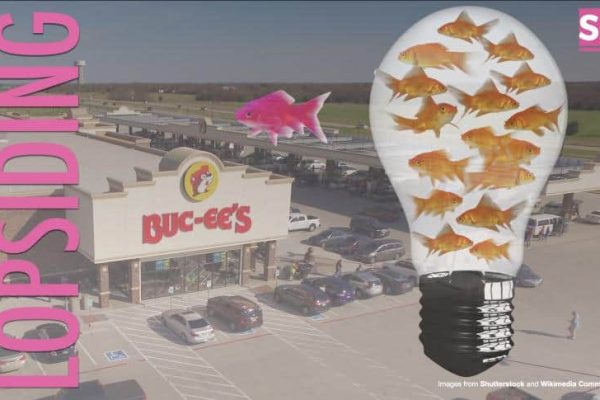
Stopped at Buc-ees on my way to Ft. Worth, Texas a week ago. There is Texas-sized and then there is Buc-ees sized.

A bit of background – On July 28, 1982, Arch Aplin III opened his first convenience store in Texas. Early on, he decided he’d need a good name and a good logo, something he could build on. The logo and name was an ode to his childhood nickname of “Beaver’’ and his beloved hunting dog named Buck. That convenience store was named Buc-ees.

From its earliest days according to their website, the store has “been committed to providing a clean, friendly, and in-stock experience for our customers.”

Buc-ees stores are notable for many reasons. In 2012, the chain won a nationwide restroom contest sponsored by Cintas. Buc-ees was not afraid to flaunt it, creating a billboard with the following message, “Top Two Reasons to Stop at Buc-ee’s: #1 and #2.” A week ago, I saw my first Buc-ees billboard over 200 miles away in Mississippi. The caption was, “No Games, Plenty of Thrones.”

This ain’t your “gas station sandwich.” In 2016 Bon Appétit named Buc-ee’s “America’s Best Rest Stop” in honor of its food. Their New Braunfels, Texas location, at 68,000 square feet, has been recognized as the World’s Largest C-store” by the National Association of Convenience Stores.

But the thing that makes Buc-ees stand out amongst any other highway rest stop is their Withholding stance against truck drivers. Sorry, 18-wheelers are not allowed at any Buc-ees.

Have you been to Buc-ees? What’s your favorite thing or go-to Buc-ees item?

Call me crazy, but I love the Beaver Nuts.

Follow me on Twitter or LinkedIn.

Stan Phelps

Stan Phelps walks the walk. He stands out in the sea of sameness by modeling his own Differentiated Experience (DX) message: Differentiation isn’t just about what you say, it’s about what you do and, more importantly, how and why you do it. Stan leverages his unique collection of 5,000+ case studies on customer, employee, and brand experience to engage audiences with informative learning-based experiences. He believes purposeful DX wins the hearts of employees and customers, and differentiation ultimately boosts loyalty, retention, referrals, and results.

Find Stan’s in-person and virtual keynotes, workshops, and Goldfish tank programs at StanPhelps.com.
Ever heard of the acronym DOTE? Do One Thing Every day. I got schooled on this by Juliet Brunhamer and her marketing team at Liberty Tax.

Juliet was talking about marketing and the importance of consistency. I couldn’t agree more. Marketing is not about the big campaign that is sporadic. It’s about the little things that are consistent. Less campaign, more commitment.

What do you do from a marketing point of view that you are committed to on a daily basis?

For me, it’s writing each weekday on LinkedIn. The practice of creating a daily post has been one of the silver linings of COVID-19. I write under #the1299 hashtag.

What’s the significance of 1299?

Here are four potential reasons:

1. Superlimited and fast – it is inspired by the Ducati 1299, the world’s most powerful twin-cylinder supermotorcycle. I wanted my posts to be compact, stylish, and powerful.

2. Ultra-Cool Delivery – an ode to Peggy Frank Memorial Act. Known as House Resolution 1299 in Congress, it is a bill that proposes that any delivery vehicle owned or leased by the USPS to be modified to include an air conditioning unit. And that the USPS may not purchase or lease any delivery vehicle unless that vehicle has an air conditioning unit. Don’t deliver the post unless it’s cool and don’t miss a day.

3. A tribute to FDR – 1299 characters forces you to be succinct and to the point. It was an ode to a piece of advice FDR once gave to his son about public speaking, “Be sincere, be brief, be seated.”

4. Insurgenct ideas – the Ottoman Empire was founded in 1299 and would rule for over 600 years. That’s when the Young Turks rose up, demanded change, and ended the Empire. A Young Turk is now defined as “an insurgent person trying to take control of a situation or organization by force or political maneuver.” I’m that insurgent trying to change the way people think about marketing and the importance of experience.

Which one is correct?

Answer: It’s not the Bugati, the Postal system, or the Ottomans. The inspiration was one of bumping against a creative constraint. Posts only stay up one year and you have a max of 1300 characters. Be succinct, be brief, and be seated.

Follow me on Twitter or LinkedIn.

Stan Phelps

Stan Phelps walks the walk. He stands out in the sea of sameness by modeling his own Differentiated Experience (DX) message: Differentiation isn’t just about what you say, it’s about what you do and, more importantly, how and why you do it. Stan leverages his unique collection of 5,000+ case studies on customer, employee, and brand experience to engage audiences with informative learning-based experiences. He believes purposeful DX wins the hearts of employees and customers, and differentiation ultimately boosts loyalty, retention, referrals, and results.

Find Stan’s in-person and virtual keynotes, workshops, and Goldfish tank programs at StanPhelps.com.
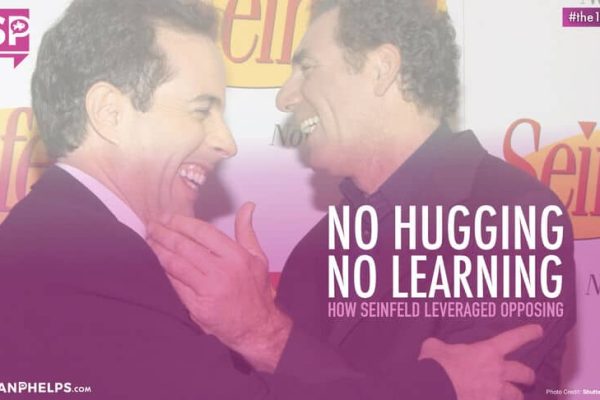
How did Seinfeld become the most successful TV sitcom of all time? They did it with a radical Pink Goldfish approach called Opposing. Creators Jerry Seinfeld and Larry David decided to do the opposite of the tried and true standard.

Instead of an embrace and a learning moment at the end of an episode, they instituted a “NO HUGGING, NO LEARNING” mantra as the rule. Not only would Jerry, Elaine, Kramer, and George not learn, they’d devolve and become worse human beings.

Do you have the courage to be an opposing brand?

The Seinfeld Chronicles almost never made it to air. NBC executive Brandon Tartikoff greenlit it for only four episodes. This was at a time that being given six episodes was considered a huge slap in the face. Tartikoff Infamously described it as too New York, too Jewish, “Who will want to see four Jews wandering around New York acting neurotic?”

To oppose is to be contradictory and dissimilar. It is simple. When everyone goes left, you go right. When everyone offers healthy options, you offer unhealthy ones. When everyone is open late, you close early. It’s maximum separation. It’s a complete break with convention. For Seinfeld, it meant no happy endings.

It’s worth taking a brief look at the definition of opposite. It means, “contrary or radically different in some respect common to both, as in nature, qualities, direction, result, or significance.”

This is important. To be opposites, two things need to be both very different and also have something in common. There’s something that unites them but something else that completely separates them.

So what? Why does this matter? It’s vital because everything doesn’t have to be different in order to be the opposite. In fact, if everything is different when you compare two things, they’re not opposites. They are unrelated. Seinfeld was still a half-hour sitcom on network television.

In other words, you don’t have to leave your industry to do the opposite of what everyone else in your industry does. That’s not doing the opposite. That’s just joining or creating a different industry.
Paradoxically, you have to maintain some similarities in order to be considered opposites. 

In the spirit of “Not that there is anything wrong with that,” how are you doing the opposite of convention in some aspects of your business?

For me, I’m not a list-builder. I won’t ask for your email. This violates a cardinal rule as a speaker. I’ve heard this a thousand times, “YOU MUST ALWAYS BE BUILDING YOUR LIST.” Nope, not me.

I also rarely ever sell my books in the back of the room. I’d much rather give you a copy of my MiniBük or a free eBook. Instead of taking a credit card, I’d much rather talk to someone about the concepts and how they can be applied to their business.

Follow me on Twitter or LinkedIn.

Stan Phelps

Stan Phelps walks the walk. He stands out in the sea of sameness by modeling his own Differentiated Experience (DX) message: Differentiation isn’t just about what you say, it’s about what you do and, more importantly, how and why you do it. Stan leverages his unique collection of 5,000+ case studies on customer, employee, and brand experience to engage audiences with informative learning-based experiences. He believes purposeful DX wins the hearts of employees and customers, and differentiation ultimately boosts loyalty, retention, referrals, and results.

Find Stan’s in-person and virtual keynotes, workshops, and Goldfish tank programs at StanPhelps.com.

For the second time in my 9 years in Raleigh, the city was under siege. This time it was a Zebra Spitting Cobra that held the city captive for three days.

Dubbed Snakegate by the media, it followed the missing snake that was first reported in a 911 call. It soon became a national news story.

Not familiar with the Zebra Cobra? Neither was I. The African snake is deadly. You not only have to worry about getting bitten. The snake can spit its venom as far as nine feet.

It would be hard to criticize the media. It was Judith Retana of CBS 17 who helped capture the snake. She was knocking on doors when she came eye to eye with the snake on a front porch.

“I was watching my feet, looking around, I looked down in the corner and all of a sudden I see this snake, his head was perched up… I’m pretty sure we made eye contact” shared Retana in her reporting.

Rest easy. After days of searching, the Raleigh police announced in a press release that the missing venomous spitting zebra cobra has been “located and safely removed” from a northwest Raleigh neighborhood.

Your Take: Do these types of stories warrant local and national coverage?

Follow me on Twitter or LinkedIn.

Stan Phelps

Stan Phelps walks the walk. He stands out in the sea of sameness by modeling his own Differentiated Experience (DX) message: Differentiation isn’t just about what you say, it’s about what you do and, more importantly, how and why you do it. Stan leverages his unique collection of 5,000+ case studies on customer, employee, and brand experience to engage audiences with informative learning-based experiences. He believes purposeful DX wins the hearts of employees and customers, and differentiation ultimately boosts loyalty, retention, referrals, and results.

Find Stan’s in-person and virtual keynotes, workshops, and Goldfish tank programs at StanPhelps.com.
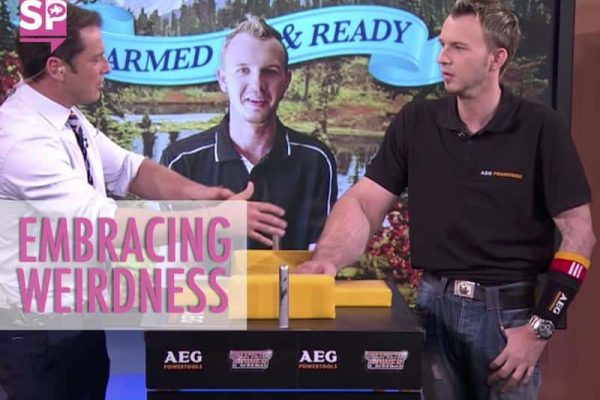
Matthias Schlitte embraces the Pink Goldfish mindset. He doubles down on what makes him weird and does less of what others do as normal. Matthias began practicing arm-wrestling when he was 16. But he only trains the muscles in his right arm. When you see a picture of him, it looks like he has a genetic deformity. It’s because he does. It’s called KTS, which causes one of a person’s four limbs to grow much larger than the others.

His right forearm is nearly 18 inches around, but his left forearm measures just 6 inches. It seems like the only muscles that he has are in his right arm. This is a huge advantage in arm wrestling because his opponents are determined by weight class. People wrestle against others of similar weight.

Matthias’ wrestling arm is much larger than that of his competitors because they have bodies with normal proportions. This means that much of their weight is in parts that don’t help them with arm wrestling.

Schlitte can spend additional time and energy exercising his right arm because he doesn’t have to bother with building the rest of his body. He is weak in many areas so that he can be incredibly strong in the area that is the most important. His flaw makes him awesome.

How are u doing less, so u can do more of what makes u unique?

Follow me on Twitter or LinkedIn.

Stan Phelps

Stan Phelps walks the walk. He stands out in the sea of sameness by modeling his own Differentiated Experience (DX) message: Differentiation isn’t just about what you say, it’s about what you do and, more importantly, how and why you do it. Stan leverages his unique collection of 5,000+ case studies on customer, employee, and brand experience to engage audiences with informative learning-based experiences. He believes purposeful DX wins the hearts of employees and customers, and differentiation ultimately boosts loyalty, retention, referrals, and results.

Find Stan’s in-person and virtual keynotes, workshops, and Goldfish tank programs at StanPhelps.com.

1 24 25 26 27 28 48
A simple illustration of a purple fish facing right on a plain background.

I've had the pleasure of working with teams at:

Three purple fish silhouettes swimming to the right on a dark background.

Find Your Best-Match Program

With over 18 possible keynote speaking presentations, workshops, and GOLDFISH TANK programs available to meet your ever-evolving needs, I’ve created this 2-minute, 6-question quiz to help you understand which program is best for you and your audience.

Meet Your Presenter

Through keynote speaking presentations, hands-on workshops, and GOLDFISH TANK programs, I empower you to power loyalty and growth.

Hi, I’m Stan Phelps. I work with organizations that want to increase loyalty, drive sales, and promote positive word-of-mouth by creating differentiated experiences.

As an author, keynote speaker, and workshop facilitator, my in-person and virtual programs stand out in a sea of sameness because I model my own message of differentiated experience (DX).

I leverage my unique collection of more than 5,500 case studies on customer, employee, and brand experience to engage audiences with practical ideas that inspire action.

A person wearing glasses and a gray quarter-zip sweater stands outdoors in front of a building with a triangular glass roof at dusk.

Every time we do business together, Something amazing happens in the world!

Through my partner B1G1, each program gives back to create global IMPACT

Two students in blue uniforms smile while washing their hands at an outdoor tap.

When we complete a GOLDFISH TANK, we give 1001 days of clean water to school children

Collage of three images: a person washing hands, a child drawing with colored pencils, and a group of people sitting outdoors with some raising their hands.

When we complete a GLOBAL engagement, we give 365 days of clean water access in Peru, 120 days of learning aids in Malaysia, and 50 days of business training for women in Malawi

Hand placing a brick on a surface with text: "One Book = One Brick" and an Amazon logo.

When someone downloads a GOLDFISH eBook, we give one brick toward building school facilities in Cambodia