
Stan Phelp's Blog

The Goldfish Chronicles

Sharing insights on customer experience, employee engagement, and brand strategy.

“We don’t change. We take the gravel and the shell and we make a pearl. And we help other people to change so they can see more kinds of beauty.”

This was advice from the artist P!NK to her daughter as part of a Video Vanguard award acceptance speech at the 2017 VMAs.

P!NK shared the story of how her daughter Willow shared a puzzling statement on the way to school one day:

“I’m the ugliest girl I know. I look like a boy with long hair.”

P!NK was flummoxed. In her words,

“And my brain went to, ‘Oh my god, you’re six. Why? Where is this coming from? Who said this? Can I kick a 6-year-old’s ass?’…

But I didn’t say anything. Instead I went home and I made a Powerpoint presentation for her. And in that presentation were androgynous rockstars and artists that live their truth, are probably made fun of every day of their life, and carry on, wave their flag and inspire the rest of us.

And these are artists like Michael Jackson and David Bowie and Freddie Mercury and Annie Lennox and Prince and Janis Joplin and George Michael, Elton John, so many artists — her eyes glazed over. But then I said, ‘You know, I really want to know why you feel this way about yourself.’

And she said, ‘Well I look like a boy,’ and I said, ‘Well what do you think I look like?’ And she said, ‘Well you’re beautiful.’ And I was like, ‘Well, thanks. But when people make fun of me, that’s what they use. They say I look like a boy or I’m too masculine or I have too many opinions, my body is too strong.”

[And then P!NK dropped a truth bomb on Willow]

“Do you see me growing my hair?’ She said, ‘No, mama.’

I said, ‘Do you see me changing my body?’ ‘No, mama.’

‘Do you see me changing the way I present myself to the world?’ ‘No, mama.’ ‘

Do you see me selling out arenas all over the world?’ ‘Yes, Mama.’

‘OK! So, baby girl. We don’t change. We take the gravel and the shell and we make a pearl. And we help other people to change so they can see more kinds of beauty.”

What a beautiful message for both life and business. Thank you Alecia Beth Moore. This is a consistent thread through her songs. Here is one of my favorite lyrics from her song, “F**kin’ Perfect”

“Please don’t you ever feel like you’re
less than, less than perfect.
If you ever feel like you’re nothing,
you are perfect to me.”

Follow me on Twitter or LinkedIn.
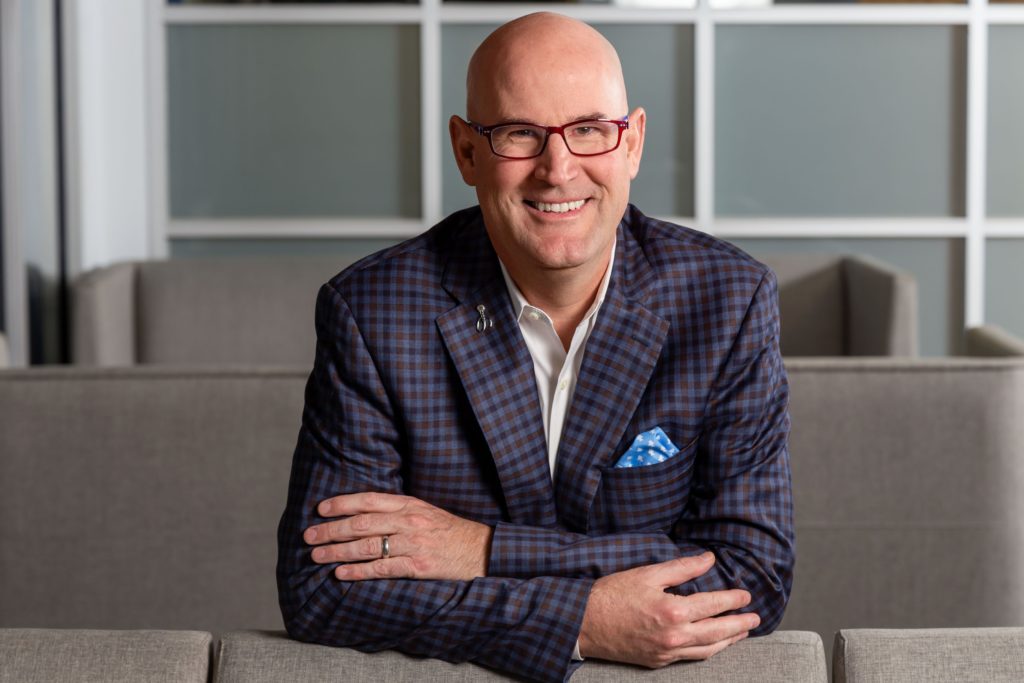
Stan Phelps

Stan Phelps walks the walk. He stands out in the sea of sameness by modeling his own Differentiated Experience (DX) message: Differentiation isn’t just about what you say, it’s about what you do and, more importantly, how and why you do it. Stan leverages his unique collection of 5,000+ case studies on customer, employee, and brand experience to engage audiences with informative learning-based experiences. He believes purposeful DX wins the hearts of employees and customers, and differentiation ultimately boosts loyalty, retention, referrals, and results.

Find Stan’s in-person and virtual keynotes, workshops, and Goldfish tank programs at StanPhelps.com.
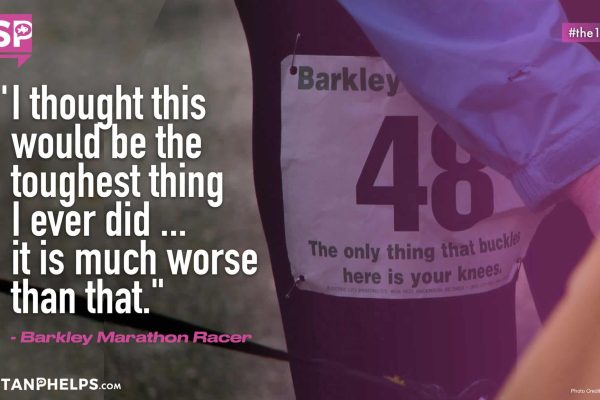
Not familiar with the Barkley Marathon? It just happened two weeks ago. And for the fifth year in a row, there were no finishers at the infamous race. In fact, in 36 years of the annual race in Tennessee, there have only been 15 finishers.

David Rendall and I feature the race in our book, “Pink Goldfish 2.0.”

I love this quote from a Barkley racer, “I thought this would be the toughest thing I ever did… it is much worse than that.”

What inspired this madness?

In 1977, James Earl Ray (the man convicted of assassinating Martin Luther King Jr.) escaped from Brushy Mountain State Penitentiary in the mountains of Tennessee. A massive manhunt ensued.

After 55 hours, he was found just eight miles away from the prison. Gary “Lazarus Lake” Cantrell thought he could have gone at least 100 miles in the time it took James Earl Ray to go just eight.

This gave him an idea for a race. Lazarus named it after his late friend Barry Barkley and set the course in the same rugged environment. Some years the race goes right by the Penitentiary. Five 20-mile loops that race participants have to complete within 60 hours.

Business Lesson 1: Challenge the norms of your industry

Normal marathons use timing chips to track runners on the course and as they finish. The Barkley Marathons have no electronic timing. Instead, runners collect pages from paperback books at various milestones along the way. For example, if you are runner #48, you rip out page 48 from the book at each checkpoint and bring it back with you to the finish line in a plastic bag. This year a runner lost his running belt containing all the pages. He found it after nearly three hours going up and down on a hill section of the course known as Little Hell. His race was over. Normal marathons provide a clear start time for the race. The Barkley Marathons have no set start time. A race starts an hour after the race organizer blows the conch shell. Normal marathons have a consistent date. This year Lazarus decided to start the race three weeks earlier than usual.

Business Lesson 2: Don’t be afraid to antagonize

The race can be brutal. In 2006, 30 of the 40 race participants were unable to even complete the first 2 miles of a 100-mile race. Organizers have a little fun with racers that fall short. If you finish a loop after the allotted time, they get out the bugle. Runners hear “Taps” as they cross the end line. One lap in this race is an accomplishment. But racers who finish 3 loops in under 40 hours are credited with a partial finish award. Race organizers call it the “Fun Run” award.

Business Lesson 3: Lopside your differentiators

The Barkley Marathon is a difficult course. They make the course harder by not marking it. The course also changes each year. And each time you finish a loop, you have to do the next loop in the opposite direction. Why? Just to make navigation that much more difficult. 

Follow me on Twitter or LinkedIn.

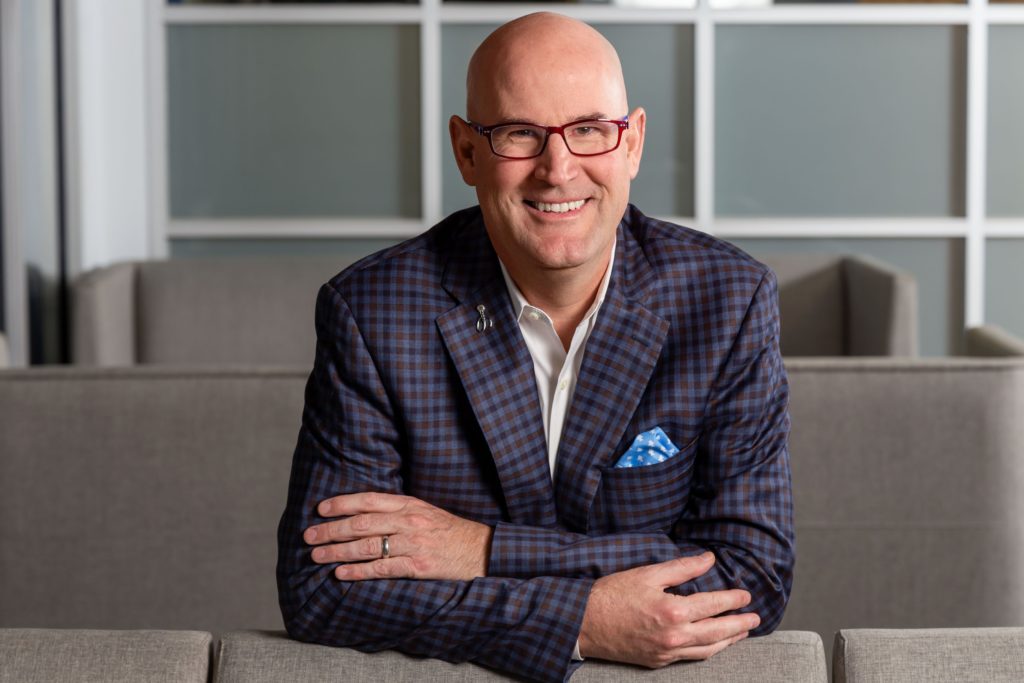
Stan Phelps

Stan Phelps walks the walk. He stands out in the sea of sameness by modeling his own Differentiated Experience (DX) message: Differentiation isn’t just about what you say, it’s about what you do and, more importantly, how and why you do it. Stan leverages his unique collection of 5,000+ case studies on customer, employee, and brand experience to engage audiences with informative learning-based experiences. He believes purposeful DX wins the hearts of employees and customers, and differentiation ultimately boosts loyalty, retention, referrals, and results.

Find Stan’s in-person and virtual keynotes, workshops, and Goldfish tank programs at StanPhelps.com.

Every dark cloud has a silver lining. We are emerging from a global pandemic into an enduring endemic. It’s important to reflect on how the crisis has impacted us in both life and work.

There is an exercise I’ve used as an icebreaker during workshops over the last two years. It’s called, “Silver Lining or Birdcage Lining.” Credit to fellow speaker Amy Climer, Ph.D., CSP for the idea.

I’m amazed every time I do it. Over 90% of the time participants pick something positive and focus on the good.

For me personally, the silver lining has been GOLF. Mark Twain once described the game as “a good walk spoiled.” For a while, I agreed with that sentiment. I had given up the game for over 10 years before the pandemic began. A combination of bad wrists (due to rheumatoid arthritis) and a lack of time (two young sons) sucked the joy out of the game. At age 40 I thought I played for the last time in Ireland with good friend Keith Green, APR.

The revival happened by accident. While spending a weekend in Savannah, my boys went to the gym. The gym for the resort was in the golf clubhouse. Soon I was receiving texts…. “Dad, come over to the range. They’ve given us clubs and balls.” I went over and gave my youngest a few tips. My oldest was only concerned about how far he could hit the ball.

While providing a few pointers . . . I hit a few balls. It didn’t hurt as bad as I feared. I even hit one or two really well. If you are a golfer🏌, you know the feeling I’m describing.

It’s now been 18 months and over 100 rounds of golf. Both of my boys have maintained interest (which is saying something for teenage boys).

I’m eternally grateful for the physical and mental benefits of the game.

Now I want to leverage GOLF as a way to give back to the community. On Monday, April 18th I will participate in a GOLF Marathon organized by the YMCA.

Starting at dawn, I’ll play 100 holes in one day at Governors Club in Chapel Hill to raise awareness and funds for the YMCA of the Triangle.  

If you’d like to support my effort, check out my giving page. But, that’s not the point of this post.

The point is to reflect on your silver linings…

To steal a quote from Brianna Wiest, “One day, the mountain that is in front of you will be so far behind you, it will barely be visible in the distance. But the person you become in learning to get over it will stay with you forever — and that is the point of the mountain.”

Follow me on Twitter or LinkedIn.

Stan Phelps

Stan Phelps walks the walk. He stands out in the sea of sameness by modeling his own Differentiated Experience (DX) message: Differentiation isn’t just about what you say, it’s about what you do and, more importantly, how and why you do it. Stan leverages his unique collection of 5,000+ case studies on customer, employee, and brand experience to engage audiences with informative learning-based experiences. He believes purposeful DX wins the hearts of employees and customers, and differentiation ultimately boosts loyalty, retention, referrals, and results.

Find Stan’s in-person and virtual keynotes, workshops, and Goldfish tank programs at StanPhelps.com.
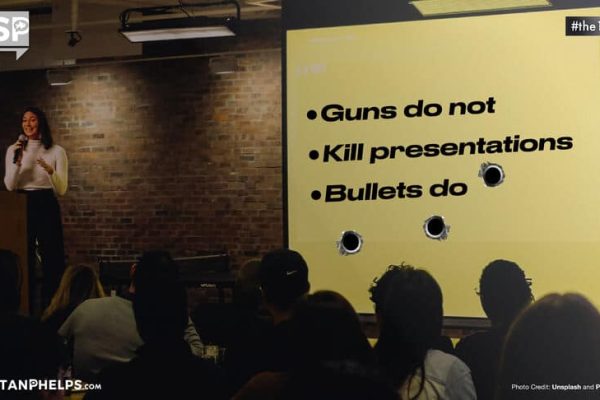
18 easy steps to create a KILLER PRESENTATION. These steps are contained in the S.I.L.V.E.R. grid method for presentation preparation.

The first three elements are about organizing:

S is for Starting:

We start with the big picture and why for our presentation. What’s in it for the audience? What’s the one thing they’ll remember?

I is for Illustrating:

Illustrating is about the construction of your presentation. How will you start? What are your three main points? And what’s your call to action when closing the presentation?

L is for Learning:

Learning is setting aside time to get comfortable with learning your presentation. Don’t put it off. Schedule time to outline, practice, and rehearse your presentation.

——————————–

The next three elements deal with the delivery of your presentation.

V is for Vaulting:

Vaulting is about starting your presentation strong. Specifically, how are you getting introduced, how you are dressed, and how you begin your presentation.

E is for Educating:

Educating is about the meat of your presentation… your key points. Is there are a magic number for key points? YES – THREE IS THE MAGIC NUMBER. For each key point, what’s the story, insight, and application/exercise?

R is for Requesting:

People tend to remember the last things you say. Make them count. Know how and when you’ll handle questions and comments. Know the story you will close with. Know the call to action at the end of your presentation.

Anything to add when preparing for a presentation?

Follow me on Twitter or LinkedIn.

Stan Phelps

Stan Phelps walks the walk. He stands out in the sea of sameness by modeling his own Differentiated Experience (DX) message: Differentiation isn’t just about what you say, it’s about what you do and, more importantly, how and why you do it. Stan leverages his unique collection of 5,000+ case studies on customer, employee, and brand experience to engage audiences with informative learning-based experiences. He believes purposeful DX wins the hearts of employees and customers, and differentiation ultimately boosts loyalty, retention, referrals, and results.

Find Stan’s in-person and virtual keynotes, workshops, and Goldfish tank programs at StanPhelps.com.
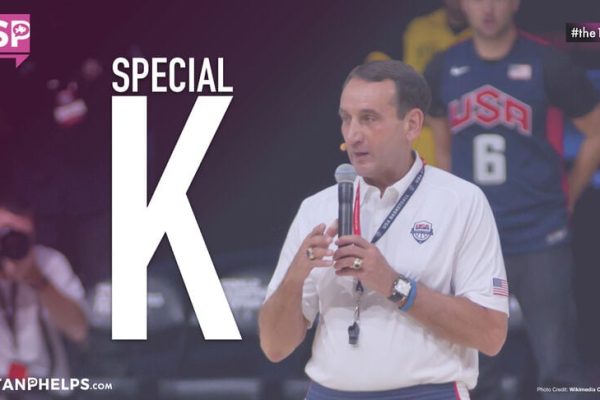
Three things Coach K can teach us about business.

First, we have to understand how Mike Krzyzewski became Coach K.

Mike played basketball under legendary coach Bobby Knight at West Point. Upon graduating in 1969, Mike began fulfilling his service commitment in Fort Carson, Colorado. In his off-duty hours, he would work out and play with the post basketball team. But his superior officer didn’t approve. The colonel told Mike, “No officer of mine is going to be wasting his time playing basketball.”

Then there was a little serendipity. General Rogers, the former commandant at West Point, was assigned to Fort Carson. The general asked Mike why he wasn’t playing and then according to Coach K,

“The general went to the colonel. ‘Why isn’t Lieutenant Krzyzewski playing on the post basketball team?’ he asked. ‘When the colonel responded that he just didn’t think it was good for an officer to participate, General Rogers replied: ‘Well, Colonel, the question is not, ‘Should Lieutenant Krzyzewski be playing basketball on our team.’ The question is, ‘Should we have a team?’ If the answer to that question is, ‘Yes, we should have a team,’ then we should have the best damn team we can possibly have.’ The colonel then agreed that the post should have a basketball team. ‘Well, Colonel,’ said the general, ‘then Lieutenant Krzyzewski will play basketball. And not only that, he will coach the team.'”

Lesson 1. Commit to being the best you can be

For our second lesson, we need to go back to Mike’s upbringing in a working-class Polish neighborhood in Chicago. His best friend was named Moe.

According to Mike,

“Moe went to Gordon Tech, which was our rival. But when we’d play Gordon, Moe was always cheering for me…Actually, he was the only guy in our group who had a car. And during the entire ride home, he’d tell me how great I was during the game. And when I got to the house, my mom would be waiting up-not to check on me but to talk to me a little bit…
Mom would tell me that I played a great game. ‘I’m very proud of you,’ she’d say over and over again… Anything that I felt good about, my mom and dad felt better about. Everything that I did was supported… In general, I’d like to think that what my mom felt about me, I can feel about the players on our Duke basketball team. If I can provide that kind of support system for our team where the managers feel good, the assistants feel good, the freshman feels good about the senior, and the senior about the sophomore, and so on…”

Lesson 2. Create a culture where everyone feels supported. Show your team that you care… and they will as well.

Each year the Duke team gathers to start the season. Coach K shares, “We have only one rule here: Don’t do anything that’s detrimental to yourself. Because if it’s detrimental to you, it’ll be detrimental to our program and to Duke.”

Coach K keeps it simple, “Too many rules get in the way of leadership.”

Lesson 3. Eliminate rules

Follow me on Twitter or LinkedIn.

Stan Phelps

Stan Phelps walks the walk. He stands out in the sea of sameness by modeling his own Differentiated Experience (DX) message: Differentiation isn’t just about what you say, it’s about what you do and, more importantly, how and why you do it. Stan leverages his unique collection of 5,000+ case studies on customer, employee, and brand experience to engage audiences with informative learning-based experiences. He believes purposeful DX wins the hearts of employees and customers, and differentiation ultimately boosts loyalty, retention, referrals, and results.

Find Stan’s in-person and virtual keynotes, workshops, and Goldfish tank programs at StanPhelps.com.

YOU CANʼT LOSE WHAT YOU DONʼT HAVE. When you present, your audience’s attention must be earned. And that starts with the very first words out of your mouth.

How you open is a critical component of any speaking engagement.

Forbes says that you make a first impression in just seven seconds. By the time you finish your first paragraph, they’ve already formed an opinion of you. If you’re, well … typical, then the opinion isn’t likely to be extraordinary.

The goal is to make a positive splash and have them ready to listen and excited to hear what you have to say.

If we only have seven seconds, then the pleasantries and throw-away phrases have got to go. No “I’m happy to be here today.” Drop the parade of “Thank you so much for . . . ” Quit telling them what you’re going to talk about. They either already know… or they don’t care. And for Pete’s sake (and everyone else not named Pete), don’t open with a joke you copied from the Internet. Just get to it.

But what is “it”? What is the opening that works for the presenter and audience alike?

You need a device that connects. That ability to connect is what makes an audience want to listen. Nothing does that better than a story. Stories transcend age, culture, and demographic to connect better than any other technique.

The opening of your story is critical. Think about your favorite book or movie. They NEVER open with “This is a story about . . . ” or “Let me tell you a story.” They introduce the setting and get to the conflict before the first chapter is over or the opening credits roll. “A long time ago, in a galaxy far, far away . . . ” (Star Wars) “It was the best of times, it was the worst of times . . . ” (A Tale of Two Cities) From the visual of the ball chasing Indiana Jones in “Raiders of the Lost Ark” or the simple uttering of “Rosebud” in “Citizen Kane,” the audience’s interest is piqued. You have far too much at stake to ramble on. Get to it! Quickly! 

Don’t finish a presentation and think, “Geez, I lost their attention somewhere during my presentation.” Win that attention from the start with a compelling story. Because… you can’t lose what you never had.

Follow me on Twitter or LinkedIn.

Stan Phelps

Stan Phelps walks the walk. He stands out in the sea of sameness by modeling his own Differentiated Experience (DX) message: Differentiation isn’t just about what you say, it’s about what you do and, more importantly, how and why you do it. Stan leverages his unique collection of 5,000+ case studies on customer, employee, and brand experience to engage audiences with informative learning-based experiences. He believes purposeful DX wins the hearts of employees and customers, and differentiation ultimately boosts loyalty, retention, referrals, and results.

Find Stan’s in-person and virtual keynotes, workshops, and Goldfish tank programs at StanPhelps.com.

Should we pay job candidates to interview? FoodShare Toronto thinks so. The non-profit organization began paying job applicants $75 per interview.

CEO Paul M. Taylor told CTV News Toronto, “I think employers have gotten off scot free for far too long by expecting candidates to bear the costs of an interview. We recognize that people sometimes have to take time off work to go for an interview. People have to commute, pay for transit or get childcare and we think employers should and should be paying for that.”

And its not just the interview…

FoodShare says that any time a candidate is asked to prepare a presentation or assignment for an interview, they will financially compensate the candidate for that work at a rate equal to the hourly rate for the position, based on the number of hours the hiring committee believes the task should take.

What’s your take on this new policy?

Here’s mine: I think it is admirable. You are showing that you value the time of your potential employee and that you recognize the costs involved with interviewing.

In a time when employers are struggling for quality candidates, this becomes a differentiator. Doing this little extra is also a harbinger. How you manage the recruiting of a new employee speaks volumes about the culture of your organization.

Follow me on Twitter or LinkedIn.

Stan Phelps

Stan Phelps walks the walk. He stands out in the sea of sameness by modeling his own Differentiated Experience (DX) message: Differentiation isn’t just about what you say, it’s about what you do and, more importantly, how and why you do it. Stan leverages his unique collection of 5,000+ case studies on customer, employee, and brand experience to engage audiences with informative learning-based experiences. He believes purposeful DX wins the hearts of employees and customers, and differentiation ultimately boosts loyalty, retention, referrals, and results.

Find Stan’s in-person and virtual keynotes, workshops, and Goldfish tank programs at StanPhelps.com.
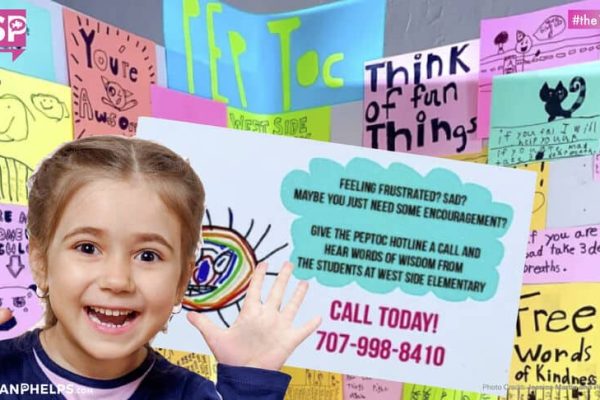
Take a minute. Call +1 (707) 998-8410 and you’ll hear, “If you’re feeling mad, frustrated or nervous, press 1. If you need words of encouragement and life advice, press 2. If you need a pep talk from kindergartners, press 3. If you need to hear kids laughing with delight, press 4.”

This is the menu you get when you call the PEPTOC Hotline.  PEPTOC is a project from the students of West Side Elementary, a school in the small town of Healdsburg, California in Sonoma County.

Big thanks to Ekaterina Walter for sharing the project yesterday on LinkedIn.

But huge credit goes to art teachers Jessica Martin and Asherah Weiss. Both helped put the program together with the hope that there is something we can all learn from these kids.

Martin shared to NPR, “Their creativity and resourcefulness is something that we need to emulate, because that level of joy and love and imagination is what’s going to save us in the end.”

Two bits of advice caught my attention when I chose option #2 to receive some words of encouragement and advice. It was very Pink Goldfishesque:

“Choose weird”

“It’s OK to be different.”

What was your favorite piece of advice?

Follow me on Twitter or LinkedIn.

Stan Phelps

Stan Phelps walks the walk. He stands out in the sea of sameness by modeling his own Differentiated Experience (DX) message: Differentiation isn’t just about what you say, it’s about what you do and, more importantly, how and why you do it. Stan leverages his unique collection of 5,000+ case studies on customer, employee, and brand experience to engage audiences with informative learning-based experiences. He believes purposeful DX wins the hearts of employees and customers, and differentiation ultimately boosts loyalty, retention, referrals, and results.

Find Stan’s in-person and virtual keynotes, workshops, and Goldfish tank programs at StanPhelps.com.
I’ll never forget watching a YouTube video of a Killer Whale taking on a Great White Shark off the coast of California. It grabbed the shark … flipped it upside down … and then proceeded with the kill. The Killer Whale only took only one chunk of the shark. It extracted the liver.

That whale intuitively knew the nutritional value of the liver. It contains several times the recommended daily allowance of vitamins such as Vitamin A, and Vitamin B12. It is also a great source of Riboflavin, Folate, and Iron.

But if we are being honest, it doesn’t matter how nutritious or energizing any liver is. That is if the smell and texture of beef liver make you want to throw-up in your mouth. Just writing this is bringing some unpleasant memories as a child at our dinner table.

Can you fixed a flawed food? A wise man once told me that you can’t make chicken salad out chicken sh*t. Or can you…

ENTER CARNIVORE AURELIOUS

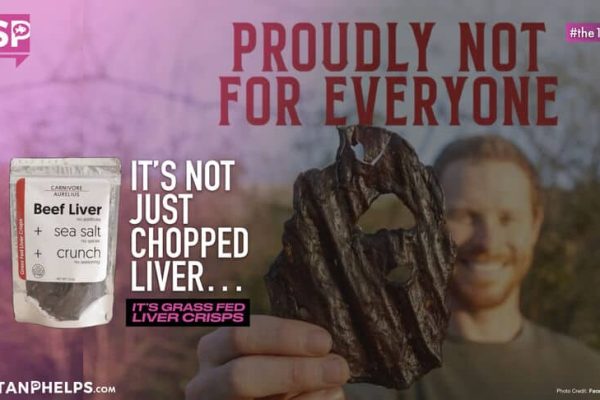
Carnivore Aurelious was started back in 2018 with the goal of restoring the world’s love for meat. They took on the challenge of beef liver. Meat that is hard to find, cook, and prepare. Their solution was to slice it up and create liver crisps. Just imagine if a potato chip and jerky had a baby.

They claim to make the first beef liver product that actually tastes good. How did they do it? Did they add in other ingredients, seasonings, or flavors? No, they didn’t. They just added the right amount of sea salt.

Big thanks to my “Pink Goldfish 2.0” co-author David Rendall for sharing one of their Facebook ads. I love the caption, “PROUDLY NOT FOR EVERYONE.”

Carnivore Aurelius is an excellent example of a Pink Goldfish. They personify an approach that accentuates the flaws of their product. They are unapologetic and flaunt that it’s not for everyone. They’ve withheld from doing the “normal” things to mask the taste of their product. In short, they are flawsome.

Would you try liver crisps? After all, it’s not just chopped liver…

Follow me on Twitter or LinkedIn.

Stan Phelps

Stan Phelps walks the walk. He stands out in the sea of sameness by modeling his own Differentiated Experience (DX) message: Differentiation isn’t just about what you say, it’s about what you do and, more importantly, how and why you do it. Stan leverages his unique collection of 5,000+ case studies on customer, employee, and brand experience to engage audiences with informative learning-based experiences. He believes purposeful DX wins the hearts of employees and customers, and differentiation ultimately boosts loyalty, retention, referrals, and results.

Find Stan’s in-person and virtual keynotes, workshops, and Goldfish tank programs at StanPhelps.com.

Past is prologue. Back in 1999, Boris Yeltsin was serving his 8th year as President of Russia.
 
The beleaguered leader was facing corruption investigations and needed political cover. After two unsuccessful hires, he wanted someone he could trust.
 
Yeltsin named the unknown Vladimir Putin as Prime Minister in August.
 
A former KGB intelligence officer, Putin was not well known. At the time, he was polling at just 2% as a possible presidential candidate.
 
Within one month of his appointment, there were a series of apartment bombings in Russia. Over 300 Russians die as a result of the blasts and panic ensues. Putin blames the bombings on Chechen rebels.
 
Within days, Putin leads the military effort to invade Chechnya. He starts the 2nd Chechen War. He boldly declares, “We will pursue the terrorists everywhere. If they are in an airport, then in an airport. And forgive me– if we catch them in the crapper, then we’ll rub them out in the crapper.”
 
But were the Chechens to blame for the bombings?
 
There is an excellent episode of “This American Life” on NPR that disputes this notion. They provide a variety of evidence that the bombings were organized by the Russian Security Service FSB. 
 
The show cites the lack of motive by the Chechens, the difficulty of accessing hexogen, and a botched bombing attempt in Ryazan by FSB agents. All signs point to a potential inside job.
 
My favorite piece of evidence involves the Speaker of the Russian Parliament. Gennadiy Seleznyov addressed the third bombing in a speech to Parliament but got the name of the city wrong. Seleznyov was in Moscow and the bombing was in Moscow. But he said the bomb went off in Volgodonsk, a small southern city 700 miles away.
 
Maybe he just got mixed up? Except that three days later an apartment building in Volgodonsk was blown up. Oop.
 
Fast forward to December. Putin is the face of the military campaign in Chechnya. His popularity is rising.
 
On New Year’s Eve, Boris Yeltsin shocks the world. He announces his retirement and names Putin as acting President.
 
Putin’s very first presidential decree in 2000 is to stop all the corruption investigations into Yeltsin.
 
The elections are supposed to be in June. Instead, Putin moves them up to March. The other political parties scramble to organize, but Putin wins 53% of the vote to become President. As President or PM, Putin has been in control for over 22 years.
 
Less than three weeks ago, Russia invaded Ukraine. Justifying the attack as a liberating move to denazify the Ukrainian government.
 
Russian forces have bombed apartment buildings in the effort. Russian state TV is falsely blaming the Ukrainian government for the blasts. Accusing Ukraine of committing war crimes against its own citizens. 
 
Now the bombed-out apartment buildings are in Kyiv and Mariupol, not Moscow or Volgodonsk. Past is prologue.

Follow me on Twitter or LinkedIn.

Stan Phelps

Stan Phelps walks the walk. He stands out in the sea of sameness by modeling his own Differentiated Experience (DX) message: Differentiation isn’t just about what you say, it’s about what you do and, more importantly, how and why you do it. Stan leverages his unique collection of 5,000+ case studies on customer, employee, and brand experience to engage audiences with informative learning-based experiences. He believes purposeful DX wins the hearts of employees and customers, and differentiation ultimately boosts loyalty, retention, referrals, and results.

Find Stan’s in-person and virtual keynotes, workshops, and Goldfish tank programs at StanPhelps.com.

1 11 12 13 14 15 48
A simple illustration of a purple fish facing right on a plain background.

I've had the pleasure of working with teams at:

Three purple fish silhouettes swimming to the right on a dark background.

Find Your Best-Match Program

With over 18 possible keynote speaking presentations, workshops, and GOLDFISH TANK programs available to meet your ever-evolving needs, I’ve created this 2-minute, 6-question quiz to help you understand which program is best for you and your audience.

Meet Your Presenter

Through keynote speaking presentations, hands-on workshops, and GOLDFISH TANK programs, I empower you to power loyalty and growth.

Hi, I’m Stan Phelps. I work with organizations that want to increase loyalty, drive sales, and promote positive word-of-mouth by creating differentiated experiences.

As an author, keynote speaker, and workshop facilitator, my in-person and virtual programs stand out in a sea of sameness because I model my own message of differentiated experience (DX).

I leverage my unique collection of more than 5,500 case studies on customer, employee, and brand experience to engage audiences with practical ideas that inspire action.

A person wearing glasses and a gray quarter-zip sweater stands outdoors in front of a building with a triangular glass roof at dusk.

Every time we do business together, Something amazing happens in the world!

Through my partner B1G1, each program gives back to create global IMPACT

Two students in blue uniforms smile while washing their hands at an outdoor tap.

When we complete a GOLDFISH TANK, we give 1001 days of clean water to school children

Collage of three images: a person washing hands, a child drawing with colored pencils, and a group of people sitting outdoors with some raising their hands.

When we complete a GLOBAL engagement, we give 365 days of clean water access in Peru, 120 days of learning aids in Malaysia, and 50 days of business training for women in Malawi

Hand placing a brick on a surface with text: "One Book = One Brick" and an Amazon logo.

When someone downloads a GOLDFISH eBook, we give one brick toward building school facilities in Cambodia