
Stan Phelp's Blog

The Goldfish Chronicles

Sharing insights on customer experience, employee engagement, and brand strategy.

The SILVER BULLET to be a great presenter is ,..

It is the magical elixir and the simple solution for the difficult problem of presenting well …

There is no silver bullet.

It takes thought, work, and the ability to be different to stand out in a sea of sameness. No one was born with the ability to wow an audience.

It’s a learned behavior. It’s a skill. Those who work at it become better than those who don’t.

Presenting well is not terribly complicated, but it is incredibly difficult.

Those who master the skill will reap the rewards of audience attention, engagement, and response. Frequently that mastery results in opportunities and promotions. 

The good news is that becoming a great presenter is attainable for anyone who is willing to work at it.

Just like driving, just like time management, just like golf, and just like being a good parent. But working at it … and doing it more is not the same thing.

Spending 10 years flipping burgers does not make you a master chef. It means you spent a decade doing something we can train a teenager to do in 15 minutes. 

TWO SIMPLE TRUTHS TO BECOMING A GREAT PRESENTER

The first simple truth is that your audience needs to hear you.

There are lots of distractions competing for their attention. Their phone may be the biggest. You need to be “Loud.” We’re not talking about your voice’s volume, although that also may be an issue, but about the compelling nature of making people want to tune in to what you are saying.

Next, what you say needs to be crystal clear. This isn’t about your diction or your microphone. This is about a transfer of a message. No confusion. No misinterpretation. No misquoting later on.

Two truths and three simple words:

Loud. And. Clear.

Again, there is no silver bullet. In the words of Matthew Oliphant,

“There is no silver bullet and frankly you probably don’t need one. It is far more important to be able to find the right kind of gun, be able to load the gun . . . and perhaps most importantly, be able to figure out where the werewolf is.”

The werewolf represents your upcoming presentation.

Follow me on Twitter or LinkedIn.
Stan Phelps

Stan Phelps walks the walk. He stands out in the sea of sameness by modeling his own Differentiated Experience (DX) message: Differentiation isn’t just about what you say, it’s about what you do and, more importantly, how and why you do it. Stan leverages his unique collection of 5,000+ case studies on customer, employee, and brand experience to engage audiences with informative learning-based experiences. He believes purposeful DX wins the hearts of employees and customers, and differentiation ultimately boosts loyalty, retention, referrals, and results.

Find Stan’s in-person and virtual keynotes, workshops, and Goldfish tank programs at StanPhelps.com.
What’s the biggest gift you can give your audience as a presenter…

It’s being present. You can’t spell the word presentation without “present.” OK, so we’re not talking about the “gift” kind of presents. But the “being present IN the moment” form of presence.

Perhaps the best advice on presence comes from Patsy Rodenburg. Rodenburg is a renowned British voice coach, author, and director. Patsy is renowned for her emphasis on expression and the primacy of the human voice. She established a framework called the “Second Circle.”

According to her presentation at TED, it’s a “state of mind and body where confident, relaxed control allows us to establish intimacy and human connection where and when we want it.”

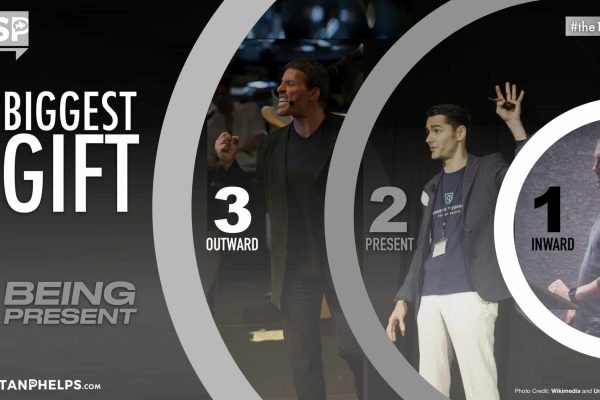
Rodenburg describes three kinds of presence when we speak: first circle, second circle, and third circle.

First circle presenters focus their energy inward. They are in their own head. Absorbed in their own thoughts and words, they minimize eye contact. They don’t connect.

In contrast, third circle presenters are bombastic and over-the-top. They focus their energy outward in order to dominate. They are loud and forceful. They can come across as telling rather than presenting. They might grab attention, but they might cause the audience to tune them out.

In between the first and third circle is the second circle. Second circle presenters have the right balance between self-awareness and being commanding. This is the ideal place you want to be when presenting. It’s the right mix of connecting with the audience and expressing yourself. It’s being present.

TIP (To Improve Presentations) – Achieve the right balance when presenting. Spend the majority of your time in the second circle. Be present . . . it’s the greatest gift you can give your audience.

Follow me on Twitter or LinkedIn.

Stan Phelps

Stan Phelps walks the walk. He stands out in the sea of sameness by modeling his own Differentiated Experience (DX) message: Differentiation isn’t just about what you say, it’s about what you do and, more importantly, how and why you do it. Stan leverages his unique collection of 5,000+ case studies on customer, employee, and brand experience to engage audiences with informative learning-based experiences. He believes purposeful DX wins the hearts of employees and customers, and differentiation ultimately boosts loyalty, retention, referrals, and results.

Find Stan’s in-person and virtual keynotes, workshops, and Goldfish tank programs at StanPhelps.com.

A flawed painting of Marilyn Monroe by Andy Warhol may auction for $200 million in May.

Flawed? How?

The late performance artist Dorothy Podber was visiting “The Factory” in 1964. While in Warhol’s art studio, she asked Andy if she could shoot some of his paintings. Warhol assumed she was referring to a camera and consented.

Podber then put on a pair of black gloves and pulled a small pistol out of her purse. She blasted a nearby stack of Monroe silkscreen paintings. According to Warhol’s friend and photographer Billy Name, she struck “Marilyn right between the eyes.”

These four paintings were marred by a bullet hole. Only the turquoise one in the Series was spared. It sold for $80 million back in 2007. It turns out the flawed ones (even though Warhol tried to cover up the bullet holes) are more awesome.  It has been estimated that the financier Kenneth Griffin bought the Shot Orange Marilyn for $250 million.

“Shot Sage Blue Marilyn” is being offered for auction by the Thomas and Doris Ammann Foundation. The charity will use the proceeds of the sale to fund health and education programs for children worldwide.

What can we learn from the late Andy Warhol about differentiation?

Warhol was a masterful prolific artist. Netflix currently has a great limited series documentary on the artist called, “THE Andy Warhol DIARIES.”

Andy understood the importance of standing out. One strategy he used was lopsiding. Take an approach that made him unique and then triple down on it.

In 1961, the relatively unknown Warhol believed he was about to break through. He had created a batch of paintings inspired by comic books. The problem was that Roy Lichtenstein beat him to the punch. Andy needed a new idea. The interior designer Muriel Latow recommended that he make paintings of money. That idea cost Warhol 50 bucks.

Latow then tossed in a second idea for lagniappe. It was one word… Campbell’s. A year later Warhol did an entire exhibit of 32 Campbell’s soup can paintings in Los Angeles. Pop art was born.

Using the technique of silkscreening, it is estimated that the artist from Pittsburgh (with the help of assistants) created over 85,000 works during his life.

So, how is it that these Warhol Marilyn’s are so coveted?

It turns out that Warhol swerved from his normal mass production process for these 1964 portraits. Andy developed a more refined and time-intensive process for creating these works. This technique turned out to be so difficult that the artist soon abandoned it.

Warhol realized he was a brand. He stood out by being flawsome. In the words of restauranteur Mr. Chow, “The master hide’s one’s weakness. The Grand Master uses his weakness. He (Warhol) is a grand master. Bad skin… bad hair, he uses all of his weaknesses.”

In Warhol’s words, “Being good in business is the most fascinating kind of art. Making money is art and working is art and good business is the best art.”

Follow me on Twitter or LinkedIn.

Stan Phelps

Stan Phelps walks the walk. He stands out in the sea of sameness by modeling his own Differentiated Experience (DX) message: Differentiation isn’t just about what you say, it’s about what you do and, more importantly, how and why you do it. Stan leverages his unique collection of 5,000+ case studies on customer, employee, and brand experience to engage audiences with informative learning-based experiences. He believes purposeful DX wins the hearts of employees and customers, and differentiation ultimately boosts loyalty, retention, referrals, and results.

Find Stan’s in-person and virtual keynotes, workshops, and Goldfish tank programs at StanPhelps.com.
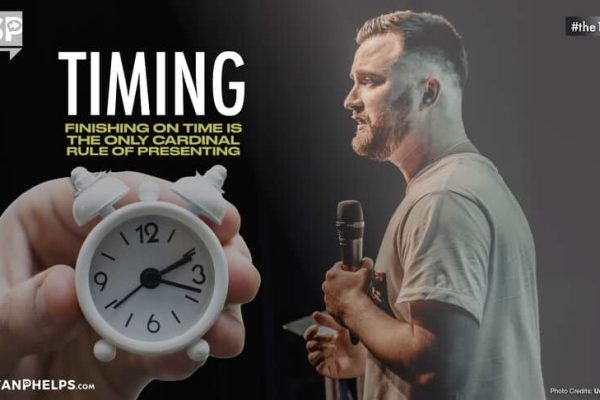
It’s the only cardinal rule of presenting. And doing THIS has the potential of ruining a great presentation.

It’s going OVER. When your allotted time is up, you need to be done. Nothing is more egregious than stealing time from the audience.

There is rarely, if ever, an excuse for going over the presentation time you’ve been allotted. 

It doesn’t matter why. There are NO excuses:

– It doesn’t matter if you started late.

– It doesn’t matter if you have more content to share.

– It doesn’t matter if someone or something hijacked your presentation.

Unfortunately there’s no Academy Awards music to play you off when your time is up. You can always finish early, but you should never go over. Of course, that means you, the presenter, need to know the time. 

In “Silver Goldfish” Alan Hoffler and I share four hacks to help you adhere to the Cardinal Rule of timing:

1. There is an app for that. Get a timer for your phone, watch, or tablet that vibrates.

2. Go analog. Have someone at the back of the room with three signs or hand gestures: 5 (minutes), 2 (minutes), and a big fat zero (STOP!).

3. Click it. Buy a clicker that has a timer built-in.

4. If you have slides, use presenter mode on your laptop. Presenter mode has a clock.

What’s your hack?

Takeaway – The key to life, to humor, and to finishing presentations is…

TIMING.

Follow me on Twitter or LinkedIn.

Stan Phelps

adidas teams up with a Georgia icon this week. The result: a masterfully sweet-looking golf shoe.

Move over Augusta National… enter the TOUR360 22 x Waffle House – truly a golf shoe unlike any other. A shoe that would make Nike‘s co-founder, the late Bill Bowerman, proud.

The University of Oregon track coach Bowerman infamously used a waffle iron to make the sole of Nike’s first track shoe.

The Oregonian / OregonLive.com shared a quote from Barbara Bowerman. Barbara told a Nike historian that she and Bill were contemplating how to handle the new artificial surface on the track,

“We were making the waffles that morning and talking about (the track). As one of the waffles came out, he said, ‘You know, by turning it upside down — where the waffle part would come in contact with the track — I think that might work… So he got up from the table and went tearing into his lab and got two cans of whatever it is you pour together to make the urethane, and poured them into the waffle iron.”

This type of ingenuity was similar to that of Adolf (nicknamed Adi) Dassler. He began making athletic shoes in the family washroom back in the 1920s.

In the 1930s, Adi had a huge break. He wordlessly presented a young American with a pair of spikes at the Berlin Olympics.

Jesse Owens wore the distinctive dark shoes with two leather strips on the sides. He would shock the world and win four gold medals.

Wait, two stripes? Yes, two. Those two leather stripes were integrated with the laces. They functionally helped keep your foot in the shoe. Years later Adi and his older brother Rudy would find that two strips weren’t enough… and added a third.

Back to the golf shoes. Global footwear director for adidas Golf Masun Denison shared the reasoning behind the weird partnership,

“We love this time of year because more than anything else it’s an unofficial start to the golf season for everyone. Waffle House is such a well-known restaurant in Georgia and throughout the U.S., we knew it would be fun to partner with their team on a design that brings a piece of the famous restaurant to everyone, all in our flagship silhouette (shoe).”

Kudos to my brother-in-law Micky Baehr for sharing the story with me. The Mick-ster knows I both worked for the brand with three stripes for 8 years and I’m borderline golf obsessed.

I’m guessing that Walt Ehmer might also share my love for the game. The Waffle House, Inc. CEO gushed, “Who knew our famous, sweet cream waffles could also be so much fun to wear?”

adidas began taking orders yesterday (April 7th) for the limited-edition cobranded shoes. Even the shoebox is a little microweird. It is designed to look like a Waffle House.

For background, Waffle House began in 1955 when Joe Rogers Sr. and Tom Forkner decided to open a 24-hour, sit-down restaurant in Georgia. Today, there are 1900 restaurants in 25 states. All of which lopside their hours. They are open 24/7/365.

Follow me on Twitter or LinkedIn.

Stan Phelps

Stan Phelps walks the walk. He stands out in the sea of sameness by modeling his own Differentiated Experience (DX) message: Differentiation isn’t just about what you say, it’s about what you do and, more importantly, how and why you do it. Stan leverages his unique collection of 5,000+ case studies on customer, employee, and brand experience to engage audiences with informative learning-based experiences. He believes purposeful DX wins the hearts of employees and customers, and differentiation ultimately boosts loyalty, retention, referrals, and results.

Find Stan’s in-person and virtual keynotes, workshops, and Goldfish tank programs at StanPhelps.com.

Warning: this can be painful…. and that’s why most people avoid it. But, don’t fall victim to not putting in the time. 

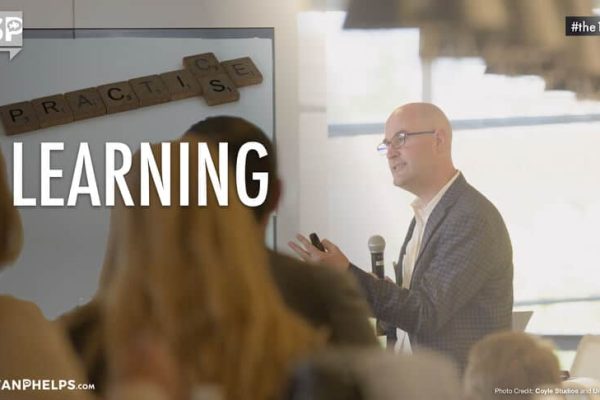
If you want to deliver an engaging presentation, you need to invest in practicing and rehearsing. 

It’s the L in the S.I.L.V.E.R. methodology. L stands for learning.

Here are some tips to be more effective when learning your presentation.

First, rehearse out loud and try to mimic your actual setting for the presentation. Are you standing or sitting? Ditch standing in front of a mirror.

Second, know the difference between practicing and rehearsing. 

Practice…

To quote Hall of Famer Allen Iverson, we talking about practice. Practice allows you to work on shorter sections of your presentation. Just like a basketball player will practice key elements of their game…. like free-throws and lay-ups, there are two specific areas you should focus on.

In “Silver Goldfish: Loud & Clear: 10 Keys to Delivering Memorable Business Presentations” Alan Hoffler and I recommend practicing your beginnings and endings.

Practice the open and close of your presentation at least twice as much as the middle. Think of practice along the lines of flying a plane. 

When are planes most likely to crash? 

Most accidents occur during take-offs and landings. Take the extra time to prepare, practice, and nail your opening and closing.

– What’s your opening story? 

– How are you closing and what’s your call to action? 

Don’t forget the old New York City joke. A tourist stops a New Yorker on the street and asks, “Excuse me, how do you get to Carnegie Hall?” The New Yorker thinks for a second and responds, “Practice, practice, practice.”

In contrast to practicing, rehearsing is running through your presentation from beginning to end. This is important from a timing perspective but more critical for establishing familiarity.

Ideally, you should rehearse your presentation at least three times. Only after that third or fourth run-through will you start to feel comfortable. 

And you want to be comfortable. This comfort level allows you to get out of your head and be more present with the audience when presenting.

What are your tips and techniques for learning?

Follow me on Twitter or LinkedIn.

Stan Phelps

Stan Phelps walks the walk. He stands out in the sea of sameness by modeling his own Differentiated Experience (DX) message: Differentiation isn’t just about what you say, it’s about what you do and, more importantly, how and why you do it. Stan leverages his unique collection of 5,000+ case studies on customer, employee, and brand experience to engage audiences with informative learning-based experiences. He believes purposeful DX wins the hearts of employees and customers, and differentiation ultimately boosts loyalty, retention, referrals, and results.

Find Stan’s in-person and virtual keynotes, workshops, and Goldfish tank programs at StanPhelps.com.
Finish this sentence. Anything that can go wrong…

… will go wrong. It’s known as Murphy’s Law. It is a law you need to be aware of when presenting. Just ask comedian Chris Rock.

OK, so who is this Murphy character?

Capt. Edward Murphy was an engineer working on an Air Force Project. Project MX981 was designed to see how much sudden deceleration a pilot could withstand in a crash. One day, after finding that a transducer was wired wrong, he cursed the technician responsible, “If there is any way to do it wrong, he’ll find it.”

If Murphy’s Law is inevitable when presenting, what can you do? For example, at some point in your presenting career Murphy will appear and your slides will disappear due to no fault of your own.

The one thing you can do is to prepare. When I present, I always have a one-page list in my pocket. Written with a sharpie, it looks like a setlist for a band. At any point, I can pull it out and have no problem staying on track. If I’m giving a virtual presentation, I use a technique I learned from Laura Bergells. Laura calls it the turkey tail. Imagine a series of post-it notes that frame your monitor.

How about sound? What happens if your lavalier microphone dies or starts to intermittently cut out. No problem, always have a handheld microphone nearby.

Setbacks happen. Something is going to slap you in your face to rock your presentation. It’s how you respond. There are four typical responses. Think of it like a bullseye.

One reaction or the outer ring may be the worst. It’s called tanking. We give up and don’t try to cope. This is a flight response. The mindset here is that if we don’t try or if we find others to blame, then it doesn’t feel that bad. Presenters here either quit or mail it in.

Another response and next ring in is anger. This is a fight response. You get mad. But it’s hard to perform effectively when we are angry. It’s better than tanking, because at least you care.

A third response and the innermost ring is to try too hard. This is caring too much. You are too much in your own head. In sports, this is called choking. We get so wrapped up in the effort and the result that we fail to perform in the moment.

The last approach and the bullseye is the ideal response. It’s what sports psychologists call the challenge-response. We stay in the moment and see everything not as a problem but as a challenge to be overcome. Here the obstacle is truly the way.

TIP (To Improve Presentations) – Choose the Challenge-Response. When you can do this, you are able to present and work through whatever Murphy throws your way. You aren’t wrapped up in the result, and you are confident that you are giving your best under the circumstances. Often, you will gain a deeper rapport with your audience when you address the issue appropriately.

Follow me on Twitter or LinkedIn.

Stan Phelps

Stan Phelps walks the walk. He stands out in the sea of sameness by modeling his own Differentiated Experience (DX) message: Differentiation isn’t just about what you say, it’s about what you do and, more importantly, how and why you do it. Stan leverages his unique collection of 5,000+ case studies on customer, employee, and brand experience to engage audiences with informative learning-based experiences. He believes purposeful DX wins the hearts of employees and customers, and differentiation ultimately boosts loyalty, retention, referrals, and results.

Find Stan’s in-person and virtual keynotes, workshops, and Goldfish tank programs at StanPhelps.com.

Should you use visuals when you present? It depends. The single biggest reason for using visuals is…

MEMORABILITY

When you present, the goal is for your message to come across “loud” and “clear” to your audience. Merely finishing the presentation isn’t the goal. 

Our objective is to share the message in a way that’s remember-able.

COMMUNICATION success only happens when the AUDIENCE can repeat your central idea in their own words.

Our ability to recall a message is enhanced by up to 650 percent when we use visuals. Let me share that again. Our ability to recall a message is enhanced by up to 650 percent when we use visuals… Six hundred and fifty percent.

Why such a big bump?

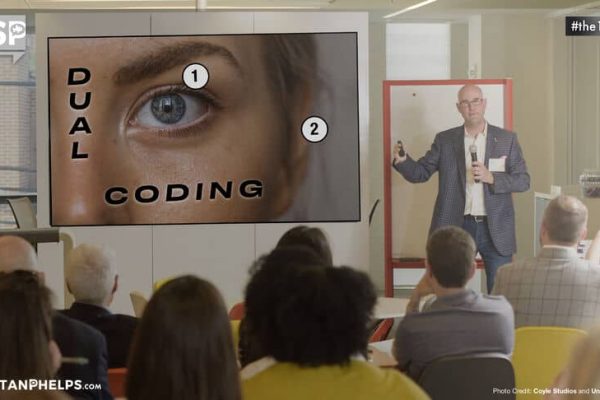
It’s because of a principle called the Picture Superiority Effect. 

The picture superiority effect refers to the fact that pictures and images are more likely to be remembered than merely words alone. 

It is grounded in the notion that the human memory is extremely sensitive to the symbolic modality of how information is presented.

It’s called dual-coding. Using both creates both verbal and image codes, whereas word stimuli only generate a single verbal code.

If you only hear something … three days later recall is 10 percent.

Hear words and add an image… three days later recall is upwards of 65 percent.

So, should you use images when present?

The answer is only if you want to enhance the ability of your audience to remember your message or call to action.

… And there is no excuse not to use great images. Here are three amazing places to go for high quality, free images:

Unsplash[dot]com
Gratisography[dot]com
Pixabay[dot]com

What’s your go-to place for images?

Follow me on Twitter or LinkedIn.

Stan Phelps

Stan Phelps walks the walk. He stands out in the sea of sameness by modeling his own Differentiated Experience (DX) message: Differentiation isn’t just about what you say, it’s about what you do and, more importantly, how and why you do it. Stan leverages his unique collection of 5,000+ case studies on customer, employee, and brand experience to engage audiences with informative learning-based experiences. He believes purposeful DX wins the hearts of employees and customers, and differentiation ultimately boosts loyalty, retention, referrals, and results.

Find Stan’s in-person and virtual keynotes, workshops, and Goldfish tank programs at StanPhelps.com.
What’s the ONE thing that can derail a presentation? It’s not visuals, it’s the overuse of . . .

TEXT

Text can kill your presentation. There is a funny saying about presentations. Let me spell it out for you in eight words:

– Guns do not 
– Kill presentations
– Bullets do 

This saying is an adaptation of a famous quote. In 1993, Senator Daniel Patrick Moynihan proposed a huge tax increase on the most vicious types of ammunition. He pointed out that, unlike guns, ammunition doesn’t last forever. 

“Guns don’t kill people,” Moynihan said, “bullets do.”

Let’s examine the four biggest mistakes when using bullets:

The first is the simple mistake of overusing them.

The second is the mistake of bringing them in all at once. Because what happens while you are speaking to the first bullet?…… The audience is already skipping ahead and ignoring you.

Reading your bullets word for word is the third mistake. Don’t insult the intelligence of your audience. On average, they can read four times faster than you speak. And know that people who can read… 
cannot not read.

The fourth mistake is using full sentences with your bullets. Or, the cardinal sin of multiple sentences in one bullet. Uggghh!

Here is the ideal tip for effective slide design. Don’t use bullets. And if you can help it, don’t use words.

But if you do use text, here are four general principles that Alan Hoffler and I share in the book, “Silver Goldfish – Loud & Clear: 10 Keys to Delivering Memorable Business Presentations.”

First, keep text to a minimum. No more than 16 words on a slide 
and no less than 30 point size for your font.

Second, speaking of fonts, pick a good one to use. Ditch the default font. I’m a big fan of Futura.

Third, AVOID THE BOTTOM of the slide.  Be mindful that text on the bottom-third of a slide may get cut off by people’s heads. Don’t put anything that’s important on the bottom of the slide. Hat tip to slide guru Wendy Gates Corbett, MS, CPTD for this tip.

Fourth, UNDERSTAND CONTRAST. Place light-colored text on a dark background and darker text on a light background. Note that lighter text on a dark background pops better. 

In summary, for illustrating your presentation, limit text and put more power in your PowerPoint. 

Follow me on Twitter or LinkedIn.

Stan Phelps

Stan Phelps walks the walk. He stands out in the sea of sameness by modeling his own Differentiated Experience (DX) message: Differentiation isn’t just about what you say, it’s about what you do and, more importantly, how and why you do it. Stan leverages his unique collection of 5,000+ case studies on customer, employee, and brand experience to engage audiences with informative learning-based experiences. He believes purposeful DX wins the hearts of employees and customers, and differentiation ultimately boosts loyalty, retention, referrals, and results.

Find Stan’s in-person and virtual keynotes, workshops, and Goldfish tank programs at StanPhelps.com.

T-Mobile started it three weeks ago. Free calls to and from Ukraine.

The Seattle based carrier decided to waive any fees associated with international long-distance and international roaming on calls and text messages made between the U.S. and Ukraine. 

They shared in a statement that, “This includes calls made within Ukraine to local numbers to cover roaming customers in Ukraine.”

One day later, AT&T and Verizon joined in the effort. Free calls will last for the next week or so.

Great job of paying it forward to help customers and their families during the conflict.

Manon Brouillette, executive vice president and CEO of Verizon Consumer Group summed up why they made the move, “During these challenging times, customers need to stay connected with loved ones in Ukraine…Waiving long distance charges for customers calling Ukraine will help them focus on what matters: communicating with family and loved ones.”

Big thanks to Amanda Jeffers for sharing the news with me. I applaud the big 3 carriers for thinking beyond the transaction and doing the little extra to honor the customer relationship.

Follow me on Twitter or LinkedIn.

Stan Phelps

Stan Phelps walks the walk. He stands out in the sea of sameness by modeling his own Differentiated Experience (DX) message: Differentiation isn’t just about what you say, it’s about what you do and, more importantly, how and why you do it. Stan leverages his unique collection of 5,000+ case studies on customer, employee, and brand experience to engage audiences with informative learning-based experiences. He believes purposeful DX wins the hearts of employees and customers, and differentiation ultimately boosts loyalty, retention, referrals, and results.

Find Stan’s in-person and virtual keynotes, workshops, and Goldfish tank programs at StanPhelps.com.

1 10 11 12 13 14 48
A simple illustration of a purple fish facing right on a plain background.

I've had the pleasure of working with teams at:

Three purple fish silhouettes swimming to the right on a dark background.

Find Your Best-Match Program

With over 18 possible keynote speaking presentations, workshops, and GOLDFISH TANK programs available to meet your ever-evolving needs, I’ve created this 2-minute, 6-question quiz to help you understand which program is best for you and your audience.

Meet Your Presenter

Through keynote speaking presentations, hands-on workshops, and GOLDFISH TANK programs, I empower you to power loyalty and growth.

Hi, I’m Stan Phelps. I work with organizations that want to increase loyalty, drive sales, and promote positive word-of-mouth by creating differentiated experiences.

As an author, keynote speaker, and workshop facilitator, my in-person and virtual programs stand out in a sea of sameness because I model my own message of differentiated experience (DX).

I leverage my unique collection of more than 5,500 case studies on customer, employee, and brand experience to engage audiences with practical ideas that inspire action.

A person wearing glasses and a gray quarter-zip sweater stands outdoors in front of a building with a triangular glass roof at dusk.

Every time we do business together, Something amazing happens in the world!

Through my partner B1G1, each program gives back to create global IMPACT

Two students in blue uniforms smile while washing their hands at an outdoor tap.

When we complete a GOLDFISH TANK, we give 1001 days of clean water to school children

Collage of three images: a person washing hands, a child drawing with colored pencils, and a group of people sitting outdoors with some raising their hands.

When we complete a GLOBAL engagement, we give 365 days of clean water access in Peru, 120 days of learning aids in Malaysia, and 50 days of business training for women in Malawi

Hand placing a brick on a surface with text: "One Book = One Brick" and an Amazon logo.

When someone downloads a GOLDFISH eBook, we give one brick toward building school facilities in Cambodia