Stan Phelp's Blog

The Goldfish Chronicles

Sharing insights on customer experience, employee engagement, and brand strategy.

Do you know the 10 Commandments of PowerPoint?

If not, you should…

PowerPoint is an amazing presentation tool if used effectively. But with great power, you need to make a point to use it responsibly.

Most people abuse it.

In the words of Seth Godin, “If there was any other tool as widely misused in your organization, you’d ban it. The cost is enormous in lost opportunity and lost time.”

So, here are my 10 Commandments (and tips) for using PowerPoint:

1. YOU SHALL HAVE CREATED AN OUTLINE OF YOUR PRESENTATION BEFORE OPENING UP POWERPOINT

Tip: Go analog first to organize your presentation. Then use slides as an aid, not a crutch.

2. YOU SHALL MAKE GOOD USE OF THE PICTURE SUPERIORITY EFFECT

Tip: Dual coding (seeing and hearing) can increase recall by 550% over just single coding (hearing). Make sure you use strong hi-res images. Your images should cover the entire slide and be impactful.

3. YOU SHALL NOT TAKE THE DEFAULT FONT OR BE VAIN IN FONT SELECTION

Tip: PowerPoint usually defaults to Calibri. Stand out with a different font that’s readable. Just because you like a playful or wacky font, that doesn’t mean you should use it.

4. KEEP THE FONT SIZE TO A MINIMUM AND KNOW YOUR POWERPOINTS

Tip: As a rule of thumb, no FONTS smaller than 30 points. Place your text on one of the four power points.

5. HONOR YOUR LIGHT AND DARK CONTRAST

Tip: Lighter-color text on a dark backdrop pops the best.

6. YOU SHALL NOT STEAL THE COPYRIGHTED IMAGES OF OTHERS

Tip: There are plenty of places to get excellent free images. I’m a fan of Wikimedia, Pixabay, Pexels, Unsplash, and Gratisography.

7. YOU SHALL NOT WRITE FULL SENTENCES ON YOUR SLIDES

Tip: It’s a PowerPoint, not a slidument.

8. YOU SHALL NOT USE BULLETS

Tip: Bullets are dangerous. They can kill presentations. Dodge them if possible. If you absolutely need them, as in sharing a list, bring your bullets in one at a time.

9. YOU SHALL NOT READ FROM YOUR SLIDES

Tip: See Commandment #7. Your audience can’t listen and read at the same time. Plus, the audience reads up to 4 times faster than you can speak. Don’t insult them.

10. YOU SHALL NOT USE OVERUSE ANIMATIONS AND TRANSITIONS

Tip: Keep it simple. Click less, be present more.

It’s no secret that Disney understands waiting. Karl Sakas shared an insight with me about the wait times at Disney Parks.

As you enter a ride’s line, the current wait time is posted. As you wait, you pass signs that indicate the wait from your current position in line.

Here’s the thing, though—they’re lies.

Disney understands that failing to meet expectations is not an option, so they set expectations with a buffer.

Let’s say the sign says the wait time is 20 minutes, but you breeze through in 16. You’re delighted. Let’s say the sign said 15 minutes and the actual result is 16. You get the idea.

Setting expectations you know you can exceed is a hallmark of excellent customer experience.

Walt Disney called this practice of doing more than expected “plussing.” John Torre summarizes the approach in his book, “How to Be Like Walt.”

John shares, “Normally, the word ‘plus’ is a conjunction, but not in Walt’s vocabulary. To Walt, ‘plus’ was a verb—an action word—signifying the delivery of more than what his customers paid for or expected to receive.”

What are you plussing as part of your customer experience?

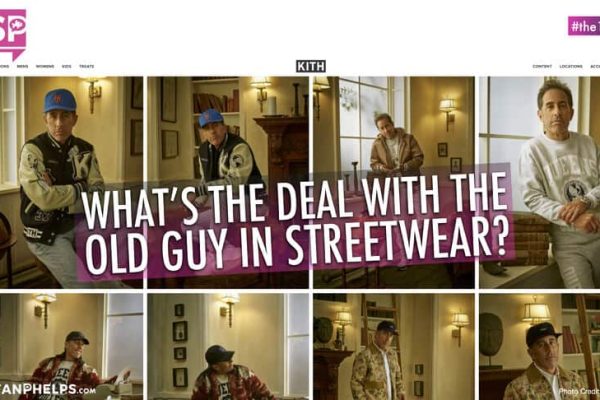
What’s the deal with the old guy in streetwear? KITH nearly broke the internet when it launched its latest seasonal collection for Fall 2022.

This assortment includes original apparel and accessories in the brand’s ongoing Classics Program starring iconic New York comedian and Queens College alum, Jerry Seinfeld.

BTW, no puffy shirts made the cut. The 68-year-old Seinfeld modeled a variety of styles and was shot by renowned photographer Mark Seliger.

KITH appeals to the GenZ and millennial crowd. They skipped a generation to feature Jerry.

It stands out as an example of the Pink Goldfish of Opposing. When everyone moves towards the norm, some courageous brands do the opposite.

Just like George Constanza learned in “Seinfeld,” sometimes the opposite is the right approach. He approaches a woman at the deli:

“My name is George, I am unemployed and live at home with my parents.” The woman named Victoria is smitten. She would recommend George for a job with the NY Yankees. George then tells the “opposite” to owner George Steinbrenner. His reply, “Hire this man!”

Back to Jerry, he looks good sporting Kith’s new hoodies, sweatpants, varsity jackets, and floral prints. The shoot calls out Jerry’s love of the Mets, his alma mater Queens College (now CUNY), white sneakers, and daily writing.

I guess 68 is the new 28. Because sometimes the opposite of a good thing… is also a good thing.

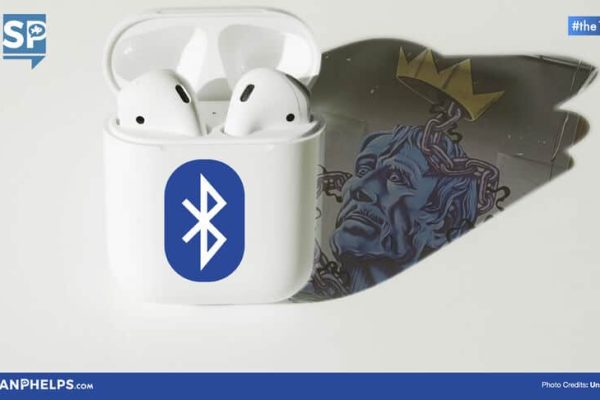
One thousand years, a King, and a dead tooth. How one man became the inspiration for wireless communication.

Our King is Harald Gormsson. Gormsson ruled Denmark back in the 10th century. The medieval king was notorious for uniting all of Scandinavia and converting the Danes to Christianity.

Harald had a nasty dead tooth that turned blue over time, earning him the nickname Blåtand.

Fast-forward ten centuries to 1996. A consortium of companies including IBM, Intel Corporation, Ericsson, and Nokia came together to create a new short-range wireless standard. They wanted to avoid the debacle of VHS vs. Beta and agree to a common platform.

The three companies were all working on their respective solutions and faced a challenge to name the one overriding standard.

In 1997, the first step toward solving the problem came about in Toronto. Two of the engineers working on the project ended up going out for a night of drinking.

Intel’s Jim Kardach met up with Ericsson engineer Sven Mattisson. Kardach had been working on a program called Business-RF and Mattisson had developed a comparable standard called MC Links.

After a few beers, the discussion turned to history.

Mattisson had just read a book called “The Longships” by Frans G. Bengtsson. The book chronicled the travels of the Viking warriors serving King Harald Gormsson. Upon learning about the nickname Bluetooth (the translation of Blatand), Kardach perked up,

“It occurred to me that this would make a good codename for the program.”

Kardach went with it and pitched the idea to others in the group. After much debate and no consensus, the group decided that Bluetooth would be a placeholder.

Later in the project, they agreed to IBM’s idea of the name PAN. PAN was an acronym for Personal Area Networking.

But it turned out that PAN presented some intellectual property and SEO challenges. It didn’t pan out.

Again, Bluetooth became the working name until marketing decided on a different name. It never happened… Bluetooth became the official standard-bearer.

I think King Harald would have been proud that his 10th-century nickname would become a 21st-century fixture.

His mark also appears on the Bluetooth logo, which is the Nordic letters H and B combined.

Drop the mark on a blue background and you have the familiar Bluetooth logo seen on millions of devices around the world. All because of a good king and his bad tooth.

Here is the lesson on ideation:

Work with what you have. Starting with a good idea always beats waiting for a perfect one to come along.

In “Red Goldfish – Motivating Sales and Loyalty Through Shared Passion and Purpose,” Graeme Newell and I feature how Chouinard started Patagonia and how the brand fits “The Protector” purpose archetype.

The start was a figurative uphill climb.

Yvon Chouinard was introduced to climbing in 1953 as a 14-year-old member of the Southern California Falconry Club. One of the adult leaders, Don Prentice, taught Yvon how to rappel down the cliffs to see the falcon nests.

The only pitons available at that time were made of soft iron. They were placed once and then left in the rock.

After meeting John Salathé, a Swiss climber who had earlier made hard-iron pitons out of Model A axles, Chouinard decided to make his own reusable pitons.

In 1957, the 18-year-old Chouinard went to a junkyard and bought a used coal-fired forge, a 138-pound anvil, tongs, and hammers. Yvon began teaching himself how to blacksmith. The word spread, and soon friends were asking for Chouinard’s steel climbing pitons.

Before he knew it, Yvon was in business. He could forge two of his pitons in an hour, and he sold them for $1.50 each.

By 1970, Chouinard Equipment had become the largest supplier of climbing hardware in the United States.

That same year on a winter climbing trip to Scotland, Chouinard bought a regulation team rugby shirt to wear rock climbing. Overbuilt to withstand the rigors of rugby, it had a collar that would keep the hardware from climbing slings from cutting into your neck. It was a blue shirt with red and yellow stripes across the chest.

Back in the US, Yvon wore it around his climbing friends. They asked where they could get one. Before long, Chouinard saw clothing as a way to help support the marginally profitable hardware business. As his company made more and more clothes, they needed to find a name for the clothing line.

According to Yvon, “To most people, especially then, Patagonia was a name like Timbuktu or Shangri-La, far-off, interesting, not quite on the map. Patagonia brings to mind, as we once wrote in a catalog introduction, ‘romantic visions of glaciers tumbling into fjords, jagged windswept peaks, gauchos, and condors.’ It’s been a good name for us, and it can be pronounced in every language.”

The name fit. Today, Patagonia nets about a billion dollars a year in sales. Over the last 50 years, Patagonia has pioneered what it means to be a responsible business.

In “Red Goldfish,” Graeme and I share how companies will shift from being “for profit” to becoming “for purpose.”

Chouinard echoed a similar direction in 2022, “Instead of ‘going public,’ you could say we’re ‘going purpose.’ Instead of extracting value from nature and transforming it into wealth for investors, we’ll use the wealth Patagonia creates to protect the source of all wealth.”

A true protector indeed.

This question was posed by Lee Silverstein in a blog post.

In his words,

“You know it when you experience it, but sometimes it’s difficult to verbalize. I like to explain the difference as ‘great’ service is the type of service that you would tell others about.”

He explains further,

“You could walk into a store and be cheerfully greeted, but it’s unlikely that over dinner that evening you would tell your family about the friendly greeting you received while shopping earlier in the day. Now if that same associate had offered to gift-wrap your purchase and then carried it out to your car for you, then that would be an experience worth sharing.”

Jay Baer echoed a similar sentiment in the Foreword for Pink Goldfish 2.0:

“We don’t make a point of telling our friends about that time we got exactly what we expected. This is why there are so few 3-star reviews:

‘Paid for a sandwich. Got a sandwich. ⭐️ ⭐️ ⭐️ ‘

If there is no story to tell, we simply don’t tell it… To turn your current customers into volunteer marketers on your behalf, you need more than competency: you need something different, distinct, and memorable. If you want more stories told about you, you need to be worthy of a story.”

One of the ways of standing out is by adding value. I call this type of Purple Goldfish “Added Service.” Lee shared his experience in the Purple Goldfish Project:

“While driving the other day, a pebble hit my windshield, leaving a small crack. I contacted Progressive Insurance and they offered to book an appointment for me to have the windshield replaced the following morning; I was very impressed. As promised, my phone rang shortly after 8 am. It was Rich from Safelite AutoGlass telling me he was on his way to my home to replace my windshield. After only 45 minutes he called me and asked me to meet him outside; he was finished and needed my signature. I walked outside to find him cleaning not just my windshield, but all of my windows! Not only that, but he informed me that he vacuumed the interior of my car as well. By investing 10 extra minutes to vacuum my car and clean my windows, Rich took a good experience and made it a great one. And what did this cost Safelite? Ten minutes of an employee’s time; a good investment.”

“Added Service” embodies the idea that a little extra attention and service can exceed the expectations of your customers. 

Lee concludes, “By taking care of all the worries that surround a window replacement on a vehicle, Safelite is one giant leap ahead of their competition.”

So, how are you taking the additional story-worthy steps of added service that make a big difference?

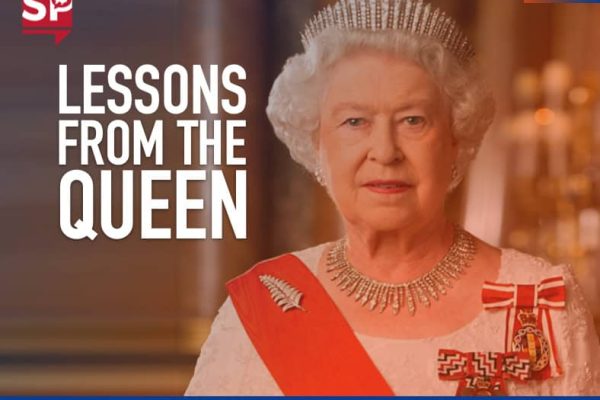
Three lessons of warmth from the life of Queen Elizabeth II.

Why warmth?

Because as we evolved as human beings, we developed skills integral to our survival. One of those was the ability to make snap judgments about our surroundings with a high degree of both speed and accuracy.

We judged everyone and everything we encounter on the two basic criteria of warmth and competence:

Warmth: What is their intent?

Competence: What is their ability to carry out that intent?

This basic truth is at the heart of the research by Dr. Bogdan Wojciszke. It has shown that over 80% of our judgments are based on just these two factors.

And these perceptions don’t just apply to people. We also apply the same standards to companies. We automatically perceive and judge their behaviors on a subconscious level.  

So, what’s more important… Warmth or Competence?

Warmth trumps competence every day of the week and twice on Sunday.

While many may point to Queen Elizabeth and her competent 70-year-reign, I believe we can learn from the warmth she demonstrated over the years.

Here are three lessons:

1. Walkabout – During a royal tour of Australia and New Zealand in 1970, Queen Elizabeth bucked centuries of royal tradition. The Queen took a casual stroll to greet crowds and shake hands. This walkabout broke the protocol of waving at the public from a protected distance.

Lesson: How can you be more accessible to demonstrate warmth?

2. Handwritten Notes – Like Queen Elizabeth, Adele Hankey was born April 21, 1926. That bond served as the basis for their unlikely relationship. They would become pen pals.

The correspondence began when Hankey, from North Dakota, wrote the queen a letter when she was crowned in 1953.

The Queen sent Adele a birthday card the following year. They would correspond back and forth around their shared birthday for the next seven decades.

Lesson: Little things, like taking the time for a handwritten note, can make a big difference.

3. The Americans – Years ago two American hikers walked up to the Queen while she was on a picnic in Balmoral.

They didn’t recognize her and asked where she lived. 

“Well I live in London, but I’ve got a holiday home just on the other side of the hills.”

The hiker asked if she had ever met Queen. 

“Well I haven’t, [then pointed to her bodyguard] but Dick here meets her regularly.”

The hiker got excited, “Oh, you’ve met the Queen? What’s she like?” 

Richard Griffin recalled his response to Sky News, “Oh, she can be very cantankerous at times, but she’s got a lovely sense of humor.”

The American then put his shoulder around Griffin, got his camera out, and promptly asked the Queen to snap a picture. 

Griffin shared, “Anyway, we swapped places and I took a picture of them with the Queen and we never let on and we waved goodbye.”

Lesson: Take your business seriously, yourself… not so much.

September 6th, 2022 was the day when many companies have dictated that workers need to return to the office.

Many workers have been remote over the last two years due to the global pandemic. Many have gotten used to work-from-home. Namely less stress and greater flexibility. Now many are being mandated to go back to the office.

Right up there with time off, flexibility is one of the most appreciated employee benefits. It has become an expectation for GenZ and Millennial workers. Recent research showed that nearly two-thirds of employees would forego a $30,000 raise if they were given flexibility over how they did their work.

For the majority of jobs, work is no longer where you go. Work is what you do. The benefits of remote work are four-fold:

1. Workers are happier and more satisfied when given flexibility.
2. Workers save money when they are not commuting.
3. Companies benefit because workers are more productive when given flexibility.
4. Companies save money when workers are not in the office.

It’s a win/win. What’s not to love if you are a CEO?

David Solomon, CEO of Goldman Sachs has expressed worries that remote work could hurt areas of their business and fray the corporate culture.

He shared back in February, “This is not ideal for us, and it’s not a new normal… It’s an aberration that we are going to correct as quickly as possible.”

Unless you were unvaccinated or had an exemption, all Goldman employees were back at their desks in the office today.

Is it about culture or is it about control?

Employers should explain why employees must return to the office, says Yale’s Joanne Lipman. There has to be a compelling reason. And when the reason stops, therefore should stop the rule.

Pollster Frank Luntz says workers are pushing back. Apple has employees petitioning against the move to require employees to be back in the office three days a week. Workers want more control over their lives, including the workplace setting.

He shared with CNBC, “It’s one of the reasons why so many businesses cannot hire the people they want – individuals now have two, three, or four job options, and they’re going to go where they feel their quality of life is not messed up.”

Luntz challenges the old command and control approach from leaders. “It’s all about what you do for the people who you serve… It isn’t about how much money you give, it’s about what you do for your people to make their lives meaningful and measurably better.”

The first is from Jennifer Cohen. Jen shares a brilliant insight on TikTok. Her podcast guest tells the story about a friend who was struggling with online dating. Her profile pictures were good. She was attractive, but she wasn’t getting past a third date. Her profile was too bland.

The problem was that she was a vegan. That would become an issue.
Jen shared that she needed an allergy. Something in her profile that was a cue. An element that would be a divider.

She bought her friend a sweatshirt that read, “If you’re not nice to animals… I’ll kill you.” It was an obvious allergy. It pushed away everyone who wasn’t a fit. Only those who were hardcore would be interested.

With online dating as well as customers, you are not for everyone. If you try to be, you’ll suffer a bunch of awkward first or second dates and never get past the early stages of a relationship.

Be upfront about your weaknesses. Don’t try to cover up your allergies. Your flaws are the things that make you unique… the things that make you awesome.

The second lesson from online dating is from a good friend who is a serial online dater. We were chatting yesterday and he mentioned how online dating was flawed. My friend mentioned he was at an event with behavioral economist Dan Ariely.

He approached Dan after the event and asked him why online dating was bad for finding a relationship. Dan shared how online dating was feature-based, whereby relationships are experience based.

Dating profiles are like lists of objective features. Good profile pic….check. Interesting bio…. check. Check all the boxes and you are a potential match.

Ariely shared that relationships are driven from an experience basis. You can’t replicate the chemistry of sharing a drink or a meal in a profile. These experiences create a feeling. Lists are logical and good for spreadsheets. Experiences are much more nuanced.

Logan Ury speaks to Ariely’s analysis in the book, “How Not to Die Alone.” She shares,

“We cannot be understood by comparing and contrasting our parts. Yet dating apps have turned living, breathing, three-dimensional people into two-dimensional searchable goods. They’ve given us the false belief that we can break people down into their parts and compare them to find the best one. Apps primarily give us a list of résumé traits and nothing more. Only by spending time with someone can you appreciate that person for the ‘experiential good’ they are.”

The same reasoning applies in marketing. Unless you are selling toothpaste, it’s not about features. Don’t worry about ticking every box. You are selling an experience. You aren’t selling perfect. Embrace the imperfect and double down on the captivating.

We don’t realize how much “little things” mean to others. Catherine Pearson shares the story of Erin Alexander in a recent article in The New York Times:

“In late August, Erin Alexander, 57, sat in the parking lot of a Target … and wept. Her sister-in-law had recently died, and Ms. Alexander was having a hard day.

A barista working at the Starbucks inside the Target was too. The espresso machine had broken down and she was clearly stressed. Ms. Alexander — who’d stopped crying and gone inside for some caffeine — smiled, ordered an iced green tea, and told her to hang in there. After picking up her order, she noticed a message on the cup: ‘Erin,’ the barista had scrawled next to a heart, ‘your soul is golden.’

‘I’m not sure I even necessarily know what ‘your soul is golden’ means,’ said Ms. Alexander, who laughed and cried while recalling the incident.
But the warmth of that small and unexpected gesture, from a stranger who had no inkling of what she was going through, moved her deeply…[She recalled] ‘that little thing made the rest of my day.'”

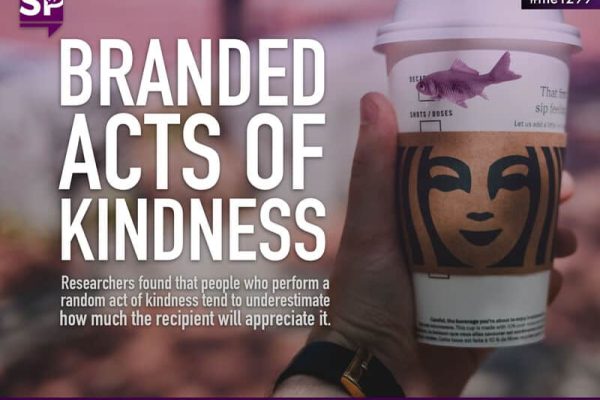
The article shares how researchers in eight different studies found that people who perform a random act of kindness tend to underestimate how much the recipient will appreciate it.

Little things can have a big impact.

So, what if you leveraged this concept as a business practice? Providing an act of kindness or a thoughtful little extra for customers. It reasons that they’d also appreciate it much more than you realize.

Having researched over 1,000 examples for “Purple Goldfish 2.0”, I can tell you there are three types of “acts of kindness” in business:

1. Random – These are good deeds or unexpected acts such as paying tolls, filling parking meters, or buying gas for consumers. They are usually one-off, feel-good activations. Here you are giving with no expectation of immediate return, except maybe for potential PR value.

2. Branded – Here the “little extra” given is usually tied closely with the brand and its positioning. It’s less random, more planned, and potentially a series of activations. This has the feel of a traditional campaign.

3. Lagniappe – the third and last type is kindness embedded into your brand. Giving little unexpected extras as a permanent part of your product or service. This is rooted in the idea of “added value” to the transaction. Not a one-off or a campaign, but an everyday practice that’s focused on your customers.

I call these “little extras” Purple Goldfish. They are done to go above and beyond the transaction to honor the relationship.

I’m going to use a little artistic license on a poem by the late Dale Carnegie:

“It costs little, but creates much.
It enriches those who receive, without impoverishing those employees who give.
It happens in a flash and the memory of it sometimes lasts forever for customers.”

What’s Your Purple Goldfish?

1 5 6 7 8 9 48
A simple illustration of a purple fish facing right on a plain background.

I've had the pleasure of working with teams at:

Three purple fish silhouettes swimming to the right on a dark background.

Find Your Best-Match Program

With over 18 possible keynote speaking presentations, workshops, and GOLDFISH TANK programs available to meet your ever-evolving needs, I’ve created this 2-minute, 6-question quiz to help you understand which program is best for you and your audience.

Meet Your Presenter

Through keynote speaking presentations, hands-on workshops, and GOLDFISH TANK programs, I empower you to power loyalty and growth.

Hi, I’m Stan Phelps. I work with organizations that want to increase loyalty, drive sales, and promote positive word-of-mouth by creating differentiated experiences.

As an author, keynote speaker, and workshop facilitator, my in-person and virtual programs stand out in a sea of sameness because I model my own message of differentiated experience (DX).

I leverage my unique collection of more than 5,500 case studies on customer, employee, and brand experience to engage audiences with practical ideas that inspire action.

A person wearing glasses and a gray quarter-zip sweater stands outdoors in front of a building with a triangular glass roof at dusk.

Every time we do business together, Something amazing happens in the world!

Through my partner B1G1, each program gives back to create global IMPACT

Two students in blue uniforms smile while washing their hands at an outdoor tap.

When we complete a GOLDFISH TANK, we give 1001 days of clean water to school children

Collage of three images: a person washing hands, a child drawing with colored pencils, and a group of people sitting outdoors with some raising their hands.

When we complete a GLOBAL engagement, we give 365 days of clean water access in Peru, 120 days of learning aids in Malaysia, and 50 days of business training for women in Malawi

Hand placing a brick on a surface with text: "One Book = One Brick" and an Amazon logo.

When someone downloads a GOLDFISH eBook, we give one brick toward building school facilities in Cambodia