Stan Phelp's Blog

The Goldfish Chronicles

Sharing insights on customer experience, employee engagement, and brand strategy.

It was meant to disparage some motorcycle riders. After an incident in Hollister, California in 1947, the American Motorcycling Association allegedly said,

“99% of the motorcycling public are law-abiding; there are 1% who are not.”

Instead of seeing this as an insult or flaw, some motorcycle clubs have embraced the moniker. The “baddest of the bad” clubs created patches to proudly showcase being a One Percenter.

David Rendall and I call this the Pink Goldfish of Flaunting (the F in F.L.A.W.S.O.M.E).

Flaunting is about being unapologetic about your flaws. You take pride in your organization’s unique characteristics. You emphasize them, accentuate them, feature them, highlight them, expose them, call attention to them, and openly display them. You definitely aren’t trying to hide them or fix them. 

One of the motorcycle clubs to embrace the 1% moniker is the Bandidos. The unofficial motto of the second-largest club is, “We are the people your parents warned us about.”

There are strict codes of conduct involving the one percenter motorcycle clubs. One is that you can never touch the patch of a one-percenter’s jacket, even accidentally.

What is something about you or your organization that others would see as a flaw? Instead of apologizing for it, how can you flaunt it and parade it without shame?

It’s DISCOVERY. Failing to give your audience time to process new ideas/concepts and allow them the space to discover how to implement what they’ve learned.

Big thanks to Victoria Tracy Ringwood and Nikki Jones for providing me the opportunity to present to KONICA MINOLTA, INC. in Mahwah, New Jersey.

I shared lessons about customer centricity from both Purple Goldfish 2.0 and Green Goldfish 2.0. It was an excellent 75-minute session.

Time constraints forced me to skip an exercise at the end of my talk called the ONE THING.

For context, at the end of a presentation, I’ll provide the audience time to think about the one thing they’ll take away from the talk.

The good news is that Vicky and the team had already built in time following my exercise for discovery. Brilliant move. Each table reflected on what they learned… and then they all wrote one new behavior they’d personally focus on.

Those index cards were then grouped into themes and pasted on the wall for everyone to see after lunch.

Credit to the Association of National Advertisers for teaching me about the importance of DISCOVERY. I now incorporate it as the last of four steps when organizing content. Here are the first three:

1. Introduce the new concept or idea.
2. Demonstrate it through a case study or case studies.
3. Create an exercise to apply the concept.

Takeaway: The biggest myth of communication is often the idea that it actually happened. Communication only occurs when your audience can repeat back your message in their words. You need to give your audience time to embrace your call to action and discover how to apply the concepts in their daily lives.

Each November we celebrate World Kindness Day. In the book Purple Goldfish 2.0, I explored how there are three different types of acts of kindness in business:

1. Random Acts of Kindness – the 1.0 kind. Good deeds or unexpected acts. They are usually one-off, feel-good activations. A random act of kindness is giving with no expectation of immediate return, except maybe for potential PR value.

2. Branded Acts of Kindness – next level 2.0. Here the item given is usually tied closely with the brand and its positioning. It’s less random, more planned, and potentially a series of activations. This has the feel of a traditional marketing campaign.

3. Lagniappe Acts of Kindness – 3.0 stuff. This is where kindness is imbedded into your brand. It is rooted in the idea of “added value” to the transaction. Not a one-off or a campaign, but an everyday practice that’s focused on customers of your brand. You are giving that little extra to your current customers.

The 3.0 version evolves the concept beyond a tactic or even a campaign to a brand differentiator. It’s a commitment that becomes a staple of the customer experience. We call these consistent acts of kindness Purple Goldfish.

A Purple Goldfish is differentiation by added value. This means finding signature elements that help you stand out, improve customer experience, and drive positive word of mouth. They are little consistent extras that either add value or reduce effort for customers.

How are you embedding kindness into your brand on a daily basis?

Do you know that a ONE-SIZE-FITS-ALL approach to leadership no longer works?

How can you navigate if there is no single black-and-white approach to success? You’ll have to use a variety of techniques to overcome challenges and get the most from your employees.

Your employees approach their work differently. You’re going to have to navigate plenty of GRAY areas to find the approach that works best.

KNOW THY SELF
In order to lead every generation, you need to know how to lead in the context of your own generation. That means understanding your own generational tendencies as well as the tendencies of those you follow.

GEN Z IS NOW THE 5TH GENERATION
Generation Z has reached the workplace. Engaging them in today’s workplace is vital to business success. It’s important to get off on the right foot. Employees make the critical decision to stay or leave within the first few months on the job. Leaders can maximize retention, engagement, and productivity by focusing on a strong first impression.

FOLLOWING IS AS IMPORTANT AS LEADING
Regardless of your leadership role, you follow someone. It might be the manager above you, it might be the CEO of your company, or it might be your Board of Directors. You’re taking direction from someone. You need to become your leader’s favorite employee. Understand the importance of following and helping your manager be the best leader he/she can be by you understanding their generation. 

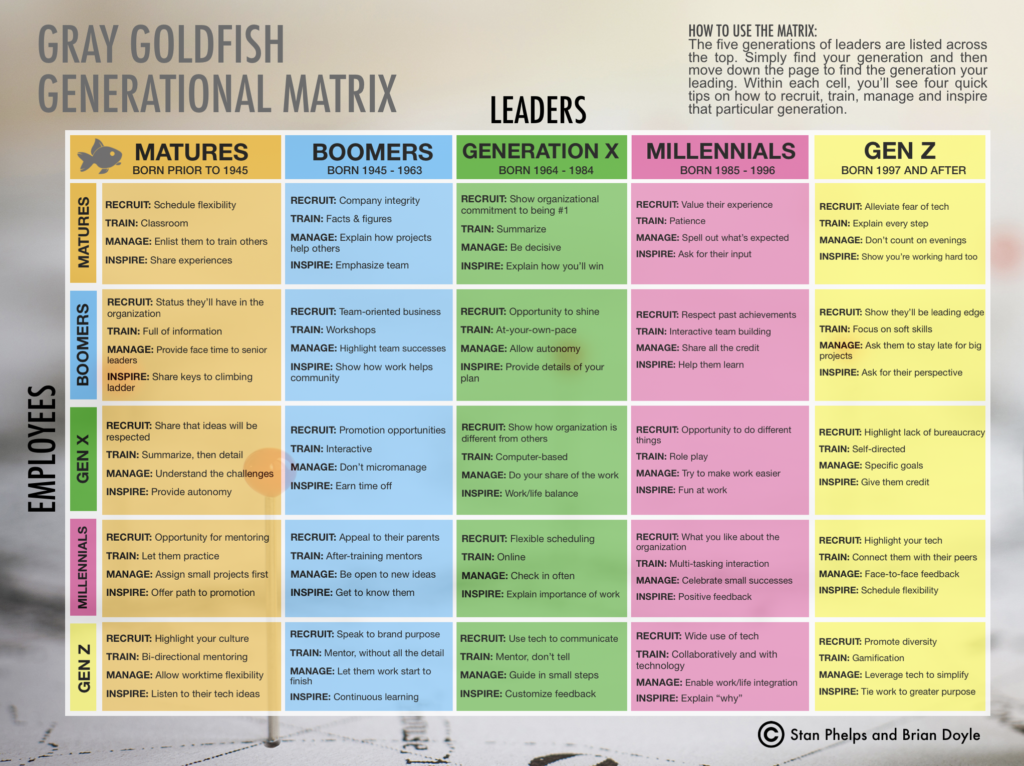
Gray Goldfish Generational Matrix for Leading Across the Generations

HERE’S A TOOL TO HELP:
Use the Gray Goldfish Generational Matrix above. It’s simple to use. Find the generation of the leader across the top row. Then find the generation of the employee down the side. The box in which they intersect contains tips on how to recruit, train, manage, and inspire across the generations.

Do you know the difference between two thumbs up and two fingers up?

The two fingers up (palm inward) have a very different meaning than peace or victory in the UK, Australia, or New Zealand. Just ask George H.W. Bush.

While visiting Canberra in 2008, W gave the V-for-victory sign as he drove in his armored limo past some demonstrators in Australia’s capital.

A friendly gesture? Nope. Holding up two fingers has the same meaning as a middle-finger gesture in America. You could say it makes the lone middle finger “one louder.” An up-and-down motion while making the gesture is often used for emphasis.

The Scottish brewery BrewDog is currently giving the two-fingers-up salute to Qatar hosting the World Cup. It is ANTAGONIZING FIFA and labeling itself as a proud anti-sponsor. Calling the event the “World F*Cup.”

Why? BrewDog is critical of human rights practices in Qatar including… the criminalization of homosexuality, the use of flogging as punishment, and the reported deaths of over 6,000 migrant workers working on World Cup infrastructure projects.

They’ve created a beer called “LOST” in honor of the anti-sponsorship. BrewDog will be donating all the profits from LOST during the World Cup tournament to human rights charities.

Hat tip to my coauthor David Rendall for sharing the story. BrewDog isn’t your ordinary craft brewer. This microbrewer is a notorious Pink Goldfish.

Here are a handful of other FLAWSOME things that make them eminently talkable:

1. Crew T-shirts – over the last few years, Brewdog had featured actual negative reviews on staff shirts. For example, “Over priced pish. F#cking awful. What a company. Complete hipster paradise.” [FLAUNTING]

2. Shower beers – In 2018, BrewDog launched DogHouse Hotels. The first craft beer hotel. Of course, they are dog-friendly. But my favorite is the minibar next to the shower. Why?… because beer tastes better in the shower. [MICRO-WEIRDING]

3. Near beer bar – Early in 2020, the BrewDog AF Bar became the world’s first alcohol-free beer bar. Based in central London, it offers 15 taps of draft alcohol-free craft beer. [OPPOSING]

4. Beer Advent Calendar – the brewery has offered the best of BrewDog in one box. A craft beer advent calendar allowed you to unwrap 24 bottles including 14 new beers for 2021, 6 new holiday beers, and 4 online exclusives. [MICRO-WEIRDING]

5. Road-kill beer – interested in trying a 55% ABV beer. It takes over seven months to brew. It’s super-limited and expensive. The thing that makes it really weird is that the bottle is encased in a squirrel. Why taxidermy squirrels? According to BrewDog,

“We wanted to do something that was at the same time beautiful and disturbing, something that made a statement and tried to make people stop and think about all of the possibilities that beer actually has.” [LOPSIDING]

Your thoughts on the World F*Cup campaign? Thumbs up or down?

At one time it was almost 10 times harder to get a job at Google than it was to get into Harvard… 

Back in 2014, I wrote an article in Forbes exploring 15 reasons why. Here is a synopsis:

1. Dollars and Sense – With billions of dollars in revenue every year, Google pays some of the highest average salaries in the tech industry.

2. On Purpose – Google has always pursued a noble cause. The company was founded with a simple motto, ”Don’t be evil.” Its mission is to organize the world’s information and make it universally accessible. 

3. Caring – No stone is left unturned in their quest to provide a welcoming work environment for employees. Actions speak louder than mere words. Why is caring so important to the company? According to the former Chief People Officer Laszlo Bock:

“It turns out that the reason we’re doing these things for employees is not because it’s important to the business, but simply because it’s the right thing to do.”

4. Creative Outlet – Google allows its employees the option to use up to 20% of their work week at Google to pursue special projects.

5. A Voice – The Google-O-Meter gives all employees a voice on employee suggestions and potential cultural changes.

6. Benefits Beyond the Grave – Should a U.S. Googler pass away while working for Google, their surviving spouse or domestic partner will receive a check for 50% of their salary every year for the next decade.

7. Modern Family – Google gives employees in same-sex relationships extra cash to cover their partners’ health benefits. 

8. Bathrooms – Googlers have access to some of the most high-tech Japanese toilets around.

9. Kingpin – The company knows how to roll. Google has a bowling alley for employees.

10. Training & Development – Google’s “CareerGuru” program matches Google executives with Google employees to provide confidential, one-on-one career coaching and guidance.

11. Wellness – The Googleplex has some interesting lap pools. The outdoor mini-pools are like water treadmills.

12. Team Building – Google’s Conference Bike is used as a team-building exercise for new employees. 

13. Collaborative Space – Google’s corridors are designed and set up for impromptu information sharing. Offices don’t resemble a typical corporate environment. Google arranges the workstations so that groups of three to four employees who work together sit in the same area.

14. Food & Beverage – Is the way to an employee’s heart through their stomach? One of the most oft-cited perks of working at Google is the food. If you work at the Googleplex, you can eat breakfast, lunch, and dinner free of charge.

15. Openness and Transparency – One of things shaping culture at the search leader are “TGIF” meetings. They tend to happen most Fridays. TGIF is where any Googler is free to ask the founders any company-related question. They’ve become a fixture of the culture.

Google didn’t become a happy company by mistake. It’s a product of thoughtful design and ultimately, culture. Founders Larry Page and Sergey Brin set the groundwork for building Google.

But maybe there is a deeper reason for creating a more welcoming and fulfilling workplace. Here is a quote from CEO Page’s Commencement Address at the University of Michigan in May 2009:

“My father’s father worked in the Chevy plant in Flint, Michigan. He was an assembly line worker. My Grandpa used to carry an “Alley Oop” hammer—a heavy iron pipe with a hunk of lead melted on the end. The workers made them during the sit-down strikes to protect themselves. When I was growing up, we used that hammer whenever we needed to pound a stake or something into the ground. It is wonderful that most people don’t need to carry a heavy blunt object for protection anymore.”

It bears repeating. Larry Page’s grandfather used to take a hammer to work for protection. I can only imagine this was a constant reminder of the quest for a happy workplace at Google. 

Amazing, amazing costumes. This is the essence of a Pink Goldfish. Credit to fellow speaker Josh Sundquist for his creativity and this flawsome TikTok video:

@josh.sundquist Recap of my #halloween ♬ original sound – Josh Sundquist

A little bit of background. At age nine, Josh Sundquist was diagnosed with a rare form of bone cancer and given a 50% chance to live. After a year of chemotherapy treatments, his left leg was amputated. He would become a Paralympic athlete and his story would be made in an Apple+ TV show called, “Best Foot Forward.”

In 2010, Josh wore a partially-eaten gingerbread man costume to Halloween costume to make his friends laugh.

A couple of years later according to his website, his girlfriend (now wife) Ashley suggested he dress as the leg lamp from the movie “A Christmas Story.” A photo of that costume went viral.

Since then he’s been dressing up every Halloween in costumes made possible by the unique shape of his body, and each year his one-legged costumes receive hundreds of millions of impressions around the world. They have been featured on television shows like ESPN, Good Morning America, and The Today Show, as well as on the front pages of Buzzfeed, Yahoo!, AOL, and countless other media outlets.

Hat tip to my Pink 2.0 coauthor David Rendall for sharing the video.

There are eight different types of Pink Goldfish. The cornerstone is FLAUNTING. It is the “F” in the F.L.A.W.S.O.M.E. framework.

Flaunt means to parade, show off, display, strut, or be ostentatious. It’s also about being unashamed or proud of something. Our interpretation of the word is positive. Flaunting is about being unapologetic about your flaws. You take pride in your unique characteristics. You emphasize them, accentuate them, feature them, highlight them, expose them, call attention to them, and openly display them. You definitely aren’t trying to hide them or fix them.

This is what Josh is doing here.

Too often, we are uncomfortable with what makes us weird. Our goal of writing “Pink Goldfish 2.0” isn’t simply to help you become comfortable with what makes you weak or weird in business and in life. David and I want you to parade those weaknesses without shame, to show them off.

This might sound unwise. It isn’t what most business books recommend.

Flaunt that you do LESS of what is considered perfect or flaunt that you do MORE of what seems imperfect.

Your flaws are the things that make you awesome.


A Pink Cow? Andy Warhol wasn’t afraid to defy normal and exploit imperfection.

Andy understood the importance of standing out. One strategy he used was the Pink Goldfish strategy of lopsiding. Take an approach that made him unique and then triple down on it.

In 1961, the relatively unknown Warhol believed he was about to break through. He had created a batch of paintings inspired by comic books. The only problem was that Roy Lichtenstein beat him to the punch.

Andy needed a new idea.

The interior designer Muriel Latow recommended that he make paintings of money. That idea cost Warhol $50.

Latow then tossed in a second idea gratis for lagniappe.

It was one word…

Campbell’s

A year later Warhol did an entire exhibit of soup can paintings in Los Angeles. Pop art was born.

After soup cans, the subjects became passenger tickets, electric chairs, and flowers. Warhol wanted to defy normal and shake up the art world.

Warhol often asked his friends what he should paint to get an outside perspective. Art Dealer Ivan Karp suggested cows, sharing that they were a “wonderfully pastoral…durable image in the history of the arts.”

He began work on a series.

Warhol recounted Karp’s reaction after seeing the Pink Cow on the yellow background,

“They’re super-pastoral!… They’re ridiculous! They’re blazingly bright and vulgar!”

Warhol would triple-down on the bovines. In one of his gallery shows in 1966, he papered the walls with the cows.

Are you ready to stand out in a pasture of sameness?

Sip on this. In 1984, the Austrian marketer Dietrich Mateschitz found himself in Bangkok on a business trip.

Feeling foggy, he drank a bottle of Krating Daeng. Dietrich found that the medicinal concoction cured his jet lag and gave him a needed boost.

He would approach the inventor of Krating Daeng, Chaleo Yoovidhya, with an offer. Dietrich proposed setting up a company in Austria to sell the energy drink abroad.

For background, Chaleo had launched the Krating Daeng brand eight years earlier in 1976. He saw an opportunity to challenge a Japanese import named Lipovitan. Chaleo’s recipe was sweeter than Lipovitan. His goal was to appeal to local taste buds.

The original label on the small brown bottle bears shows two red Indian bison just about to butt heads on a yellow circle.

Just like Chaleo tweaked the recipe, Dietrich would make three small adjustments to Krating Daeng.

1. He carbonated it to make it more appealing to international tastes. [Plus, this made it a better mixer for alcoholic drinks]

2. He 86’ed the medicine bottles for sleek, eye-catching, silver-and-blue aluminum cans.

3. He changed the Thai name to the rough English translation: Red Bull

Dietrich would launch Red Bull in Austria in 1987 with the slogan, “Red Bull Gives You Wings.” Unlike in Thailand, where the drink was a staple for the working class tuk-tuk drivers, Red Bull would be marketed as an upscale drink. Through athletes and events, Red Bull would dominate through its sponsorship of extreme sports.

When other energy drinks began to copy the sponsorship strategy, Red Bull pivoted to ownership. Pioneering the practice of owning its own events and teams.

If there ever was a Pink Goldfish brand that defied normal and exploited imperfection, it would be Red Bull. David Rendall and I purposely decided not to feature it in the original Pink Goldfish or Pink Goldfish 2.0. Too obvious. Call that our own pink goldfish practice of “withholding.”

Sadly, Dietrich Mateschitz passed away in October, 2022. The 78-year-old succumbed to a protracted battle with cancer.

In honor of his legacy, let me share my favorite Dietrich quote,

“The most dangerous thing for a branded product is low interest.”

Honored to be a guest of Bernie Borges of iQor on Episode 60 of the “Digitally Irresistible” podcast.

Watch the episode here

Bernie and I talked about the I.D.E.A. framework for creating a differentiated experience (DX).

I co-created this framework with “Purple Goldfish 2.0” coauthor Evan Carroll. Credit to Nicole Gobbo for this write-up of the process from the episode:

The I.D.E.A. Framework

Inquire
In the I.D.E.A. framework, an improved customer experience begins with the inquire phase. This phase helps you gather insights to best understand the customers you serve.

Look at things from your customers’ perspective. Think about all the experiences along their customer journey and consider how they relate to you as a brand.

Use the information you gain to uncover gaps and opportunities throughout the customer experience. A gap is a friction point. Opportunities are key moments within the customer experience that you can elevate to create a truly amazing experience.

Design
The design phase provides an outline for identifying the parts of the customer journey you want to address and how you plan to improve them.

First, set your focus on what you plan to address. Identify the most critical gaps you want to fix as well as the most promising opportunities.

Once you’ve set your focus, begin asking big questions to explore different ways you could address the gaps and opportunities. What would you do if you had a year to make the improvements? What if you had a million dollars? What if you had 10 minutes and $10?

Then brainstorm and design ideas that address your gaps and opportunities.

Evaluate
Once you have developed some ideas, evaluate the best ones on your list.

The evaluate phase begins internally to ensure you have the capability to deliver on the idea. Look within the organization to answer questions such as the resources it would take to implement the idea and whether you have the organizational bandwidth.

Once you’ve assessed internal capabilities, begin the external validation process. Test your ideas in a focus group, do surveys, or run them by a customer advisory board.

The third and final step is the pilot phase. Test your solution in a specific market or in a limited fashion to validate its effectiveness. If the pilot is successful then you’re ready for the last stage.

Advance
Advance is where the rubber hits the road.

Incorporate the feedback you learned from the pilot and achieve buy-in. Secure the budget and resources you need to effectively implement the idea.

Plan the rollout by training your team and creating the processes and procedures to carry out the idea.

Determine how you’re going to measure improvement to the experience on an ongoing basis.

1 4 5 6 7 8 48
A simple illustration of a purple fish facing right on a plain background.

I've had the pleasure of working with teams at:

Three purple fish silhouettes swimming to the right on a dark background.

Find Your Best-Match Program

With over 18 possible keynote speaking presentations, workshops, and GOLDFISH TANK programs available to meet your ever-evolving needs, I’ve created this 2-minute, 6-question quiz to help you understand which program is best for you and your audience.

Meet Your Presenter

Through keynote speaking presentations, hands-on workshops, and GOLDFISH TANK programs, I empower you to power loyalty and growth.

Hi, I’m Stan Phelps. I work with organizations that want to increase loyalty, drive sales, and promote positive word-of-mouth by creating differentiated experiences.

As an author, keynote speaker, and workshop facilitator, my in-person and virtual programs stand out in a sea of sameness because I model my own message of differentiated experience (DX).

I leverage my unique collection of more than 5,500 case studies on customer, employee, and brand experience to engage audiences with practical ideas that inspire action.

A person wearing glasses and a gray quarter-zip sweater stands outdoors in front of a building with a triangular glass roof at dusk.

Every time we do business together, Something amazing happens in the world!

Through my partner B1G1, each program gives back to create global IMPACT

Two students in blue uniforms smile while washing their hands at an outdoor tap.

When we complete a GOLDFISH TANK, we give 1001 days of clean water to school children

Collage of three images: a person washing hands, a child drawing with colored pencils, and a group of people sitting outdoors with some raising their hands.

When we complete a GLOBAL engagement, we give 365 days of clean water access in Peru, 120 days of learning aids in Malaysia, and 50 days of business training for women in Malawi

Hand placing a brick on a surface with text: "One Book = One Brick" and an Amazon logo.

When someone downloads a GOLDFISH eBook, we give one brick toward building school facilities in Cambodia