Stan Phelp's Blog

The Goldfish Chronicles

Sharing insights on customer experience, employee engagement, and brand strategy.

Our brain is our biggest consumer of energy. As we have evolved, we’ve figured out ways to conserve its effort. We develop cognitive schemas to figure out how the world works. Schemas are recognizable patterns that allow us to automatically adapt our behavior.

For example, every day you get into the car and you know instinctively to drive on the right side of the road. Fast forward and you’re on a trip to the UK or Australia. The first time you drive on the left side, it throws you for a loop. It’s disruptive to your normal driving schema so it forces the brain to think and thereby, it elicits word of mouth.

Years ago Procter & Gamble launched a new Secret deodorant. It utilized a moisture activated ingredient that kicks in when you sweat. P&G understood that this could be positioned against the traditional schema of the more you work out, the more you sweat, and the worse you smell. The counter-intuitive tagline for the brand became,

The More You Move, the Better You Smell

Did it get people talking? A staggering 51,000 consumers posted comments on P&G’s website about the product.

Takeaway: Most organizations fail to deliver an exceptional employee experience. Sweat the little things. Do the unexpected and disrupt schemas. Become talk-able.


Lessons from a Crepe Myrtle tree. Are you familiar with the premier summer-flowering tree of the South? It tolerates heat, humidity and does well in most soils. It grows quickly and can reach as high as 35 feet. Left unchecked though, the growth can sap the beauty and the branches get weighed down.

Being transplants, the tree caught the attention of both David Rendall (Midwest) and I (Northeast) because of the way it is pruned. Each winter you see rows and rows that have been cut back severely with only the largest branches remaining. This annual pruning is vital to maintaining its health.

In our efforts to make our companies well-rounded and multi-faceted, we often develop branches that are unproductive. Unfortunately, we don’t prune them and they end up sapping our strength and resources.

Every company has a limited amount of time, energy, and resources. The Pink Goldfish strategy of minimizing (pruning) allows us to conserve those resources and use them in ways that improve our effectiveness.

In the book, The Art of Non-Conformity, Chris Guillebeau says, “To fulfill some commitments, others must be excluded.” He refers to this as “radical exclusion.”

Takeaway: What are you willing to radically prune as we begin planning for 2021?

Families have changed. Today’s employers need to prepare for things such as infertility, adoption, parental leave, daycare, returning workers, and eldercare.

It is critical that companies support employees so they can address family needs. This allows them to feel supported and focused. Little extras can make a huge difference.

Here are five examples:

1. Wendy’s offers adoptive employees a combination of up to $24,300 in adoption assistance and up to six weeks paid adoption leave.

2. At Eli Lilly, expectant mothers are allowed to take one month of paid leave before their due date.

3. Bain & Company offers a backup child and adult care program called Parents in a Pinch.

4. Aetna Life & Casualty reduced resignations of new mothers by 50 percent by extending its unpaid parental leave policy to six months.

5. Stew Leonard’s offers “Mom’s hours,” enabling mothers to work while their children are in school and take off the whole summer.

According to the New York Times:

“These kinds of benefits are a departure from the upscale cafeteria meals, massages, and other services intended to keep employees happy and productive while [at the office]. And the goal is not just to reduce stress for employees, but for their families, too.”

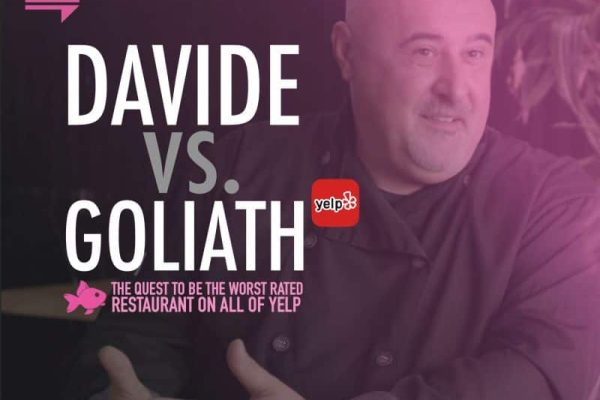
David fought Goliath and won. Well, Davide fought Yelp and won. Davide Cerretini started Botto Bistro in Richmond, California in 2009. Early on, he saw Yelp as an ally in his efforts to gain new customers.

Why is Yelp so important? Research shows that even a ½ star improvement in an establishment’s rating can increase business by almost 20 percent during peak times. Davide was eager to earn positive reviews and see new faces walking through the doors of Botto Bistro. But that’s not what happened.

Davide started to notice that five-star reviews from loyal customers were disappearing from Yelp and one-star reviews from questionable sources were multiplying. He contacted Yelp to find out what was happening, but was unable to resolve the issue. His suspicion was that Yelp was manipulating the reviews in an effort to convince him to buy ads. He isn’t the first to complain, but legal challenges from other businesses were unsuccessful.

After battling for 5 years, he reached a breaking point in 2014. He was a small restaurant with ten tables at a single location. Yelp was a six-billion dollar publicly-traded company. How could he fight back?

What did he do? Davide took on Goliath.

Most businesses just give in to the pressure. They purchase ads from Yelp and beg customers for good reviews. They do everything possible to please every customer and live in fear of the next negative review. They feel powerless to defend themselves. 

Davide refused to play the game by the existing rules. He changed the game. He had a new goal. He didn’t want high ratings. He wanted to be the lowest-rated restaurant on Yelp. He didn’t want to be the best. He wanted to be the worst.

He made a simple offer. 25 percent off your pizza if you post a one-star review on Yelp. Did it work? Yes. Immediately and beautifully. He did more business in one day than he usually did in a month. He was interviewed by the media from coast to coast. Botto Bistro was a sensation. It didn’t just help his restaurant. It became a galvanizing event for small businesses throughout the country. He had started a revolution. 

Want to learn more: Here’s fun video from The Daily Show with Trevor Noah: https://youtu.be/qwF9ehhEoss

Great companies understand the importance of effort and signaling. Little things such as “follow up” or saying “thank you” are indications that the organization values the relationship.

To quote Rory Sutherland in the book Alchemy: The Surprising Power of Ideas That Don’t Make Sense, “The meaning and significance we attach to something is felt in direct proportion to the expense with which it is communicated.”

Sutherland maintains that costliness carries meaning. This means that a handwritten thank-you card or a phone call carries more meaning than a text or an email. The effort is a signal to the customer that the company cares.

In Purple Goldfish 2.0, Evan Carroll and I share a handful of stories of follow-up/thank you.

1. Jack Mitchell of Mitchells sending 5 handwritten notes each day to key customers.
2. A pharmacist from Rite Aid calling to check-in on customers.
3. A United Airlines pilot sharing his business card with a note to thank first-class customers.
4. Wufoo sends thank you notes crafted out of construction paper and decorated with stickers.
5. Big Ass Fans calls all customers to follow up after an order is received.

Following up has multiple benefits, not the least of which is increased loyalty. How are you signaling that you care?

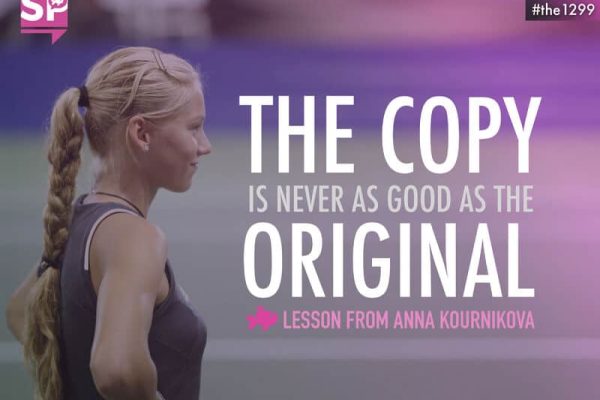
A branding and strategy lesson from former tennis player Anna Kournikova, “The copy is never as good as the original.”

Here is the backstory:

In a former life, I used to work with the Russian star during my days at adidas. In 2002, I was in the room when Anna was being interviewed at the Octagon House in the Wimbledon village. Maria Sharapova was a rising junior player at the tournament. Maria had made some offputting remarks when asked about being compared to Anna. Now the reporter was asking Kournikova to comment. Anna shrugged it off and declined to specifically address it. With a coy smile, she shared, “I’ll only say this. The copy is never as good as the original.”

There is a great lesson here as it pertains to branding and strategy. Many companies benchmark the leader and begin to emulate the things that make them successful. This type of copying leads to sameness, not competitive separation.

By contrast, smart companies embrace who they are. They expose themselves and flaunt what makes them unique. In the words of my co-author David Rendall, “You have to be willing to reveal, instead of conceal; declare, instead of deny; disclose, instead of disguise; confide, instead of hide.”

Takeaway: Don’t be a copy. Once is witty… twice is shitty.

Don’t sugarcoat who you are. Own it and expose it. Exposing is about honesty and authenticity. It’s obvious that integrity is important. Almost every company has a version of it as part of its core values.

Yet, few companies are able to live up to it.

There is power in being straightforward and candid. Especially when traditional marketing involves highlighting the positive and obscuring the negative.

For example, the message on a bag of Domino sugar explains that “sugar is a 100% natural simple carbohydrate. Carbohydrates are an important part of any balanced diet. Sugar contains no fat or cholesterol and has 15 calories per teaspoon.” They make it sound like the perfect food.

Domino’s strategy seems to make sense. Why tell customers about what’s wrong?

However, there’s a major problem with this approach. We all know that sugar isn’t the perfect food and that undermines our ability to trust Domino. They aren’t being honest.

Counter to Domino, IT’SUGAR practices exposing. Instead of trying to pretend that sugar is healthy, they put all of the negatives right on the label. Honesty is in their name.

What do they sell? Sugar. What’s the main ingredient? Sugar. They sell Gummy Bears the size of your head.

Takeaway: Be brutally honest. Expose.

I can distinctly remember having a conversation with a law school classmate named John. John was from South Carolina. He was sharing his thoughts about his summer job working in a law office in the Palmetto State. When I asked if he’d considered staying on full-time after school, he shook his head,

“No way.”

When prodded further, John revealed that he had an issue with the partner that was managing him. “He doesn’t give any attaboys.”

I had never heard that word before, but no explanation was needed. John felt his work wasn’t appreciated or recognized at the firm.

In the words of Angela Maiers, “YOU MATTER. These two words can change your mood, change your mind, and have the power to change lives and the world if we understand and leverage them in the right way.” Recognition resonates in the workplace. 35% of workers cite frequent recognition of accomplishments as the most effective non-monetary reward. Thanking people for their work is key to making them feel appreciated.

Recognition fuels a sense of worth in individuals. Dale Carnegie spoke to the importance of recognition over 80 years ago. “Be lavish in your praise and hearty in your approbation.”

How are you giving attaboys and attagirls to your team members during this time of uncertainty?

Four words that sum up the adherence to the Mandalorian creed. “This is the way.” These four words bind together this tribe of bounty hunters.

If you are a fan of the show, then you are familiar with the code that was launched in Season 1.

If you are not, here is the scene:

The Mandalorian armorer addresses the main character, “When one chooses to walk the way of the Mandalore, he is both hunter and prey. How can one be a coward if one chooses this way of life?”

She asks. “Have you ever removed your helmet? Has it ever been removed by others?”

When the main character answers both questions in the negative, the armorer replies:

“This is the way”

The larger group of Mandalorians in the room repeats in unison,

“This is the way”

This singular phrase got me thinking about the code StanPhelpsSpeaks.com lives by.

I’m inspired by the Baker Roofing Company. Their code is “Always Good Work.” In 1915, W.P. Baker hung a sign in his downtown Raleigh shop indicating they were open for business. That sign read “We shall do good work. At a profit if we can, at a loss if we must, but always good work.”

My manifesto is now on my website, but I’m searching for my three or four words.

What’s your code or creed?

“It doesn’t matter how many people hate your brand as long as enough people love it. . . You can’t be afraid of offending people. You can’t try and go down the middle of the road. You have to take a stand on something.” – Phil Knight, Founder of Nike

The Pink Goldfish of Antagonizing is about intentionally irritating, aggravating, and instigating. Co-author David Rendall and I advocate for purposefully going out of your way to rub some people the wrong way.

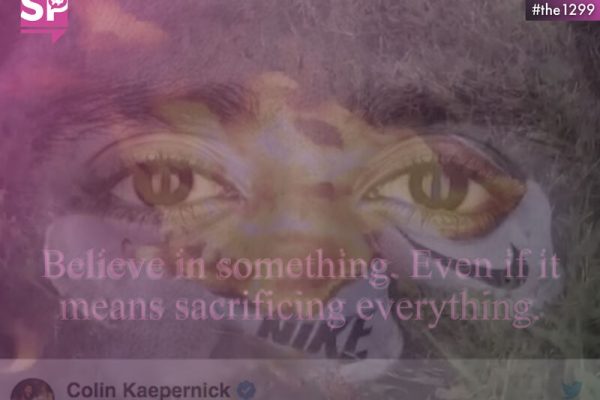
Just over two years ago, Nike released an incredibly controversial ad campaign featuring Colin Kaepernick, the former NFL quarterback, who was revered and reviled for taking a knee during the national anthem to protest police brutality.

In the ads, Nike’s tagline was printed over the face of Kaepernick:

Believe in something,
even if it means
sacrificing everything

The response was extreme. People were talking about it, but they were also taking action.

– People predicted the end of Nike, a loss of sales and stock value. People burned their shoes and jerseys.

– People predicted the resurgence of Nike, a rise in sales and stock price. People bought their shoes and jerseys.

As of October, Nike’s stock is now up 59% since the campaign.

Takeaway: Take a stand on something. Antagonize.

Follow me on Twitter or LinkedIn.

Stan Phelps

Stan Phelps walks the walk. He stands out in the sea of sameness by modeling his own Differentiated Experience (DX) message: Differentiation isn’t just about what you say, it’s about what you do and, more importantly, how and why you do it. Stan leverages his unique collection of 5,000+ case studies on customer, employee, and brand experience to engage audiences with informative learning-based experiences. He believes purposeful DX wins the hearts of employees and customers, and differentiation ultimately boosts loyalty, retention, referrals, and results.

Find Stan’s in-person and virtual keynotes, workshops, and Goldfish tank programs at StanPhelps.com.

1 40 41 42 43 44 48
A simple illustration of a purple fish facing right on a plain background.

I've had the pleasure of working with teams at:

Three purple fish silhouettes swimming to the right on a dark background.

Find Your Best-Match Program

With over 18 possible keynote speaking presentations, workshops, and GOLDFISH TANK programs available to meet your ever-evolving needs, I’ve created this 2-minute, 6-question quiz to help you understand which program is best for you and your audience.

Meet Your Presenter

Through keynote speaking presentations, hands-on workshops, and GOLDFISH TANK programs, I empower you to power loyalty and growth.

Hi, I’m Stan Phelps. I work with organizations that want to increase loyalty, drive sales, and promote positive word-of-mouth by creating differentiated experiences.

As an author, keynote speaker, and workshop facilitator, my in-person and virtual programs stand out in a sea of sameness because I model my own message of differentiated experience (DX).

I leverage my unique collection of more than 5,500 case studies on customer, employee, and brand experience to engage audiences with practical ideas that inspire action.

A person wearing glasses and a gray quarter-zip sweater stands outdoors in front of a building with a triangular glass roof at dusk.

Every time we do business together, Something amazing happens in the world!

Through my partner B1G1, each program gives back to create global IMPACT

Two students in blue uniforms smile while washing their hands at an outdoor tap.

When we complete a GOLDFISH TANK, we give 1001 days of clean water to school children

Collage of three images: a person washing hands, a child drawing with colored pencils, and a group of people sitting outdoors with some raising their hands.

When we complete a GLOBAL engagement, we give 365 days of clean water access in Peru, 120 days of learning aids in Malaysia, and 50 days of business training for women in Malawi

Hand placing a brick on a surface with text: "One Book = One Brick" and an Amazon logo.

When someone downloads a GOLDFISH eBook, we give one brick toward building school facilities in Cambodia