Stan Phelp's Blog

The Goldfish Chronicles

Sharing insights on customer experience, employee engagement, and brand strategy.

This summer I visited the Lorraine Motel in Memphis with my 13-year-old son James. It is the place that Martin Luther King Jr. was fatally shot on the 2nd-floor balcony.

We weren’t participating in dark tourism. Not familiar with the term? Dark tourism is “the act of travel and visitation to sites, attractions, and exhibitions which have real or recreated death, suffering or the seemingly macabre as a main theme.” We were seeking light.

The infamous Lorraine Motel is now a part of the National Civil Rights Museum. A place that turns the journey of civil rights into a one-of-a-kind museum experience. The culmination of that experience ends on the 2nd-floor of the motel. You view Room 306 and look out onto the balcony. It gives me chills just thinking about it.

A day before his death, MLK delivered the prophetic “I’ve Been to the Mountaintop” speech:

“Like anybody, I would like to live – a long life; longevity has its place. But I’m not concerned about that now…I’ve seen the Promised Land. I may not get there with you. But I want you to know tonight, that we, as a people, will get to the Promised Land.”

In the speech, King calls for unity and nonviolent protest. He challenges our country to live up to its ideals. It was important then and vital now.

Follow me on Twitter or LinkedIn

Stan Phelps

Stan Phelps walks the walk. He stands out in the sea of sameness by modeling his own Differentiated Experience (DX) message: Differentiation isn’t just about what you say, it’s about what you do and, more importantly, how and why you do it. Stan leverages his unique collection of 5,000+ case studies on customer, employee, and brand experience to engage audiences with informative learning-based experiences. He believes purposeful DX wins the hearts of employees and customers, and differentiation ultimately boosts loyalty, retention, referrals, and results.

Find Stan’s in-person and virtual keynotes, workshops, and Goldfish tank programs at StanPhelps.com.
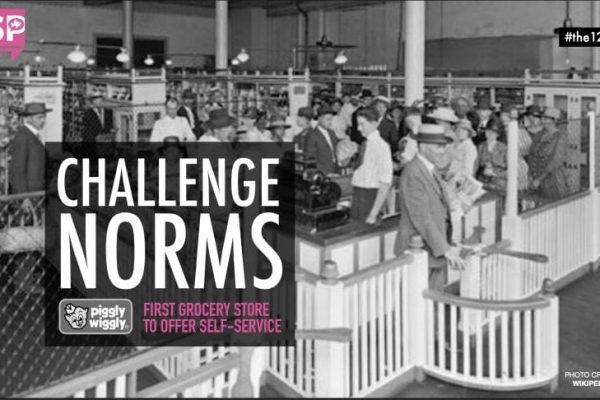
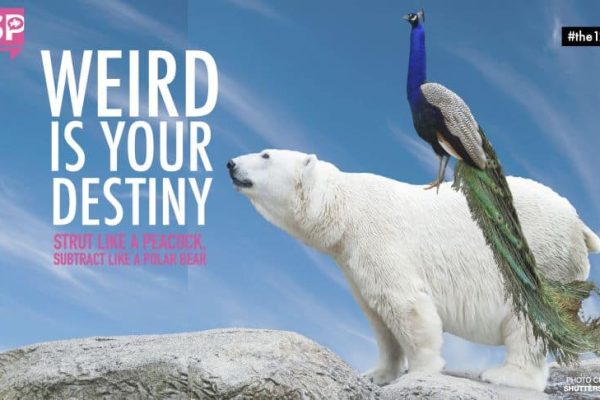
Break your industry standards and norms to stand out. Do MORE of what makes you weird or intentionally do LESS of what everyone considers as normal. Do MORE of what your customers value and unapologetically LESS of what they don’t.

Over 100 years ago, Clarence Saunders challenged an industry norm in Memphis by doing LESS. Before 1916, groceries were sold at stores where a clerk would fetch goods. They’d measure out flour and sugar, ground coffee beans, and add write prices in pencil on the back of the sacks.

Even the big chain stores used clerks. Although the chain store model kept costs down, clerks were expensive. Saunders’s self-serve model cut these costs. Shoppers on that first day did see some employees stocking shelves, but according to the Tennessee Historical Quarterly, “They politely refused to select merchandise for visitors.”

By the end of that first year, there were 9 locations around Memphis. Saunders would call his stores Piggly Wiggly. The chain now has over 500 grocery stores in 17 states. Why the weird name? According to the Piggly Wiggly website, “Someone once asked him [Saunders] why he had chosen such an unusual name for his organization, to which he replied, ‘So people will ask that very question.”

Follow me on Twitter or LinkedIn

Stan Phelps

Stan Phelps walks the walk. He stands out in the sea of sameness by modeling his own Differentiated Experience (DX) message: Differentiation isn’t just about what you say, it’s about what you do and, more importantly, how and why you do it. Stan leverages his unique collection of 5,000+ case studies on customer, employee, and brand experience to engage audiences with informative learning-based experiences. He believes purposeful DX wins the hearts of employees and customers, and differentiation ultimately boosts loyalty, retention, referrals, and results.

Find Stan’s keynotes and workshops at StanPhelps.com.

Weird is your destiny. The word “weird” comes the Old English “wyrd.” It is of Germanic origin meaning destiny. In Middle English, it originally meant “having the power to control destiny.” According to Wikiquote, weird “is a term corresponding to those of fate or destiny, but involving complex interactions of universal necessity and individual choice.”

Fit in or fit out? We can choose to accept our weirdness or we can blindly follow the norms of others.

Here are 7 reasons not to be normal:

1. BEING NORMAL MAKES YOU ORDINARY…BEING WEIRD MAKES YOU RARE.

2. BEING NORMAL MAKES YOU EASY TO IMITATE…BEING WEIRD MAKES YOU ORIGINAL.

3. BEING NORMAL MAKES YOU INVISIBLE…BEING WEIRD MAKES YOU NOTICEABLE.

4. BEING NORMAL MAKES YOU PREDICTABLE…BEING WEIRD MAKES YOU SURPRISING.

5. BEING NORMAL MAKES YOU FORGETTABLE…BEING WEIRD MAKES YOU MEMORABLE.

6. BEING NORMAL GIVES PEOPLE NOTHING TO TALK ABOUT…BEING WEIRD MAKES YOU REMARKABLE.

7. BEING NORMAL MAKES YOU POWERLESS…BEING WEIRD MAKES YOU INFLUENTIAL.

Takeaway: What makes us weird is also what makes us wonderful. Own it and strut your weirdness like a peacock. Subtract and avoid following the crowd like a polar bear. Ready to stand out in a sea of sameness?

Follow me on Twitter or LinkedIn.

Stan Phelps

Stan Phelps walks the walk. He stands out in the sea of sameness by modeling his own Differentiated Experience (DX) message: Differentiation isn’t just about what you say, it’s about what you do and, more importantly, how and why you do it. Stan leverages his unique collection of 5,000+ case studies on customer, employee, and brand experience to engage audiences with informative learning-based experiences. He believes purposeful DX wins the hearts of employees and customers, and differentiation ultimately boosts loyalty, retention, referrals, and results.

Find Stan’s keynotes and workshops at StanPhelps.com.

Can clutter increase team-building and ultimately innovation? Cited by the book INFLUENCER, Hewlett-Packard used to encourage that employees keep, of all things, a messy desk. The thinking by HP was that by leaving work visible and accessible, that it was much more likely that others wandering by would see, take an interest, and get involved in the work of a colleague.

Steve Jobs had a similar strategy at Pixar. He placed the bathrooms at the center of the headquarters. In his words, “So we designed the building to make people get out of their offices and mingle in the central atrium with people they might not otherwise see.”

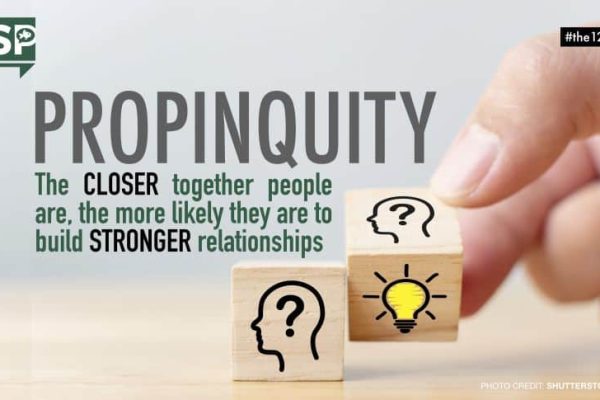
Both HP and Pixar are examples of the concept of PROPINQUITY. Propinquity is the physical or psychological proximity between people. It is also the concept that physical proximity as a critical factor in influencing change and nurturing culture. The closer people are, the more likely they are to build the best relationships. Better relationships should lead to better collaboration and teamwork.

As we deal with a remote workforce, we need to be mindful of propinquity. How are we creating opportunities for our teams to get together digitally? How are reinforcing kinship and togetherness when we are physically apart?

Follow me on Twitter or LinkedIn

Stan Phelps

Stan Phelps walks the walk. He stands out in the sea of sameness by modeling his own Differentiated Experience (DX) message: Differentiation isn’t just about what you say, it’s about what you do and, more importantly, how and why you do it. Stan leverages his unique collection of 5,000+ case studies on customer, employee, and brand experience to engage audiences with informative learning-based experiences. He believes purposeful DX wins the hearts of employees and customers, and differentiation ultimately boosts loyalty, retention, referrals, and results.

Find Stan’s keynotes and workshops at StanPhelps.com.

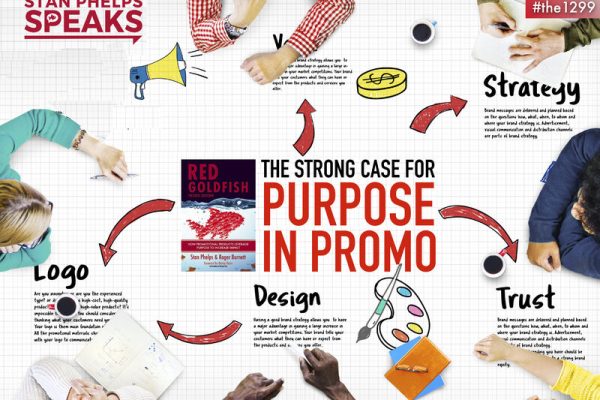
The case for PURPOSE in promotional products. Today, I have the honor of speaking at the PPAI Expo. Roger Burnett, CAS and I will be presenting on the concept of a Red Goldfish.

The session is designed for industry professionals and anyone responsible for putting their company brand on promotional marketing items. Promotional products as a medium have proven to achieve measurable results when used thoughtfully and strategically.

But for many organizations, promo is often an after-thought. Promotional products are sometimes seen as a nuisance purchase and often driven by searches for lowest cost products, frequently executed with no interaction with a specialist in the field.

We describe these poorly executed, cheap, non-useful products that do nothing more than checking a box as BRANDFILL. Brandfill is embarrassing and harmful to the buyer, the seller, and the environment. There is a better way and a North Star.

Purpose offers a unique opportunity to build an emotional relationship with customers. Promotional marketing items imbued with purpose can become tangible, sought-after extensions of a brand.

Lagniappe – Want to learn more about purpose in promo? Free eBook (today 1/14) on Amazon. Get your copy of Red Goldfish Promo Edition here: https://www.amazon.com/Red-Goldfish-Promo-Promotional-Products-ebook/dp/B08HY78T79

The book shows how promotional products can leverage purpose to increase impact. Based on a collection of more than 250 case studies, Red Goldfish reveals the five ways businesses in the Promotional Marketing industry can tap into purpose.

The book is divided into three main parts:

The first section is “The Why.” We make the case for why you should leverage purpose. We’ll share the meaning behind the red in Red Goldfish and explore the idea that little things can make a huge difference with the metaphor of a goldfish. 

The second section is “The What.” Here we explore leading-edge case studies in the categories of give back, diversity & inclusion, environmental, experience, and transparency & trust.

The third section is “The How.” Here we’ll share the three-step process for creating and leveraging purpose.

Follow me on Twitter or LinkedIn.

Stan Phelps

Stan Phelps walks the walk. He stands out in the sea of sameness by modeling his own Differentiated Experience (DX) message: Differentiation isn’t just about what you say, it’s about what you do and, more importantly, how and why you do it. Stan leverages his unique collection of 5,000+ case studies on customer, employee, and brand experience to engage audiences with informative learning-based experiences. He believes purposeful DX wins the hearts of employees and customers, and differentiation ultimately boosts loyalty, retention, referrals, and results.

Find Stan’s keynotes and workshops at StanPhelps.com.

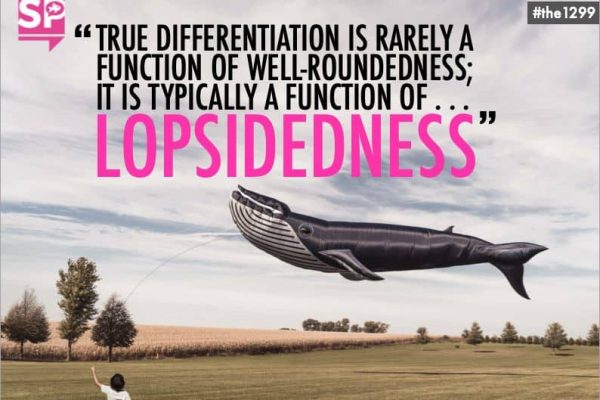
“True DIFFERENTIATION is rarely a function of well-roundedness; it is typically a function of LOPSIDEDNESS.” This quote is by Harvard Business School Professor Youngme Moon in her book, “Different – Escaping the Competitive Herd.”

This approach speaks to the “L” in the FLAWSOM framework of lopsiding. Do most brands leverage this approach? NO.

Most brands are trying to be balanced and well-rounded. Synonyms for balanced include: sane, normal, and stable. Those sound like worthy goals. Be the perfect amount of everything. Appeal to everyone.

Lopsiding is the opposite. It is about being unbalanced, imperfect, unstable, and odd. Antonyms for unbalanced include: crazy, insane, and unsound. Those don’t sound like promising descriptions of brand strategy. Lopsiding involves amplifying, not reducing, your brand’s flaws. We want you to expand them, magnify them, exaggerate them, and then supersize them.

CASE IN POINT: Menu size. Shouldn’t you keep it simple. Don’t paralyze customers with choice. Less is more right? Maybe not. Boasting 250 menu items, (including 85 different ways to order chicken and 50 different types of cheesecake) The Cheesecake Factory menu is nearly 6,000 words. Wonderful example of lopsiding.

What are you tripling down on to be more lopsided?

Follow me on Twitter or LinkedIn

Stan Phelps

Stan Phelps walks the walk. He stands out in the sea of sameness by modeling his own Differentiated Experience (DX) message: Differentiation isn’t just about what you say, it’s about what you do and, more importantly, how and why you do it. Stan leverages his unique collection of 5,000+ case studies on customer, employee, and brand experience to engage audiences with informative learning-based experiences. He believes purposeful DX wins the hearts of employees and customers, and differentiation ultimately boosts loyalty, retention, referrals, and results.

Find Stan’s keynotes and workshops at StanPhelps.com.

Honored to be a guest on the Vibrant Leadership podcast with Nicole Greer. We talk about the pathways to become an incredible leader.

Great stories about Douglas Conant, Theo Epstein, and Bill Treasurer.

Listen here:

Some of the areas we discuss:

– Consistent touchpoints during the pandemic
– Committing fully to any endeavor
– How to recognize and provide feedback effectively
– A clear path to becoming a leader

Follow me on Twitter or LinkedIn

Stan Phelps

Stan Phelps walks the walk. He stands out in the sea of sameness by modeling his own Differentiated Experience (DX) message: Differentiation isn’t just about what you say, it’s about what you do and, more importantly, how and why you do it. Stan leverages his unique collection of 5,000+ case studies on customer, employee, and brand experience to engage audiences with informative learning-based experiences. He believes purposeful DX wins the hearts of employees and customers, and differentiation ultimately boosts loyalty, retention, referrals, and results.

Find Stan’s keynotes and workshops at StanPhelps.com.

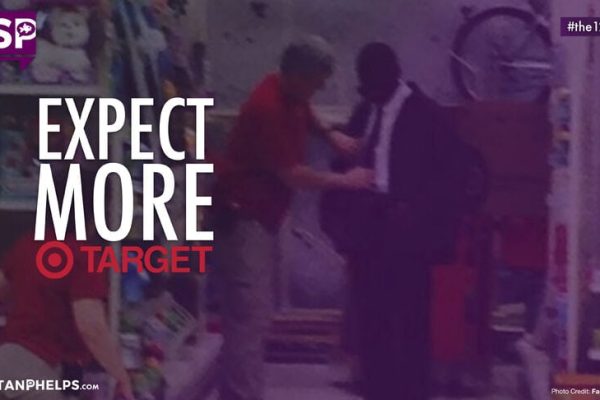
It was an ordinary Wednesday afternoon for Audrey Shepps Mark in North Raleigh. She was shopping at the Super Target located at the Triangle Town Center. In the midst of buying some headbands and a ham, according to Audrey, she had her “heart warmed.”

A young teenage boy had stopped by Target in search of a clip-on tie. He was making a pit stop before heading to a job interview. He encountered a problem. Target doesn’t sell clip-on ties. The store only sells regular ties. A Target team member began to assist the young man. Audrey watched as the situation unfolded.

In her words on Facebook,

“The team member took the time to help the nervous teen put on his new tie, tuck in his shirt and then showed him how to give a proper handshake and tackle a few tough interview questions! As the kid exited the store, a bunch of supportive Target team members cheered him on! THIS is true customer service – Right on the mark, Target!!”

This story went viral nearly six years ago. Why did it resonate? I believe it’s because it touches us in a way that’s innate to how we’ve developed as humans. Target did more than expected. This #PurpleGoldfish of “added service” went beyond the transaction. A “little extra” to honor the relationship with a customer.

Follow me on Twitter or LinkedIn

Stan Phelps

Stan Phelps walks the walk. He stands out in the sea of sameness by modeling his own Differentiated Experience (DX) message: Differentiation isn’t just about what you say, it’s about what you do and, more importantly, how and why you do it. Stan leverages his unique collection of 5,000+ case studies on customer, employee, and brand experience to engage audiences with informative learning-based experiences. He believes purposeful DX wins the hearts of employees and customers, and differentiation ultimately boosts loyalty, retention, referrals, and results.

Find Stan’s keynotes and workshops at StanPhelps.com.

Bryson DeChambeau burst into the mainstream in 2020. His approach to lopsiding the game has been described as “Breaking Golf.” And he’s doing it more and less by the numbers.

– MORE: Bryson bulked up adding forty pounds of weight over the last year. The result is a faster swing and 22 more yards off the tee.

– LESS: Bryson is obsessed with testing his equipment. The loft on his driver is only 5 degrees. That’s half the loft of most of his competitors. He talks about getting it down to 0.

– MORE: Bryson does more of the same. Since the age of 15, all of his irons are a single-length. Why? Because if every iron is the same length, then it becomes easier to have a repeatable swing.

– LESS: Bryson doesn’t regularly practice putting. He shared to Sports Illustrated, “the past two, three years, we’ve learned everything that I needed to learn in order to launch the ball properly control speed and start it on my line. That’s all it is.”

Is it working? Yes. Last week the #5 golfer in the world was competing in the Sentry Tournament of Champions in Maui.

Branding Takeaway: Want to stand out? Be like Bryson. Do more of what makes you unique and less of what everyone else considers normal.

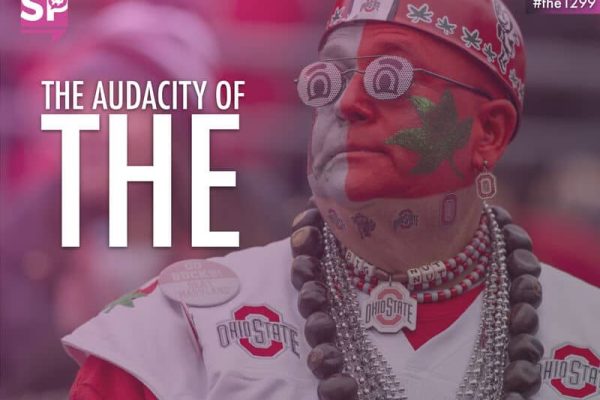
The battle of “Thee” and “The.” Last night the University of Alabama faces off against The Ohio State University in the College Football National Championship. Notice something about the official name for Ohio State University bolded above? It may be written as “The,” but if you are a football fan . . . or if you know an alum, then you know it is pronounced differently. For some reason, there is an extra E at the end of The. Thee Ohio State University is quite proud of “The” and in #PinkGoldfish fashion, they flaunt it.

Who put the Thee in The? How did OSU begin its assault on the most commonly used word in The English language?

According to TheSpun, “The University was renamed in 1878 because the board of trustees thought Ohio Agricultural And Mechanical College didn’t live up to the school’s prestige. The president of the university thought that the new name would further separate the institution from other schools in Ohio.”

It wasn’t until 1986 that the University changed their logo and began emphasizing the THE. OSU did want to be confused with Oklahoma State or Oregon State. It soon became a point of pride.

In 2018, they tried to trademark The and were given the Heisman by the USPTO.

Your call? Touchdown (smart branding) or Personal Foul (vanity gone wrong)?

1 38 39 40 41 42 48
A simple illustration of a purple fish facing right on a plain background.

I've had the pleasure of working with teams at:

Three purple fish silhouettes swimming to the right on a dark background.

Find Your Best-Match Program

With over 18 possible keynote speaking presentations, workshops, and GOLDFISH TANK programs available to meet your ever-evolving needs, I’ve created this 2-minute, 6-question quiz to help you understand which program is best for you and your audience.

Meet Your Presenter

Through keynote speaking presentations, hands-on workshops, and GOLDFISH TANK programs, I empower you to power loyalty and growth.

Hi, I’m Stan Phelps. I work with organizations that want to increase loyalty, drive sales, and promote positive word-of-mouth by creating differentiated experiences.

As an author, keynote speaker, and workshop facilitator, my in-person and virtual programs stand out in a sea of sameness because I model my own message of differentiated experience (DX).

I leverage my unique collection of more than 5,500 case studies on customer, employee, and brand experience to engage audiences with practical ideas that inspire action.

A person wearing glasses and a gray quarter-zip sweater stands outdoors in front of a building with a triangular glass roof at dusk.

Every time we do business together, Something amazing happens in the world!

Through my partner B1G1, each program gives back to create global IMPACT

Two students in blue uniforms smile while washing their hands at an outdoor tap.

When we complete a GOLDFISH TANK, we give 1001 days of clean water to school children

Collage of three images: a person washing hands, a child drawing with colored pencils, and a group of people sitting outdoors with some raising their hands.

When we complete a GLOBAL engagement, we give 365 days of clean water access in Peru, 120 days of learning aids in Malaysia, and 50 days of business training for women in Malawi

Hand placing a brick on a surface with text: "One Book = One Brick" and an Amazon logo.

When someone downloads a GOLDFISH eBook, we give one brick toward building school facilities in Cambodia