
Stan Phelp's Blog

The Goldfish Chronicles

Sharing insights on customer experience, employee engagement, and brand strategy.

FAVOR – Help us pick our subtitle from these 3 options:
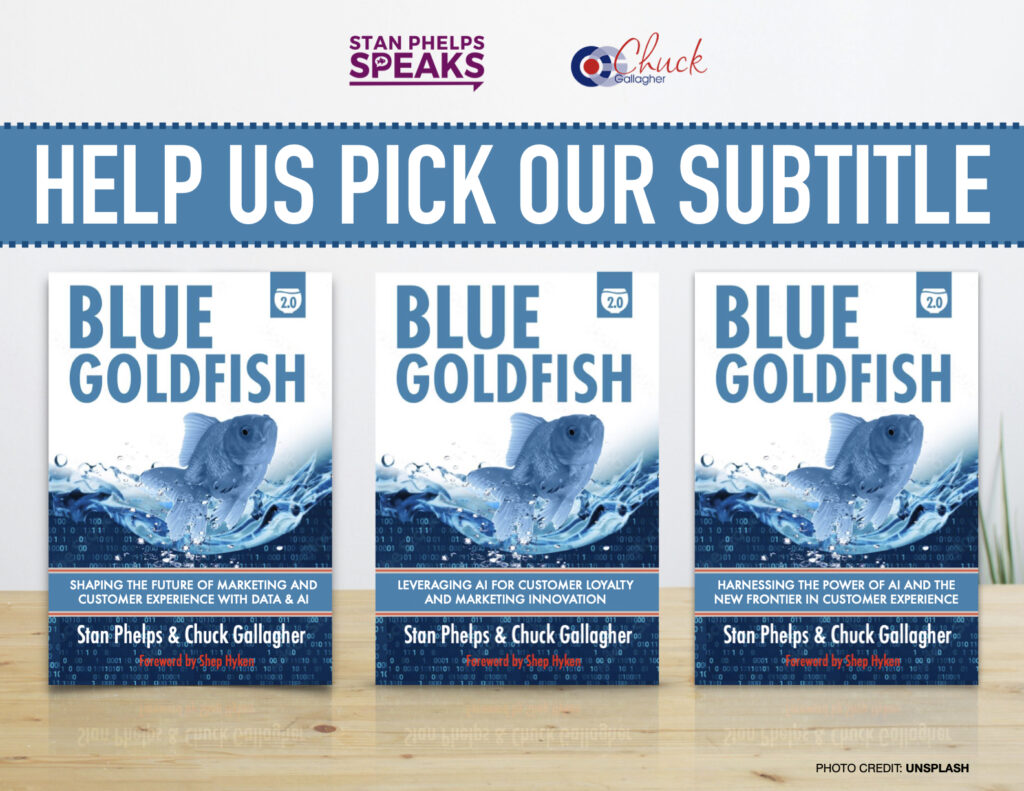
A. SHAPING THE FUTURE OF MARKETING AND CX WITH DATA & AI

B. LEVERAGING AI FOR CUSTOMER LOYALTY AND MARKETING INNOVATION

C. HARNESSING THE POWER OF AI AND THE NEW FRONTIER IN CX

A bit of background. I’m partnering up with Chuck Gallagher on “Blue Goldfish 2.0.” We have updated the original “Blue Goldfish – Leveraging Technology, Data and Analytics to Drive Profits & Prophets” co-authored with Evan Carroll in 2016.

Based on a review of more than 400 case studies, the 2.0 edition shares the 8 ways technology can be used to enhance the customer experience.

Do you prefer A, B or C?

I remember 30 years ago today when I was a second-year grad student at Villanova University. I was preparing to go home to stay with my parents for Spring Break.

Then I got a call from my manager the previous summer at my internship at IMG. Bo Johnson was now at adidas. He invited me to come out to Indian Wells, California for a week to work the 5th biggest tennis tournament in the world.

The next day I received a plane ticket via FedEx. That very night I flew to LA and rented a car. I was bleary-eyed when I pulled into the Hyatt Grand Champions Resort at 3 a.m. It can feel stark if you’ve never been to the desert at night. Pulling into the Hyatt was like entering a beautiful green oasis.

That week I worked retail, did grassroots tennis clinics, helped out with hospitality, and interacted with players. I loved every single minute. I was hooked.

Fast forward two years from that day and I was now working for adidas in Portland. I had my dream job managing US Tennis Promotions.

The first endorsement agreement I ever negotiated in my role was done in Indian Wells with the legendary Rod Laver.

I’d come back to the desert another handful of times over the next 8 years.

12 years ago I brought Jenn and my boys to the desert. We came out to be part of the 10th Desert Smash at La Quinta Resort & Club. It’s a celebrity charity event founded my by former adidas colleague and good friend Ryan Macaulay.

Earlier this week was the 20th edition of Desert Smash. Having a commitment this week in Albuquerque, I knew I needed to rally. My best friend David Ackerman joined me for the trip.

It was 3 brilliant days of golf, tennis, and experiences. Highlights were seeing Joshua Tree National Park, watching amazing players like Novak Djokovic and not-so-great players like Charlize Theron, meeting actor Christopher McDonald (“Shooter McGavin”), and taking on the island green Alcatraz at PGA West’s Stadium Course.

Huge congrats to Ryan for creating an amazing event that has raised over $3 million for charity.

Indian Wells will always remain a special place in my heart. It changed my life.

Do you have a place like it?

In 2003, I found myself among a group called “ON THE EDGE,” where we delved into life’s intricacies and sought to push boundaries.

It was during one of these meetings that fellow member Gene Seidman introduced us to the concept of lagniappe—a Creole term signifying that little extra something given by a merchant at the time of purchase. It immediately resonated deeply and stuck with me.

Fast forward 5 years and I’m working within the leadership team of an experiential marketing agency. We created monumental product launches and PR stunts that left a lasting impression. While many of our projects garnered acclaim like the World’s Largest Logo for KFC, I felt a sense of emptiness. The relentless pursuit of spectacle for earned media lacked substance.

Determined to find a more meaningful approach to marketing, I launched a blog titled 9 INCH MARKETING in 2009. Nothing personal [… unfortunately], the name stemmed from an intriguing fact: the average distance between the stem of the brain and the top of the heart is exactly 9 inches.

This notion became symbolic for me—a reminder that the goal of business should be to win the hearts of your customers. It was during a fateful evening in September of that year, amidst the vibrant chaos of NYC, that my perspective underwent a profound transformation.

I was at a rooftop bar with my agency colleague Brad when we struck up a conversation with an older gentleman. Our discussion veered towards the concept of timeliness, sparked by my assertion about the importance of punctuality. In response, the gentleman delivered a paradigm-shattering revelation:

“There is no such thing as being on ‘time.’ You are either early or you are late.”

This epiphany reframed my understanding not only of punctuality but also of customer expectations in business. The notion of merely meeting expectations suddenly seemed inadequate. In business, I realized, that one must either fall short of expectations or surpass them. There is no middle ground.

Reflecting on this revelation, I came to see the fallacy of striving to meet expectations. It was a realization akin to dispelling the myths of childhood—Santa Claus, the Tooth Fairy, and the illusory concept of “meeting expectations.” In truth, exceeding expectations is the true measure of business success.

Armed with this newfound perspective, I embarked on a journey to revolutionize marketing. No longer content with surface-level spectacle, I started the Purple Goldfish Project. The Project was a quest to find 1,001 examples of companies that went beyond the expected to deliver a truly exceptional experience.

The Project led to my first book in 2012 and eventually to the creation of the Goldfish Series of books, where I shared insights on both customer and employee experience.

So I ask you: What is your lagniappe? How are you going above and beyond the transaction to win the hearts of your employees and customers? How are you navigating the longest and hardest 9 inches?

In addition to being an attorney, Stan is a Virtual Master Presenter (VMP) and Certified Speaking Professional (CSP).

The CSP® is the highest-earned credential from the National Speakers Association (NSA) and brings numerous benefits and advantages for clients.

Here are five benefits of hiring a CSP:

  1. Expertise and Professionalism: CSPs have demonstrated a high level of expertise and professionalism in the speaking industry. To earn the CSP designation, speakers must meet strict criteria, including a minimum number of paid speaking engagements, extensive experience, and ongoing education. Clients can have confidence in the CSP’s knowledge, skills, and ability to deliver a top-notch presentation.
  2. Unparalleled Speaking Skills: CSPs are exceptional speakers who have honed their craft through years of experience. They possess outstanding stage presence, delivery techniques, and the ability to captivate and engage audiences effectively. With their polished speaking skills, CSPs can deliver impactful messages that resonate with attendees and drive desired outcomes.
  3. Customized and Tailored Content: CSPs understand the importance of tailoring their presentations to meet the specific needs and objectives of each client. They invest time in researching and understanding the client’s industry, audience, and challenges to create customized content that addresses the client’s unique requirements. This ensures that the presentation is relevant, meaningful, and valuable to the audience.
  4. Professional Code of Ethics: CSPs adhere to a strict code of ethics set by the NSA. This code ensures that CSPs maintain the highest standards of professionalism, integrity, and ethical conduct in their speaking engagements. Clients can trust that their CSP will conduct business with honesty, transparency, and respect for all stakeholders involved.
  5. Cutting-Edge Knowledge and Insights: CSPs are committed to continuous learning and staying up-to-date with the latest industry trends, best practices, and insights. They invest time and resources in professional development to expand their knowledge base and bring fresh ideas and perspectives to their presentations.

If you’d like to begin a discussion about how I can help you with a virtual Keynote, Workshop, or Goldfish Tank program,  you can grab time on my schedule here, reach me by email at [email protected] or by text/phone at 1 919 360 4702.


In 2023, I became certified as a Virtual Master Presenter. Why did I do it? Two main reasons:

  1. Because virtual presentations are here to stay.
  2. Because OK presentations aren’t OK anymore.

In today’s digital landscape, the bar for presentations has been raised. Audiences crave engagement, connection, and impact. That’s where the Virtual Master Presenter (VMP) steps in. They can transform mundane presentations into unforgettable experiences.

But what exactly is a Virtual Master Presenter?

A VMP is a seasoned speaking professional who has honed their craft through the eSpeakers Virtual Master Presenter course, culminating in the prestigious VMP credential.

The certification was the result of immersive program, conducted over five half-day sessions, equips presenters with the skills and techniques needed to captivate virtual audiences like never before.

Why should you hire a Virtual Master Presenter (VMP)?

So, why should you consider hiring a Virtual Master Presenter for your keynotes and training sessions? Here’s why:

  1. Elevated Presentation Setup: VMPs master the art of creating a refined virtual presentation setup, ensuring optimal lighting, background, camera angle, microphone, and personal image. They understand that every detail matters to create a professional and engaging environment.
  2. Enhanced Audience Connection: Through specific interaction techniques, VMPs foster a deeper connection with their audience. They know how to maintain eye contact, manage windows effectively, and engage attendees to mitigate “Zoom fatigue” and keep them fully immersed in the presentation.
  3. Compelling Slide Design: VMPs craft slides that are not only visually stunning but also highly effective in conveying information. They utilize relevant animations and optimize slides for mobile viewing, ensuring maximum engagement and retention.
  4. Tech Troubleshooting Expertise: In the unpredictable world of virtual presentations, technical glitches can happen. VMPs are prepared with contingency plans (Plan B, or even Plan C) to swiftly recover from any disruptions, keeping the presentation seamless and professional.

In conclusion, hiring a Virtual Master Presenter is your gateway to delivering impactful, unforgettable presentations in the virtual realm. With their expertise, you can elevate your presentations, connect deeply with your audience, and leave a lasting impression that resonates long after the session ends.

If you’d like to begin a discussion about how I can help you with a virtual Keynote, Workshop, or Goldfish Tank program,  you can grab time on my schedule here, reach me by email at [email protected] or by text/phone at 1 919 360 4702.

First, a bit of background on the song. Billy Joel came up with the idea when he was turning 40. A chance meeting with Sean Lennon (son of John and Yoko) made him realize how each subsequent generation feels things are getting worse.

The 1989 song lists 117 historical events from the 1940s to the late 1980s, chronicling everything from scientific advances to political events in chronological order.

In “Blue Goldfish,” we similarly traced 71 events in the evolution of technology and data analytics that brought us AI. While doing so, two facts come into sharp focus.

First, the rate of innovation is ever-increasing. In Joel’s words, “It was always burning, since the world’s been turning.” And what would seem like a giant leap 60 years ago appears more like a small step today.

Second, these innovations are changing the average consumer. Going from a world where connected technology is mostly a dream to such ubiquity where more humans have mobile phones than access to working toilets is nothing short of impressive.

As you consider the journey, there’s no doubt that expectations for our customers have changed. We’ve forced them to change with each innovation being faster, smaller, and more accessible than the last. The same expectations apply to your business.

Your customers expect faster response times, shorter wait times, more value, and a personalized experience all at once. The companies that figure out how to leverage AI to serve this modern consumer will thrive. And the others? Their days are numbered.

In my next book “Blue Goldfish 2.0” (coming April 11th), we highlight companies leveraging AI to improve customer experience. Technology brought us these increasing expectations and it’s the only thing that can save our businesses from them.

Speaking of AI, I shared our 71 events with ChatGPT and asked it to write a song similar to “We Didn’t Start the Fire.” Here is the full song:

(Verse 1) In ’61, Kilby and Noyce, their genius unchained,

The silicon chip birthed, technology gained.

No more vacuum tubes, their size and their drain,

A revolution launched, a computer’s domain.

Roger Easton’s vision, GPS took flight,

Tracking satellites, guiding us right.

Goodnight’s SAS, statistics in sight,

From farm fields to boardrooms, shining so bright.

(Chorus) We didn’t start the fire, but we lit the flame,

Innovation’s our anthem, the world’s never the same.

From the moon to the web, we’ve played the game,

The journey continues, our legacy to claim.

(Verse 2) ’69, Armstrong’s moonwalk, a giant leap made,

ARPANET’s birth, Licklider’s crusade.

Moore’s Law declared, computing cascade,

Transistors and chips, our progress displayed.

Xerox Alto’s dawn, a desktop dream,

Martin Cooper’s call, a mobile scheme.

Personal computers, a tech regime,

Digital photos, a Kodak theme.

(Chorus) We didn’t start the fire, but we lit the flame,

Innovation’s our anthem, the world’s never the same.

From the moon to the web, we’ve played the game,

The journey continues, our legacy to claim.

(Bridge) From eBay’s auctions to Wikipedia’s might,

Driverless cars, AI’s insight.

Google’s searches, YouTube’s delight,

Amazon’s reign, the future in sight.

(Verse 3) In ’21, DeepMind’s grand feat,

Protein folding solved, diseases to beat.

In ’22, fusion’s heat,

National Ignition’s promise, energy replete.

ChatGPT’s arrival, conversation’s new height,

AI’s widespread, in day and night.

Voice assistants aid, with insight,

A future powered, by AI’s light.

(Chorus) We didn’t start the fire, but we lit the flame,

Innovation’s our anthem, the world’s never the same.

From the moon to the web, we’ve played the game,

The journey continues, our legacy to claim.

(Outro) From silicon dreams to AI’s embrace,

We’ve journeyed far, in time and space.

The fire still burns, in every place,

Innovation’s anthem, humanity’s grace.

In the 80s classic, Chevy Chase plays a Los Angeles Times undercover reporter named Irwin M. “Fletch” Fletcher. Posing as a junkie, Fletch is working on an article exposing drug trafficking on the beaches of Los Angeles. His editor Frank is pressing him to run the story.

Fletch: “Can’t do that, Frank. Fat Sam isn’t the story, there’s a source behind him.”

Frank: “Who?”

Fletch: “Well, there where we’re in kind of a gray area.”

Frank: “How gray?”

Fletch: “Charcoal”

The lesson is that in life… and leadership, there isn’t always a clear-cut path.

When you lead people who, because of their generation, perceive the world very differently, there is no black-and-white approach to success. You’ll have to use a variety of techniques to overcome challenges and get the most from your employees.

A one-size-fits-all approach is a recipe for disaster because your employees approach their work differently. This holds true even for an organization with just one generation, much less one with five. You’re going to have to navigate plenty of gray areas to find the approach that works best.

Gray is a color often associated with something nondescript or unremarkable. We hate to be the ones to tell you this, but that’s how most employees view their leadership team. In our book “Gray Goldfish – Navigating the Gray Areas to Successfully Lead Every Generation,” Brian Doyle and I share some alarming stats:

– Forbes tells us that 63% of employees don’t trust their leaders.

– Gallup completed a study saying a staggering 87% of employees are not engaged (and leadership plays at least a passing role in that).

– Accor/Edenred states that 90% of companies think an engagement strategy will improve business success.

To foster trust and engagement, you need clear, actionable approaches to win over every generation in your workforce. Creating strategies specific to your employees and your situation.

Does it really matter if you engage all five generations of employees in your company? The Korn Ferry Institute would suggest it does. Their study determined that firms that engage and enable their employees achieve up to 4.5x more revenue growth than companies that don’t. Research by Kenexa echoed this stat, saying companies that have highly engaged employees earn 2x the net income of companies that don’t.

Think about those stats. It doesn’t matter if you’re a small organization or a large one, doubling your revenue and net income is huge! And, if you want to create a new product or service, just connect with your employees—every generation, not just yours—so that they are engaged with their work.

“Gray Goldfish” provides guidance on each generation and 50 tips (a blatant nod to 50 Shades). Here is one of those tips:

TIP #7 CHECKING IN (from the Chapter on Recruiting and Onboarding)
Check-in early and often as you onboard new employees. For example, when employees join Davies PR, they are given a 3-month, 6-month, 9-month, and a one-year review to ensure they get a “Best Start” at Davies. After the first year at the company, employees receive annual 360-degree reviews in which they are assessed by their co-workers.

Leadership is overrated. FOLLOWING is as important as LEADING. If you’ve never seen it… take 3 minutes and watch this TED talk by Derek Sivers:

Even if you are a leader, you follow someone. It might be the manager above you, it might be the CEO of your company, or it might be your Board of Directors. You’re taking direction from someone.

As a follower, you can help your manager be the best leader he/she can be by understanding their generation.

Here are 15 tips for managing the gray of following every Generation:

FOLLOWING MATURE LEADERS
Matures are tough. They became frugal greatly influenced by the Great Depression, persevered in very tough times, and almost always put service before self. If you’re working for a Mature, these are the characteristics for you to highlight.
Tip #1: Be conservative with your budget 
Tip #2: Stay upbeat in tough times 
Tip #3: Service before self

FOLLOWING BOOMER LEADERS
Boomers take great pride in their work. They consider their position a status symbol and are largely defined by their employment. In their mind, it took a lot of blood, sweat, and tears to get to where they are today. By aligning with their ideals, you’ll shine in their eyes.
Tip #1: Live with and be prepared to provide detail
Tip #2: Be a lifetime learner and enable them to be one as well
Tip #3: Show your work (and how hard you’re working at it)

FOLLOWING GEN X LEADERS
Despite being recognized enough to be placed in a leadership position, Generation X still doesn’t trust upper management. Because they were often left alone to create their own path, they are self-oriented (not to be confused with selfish) and are looking to get their work done, get credit for that work, and still have a little fun along the way.
Tip #1: Keep it brief
Tip #2: Recognize credit where credit is due
Tip #3: Make work fun

FOLLOWING MILLENNIAL LEADERS
As the generation that represents more than 50% of the workforce, Millennials are in a unique situation. They are rapidly taking on leadership roles while still being on the younger end of an organization’s employees.
Tip #1: Consider suggesting a (reverse) mentoring arrangement
Tip #2: Embrace multitasking
Tip #3: Organize group learning or other activities

FOLLOWING GENERATION Z LEADERS
Just due to their age, if you have a Generation Z leader, it’s likely their first “work” leadership role. That means they may be somewhat inconsistent in their leadership approach (as we all were). You’ll need to be patient with that and roll with the punches. Like other generations, they’ll figure it out, and if they learn leadership with the speed they learn other things, they’ll likely understand leadership faster than their forebearers.
Tip #1: Be quick and frequent
Tip #2: Work/life integration
Tip #3: Get onboard with tech

Here is one more masterful tip on following:

MASTERFUL TIP: Theo Epstein, former president of baseball operations for the Chicago Cubs and former General Manager for the Red Sox, became the youngest GM and one of the most important people in Major League Baseball through followership.

Epstein believes in what he calls the 20 percent rule. Theo explained this to David Axelrod on The Axe Files, “Whoever your boss is, or your bosses are, they have 20% of their job that they just don’t like …. So if you can ask them or figure out what that 20% is, and figure out a way to do it for them, you’ll make them really happy, improve their quality of life, and their work experience.”

Spring (RE)Training? In a groundbreaking shift ahead of the 2018 season, renowned baseball teams such as the Phillies, Mets, Red Sox, Yankees, and Nationals opted for a bold strategy replacing seasoned managers with youthful skippers.

The age gap was staggering, ranging from 8 to 26 years younger, with some lacking major league managing experience. Tom Verducci of Sports Illustrated highlighted that “the ability to connect with young players and a comfort with analytics rose above experience.”

These visionary managers excelled in bridging the gap with the latest generation of players, exemplified by 42-year-old Alex Cora leading the Boston Red Sox to a World Series triumph in his inaugural year at the helm.

This transformative move from traditionally conservative baseball owners serves as a poignant wake-up call for leaders in all domains.

🌐 Navigating the Five Generations at Work 🌐

With the dawn of Gen Z in the workforce, we now witness an unprecedented convergence of five distinct generations. Millennials represent the largest cohort, followed by Generation X, Baby Boomers, and Matures. It’s commonplace for today’s leaders to oversee teams spanning a staggering 60-year age range, as exemplified by my father-in-law, Fred Wills, who remained an active contributor until the age of 89.

Effectively relating and connecting across these generational divides is paramount. Each cohort brings forth unique expectations and requirements. Echoing the wisdom of former MLB manager Joe Maddon, who underscores that effective leadership and culture emanate from relationships. He believes building bonds across the generations fosters trust and paves the way for an open exchange of ideas.

Navigating this multigenerational landscape presents uncharted territory for today’s leaders. As Carol Hymowitz elucidates in The Wall Street Journal,

“That means they must create opportunities for young employees to advance (or risk losing them) while also making sure veterans, whose skills they need in today’s tight labor market, don’t feel overlooked. And to maintain productivity and innovation, they must persuade employees of disparate ages to collaborate.”

It’s an imperative task—mastering the art of managing the gray. That’s where the Generational Matrix (see below) comes in. Created by Brian Doyle and myself in the book, “Gray Goldfish – Navigating the Gray Areas to Successfully Lead Every Generation.”

HOW TO USE IT:
Find your generation as a leader across the top row. Then scan down the column to find guidance on how to recruit, train, manage, and inspire across each of the five generations.

New Speaker Reel

 Excited to share my NEW 2-minute Speaker Reel. Here is the world debut…

Huge thanks to Aaron Lympany for his amazing work on the Project. From briefing, to scripting, to shooting and editing, it was a super fun process. Excited with the end result from Rhymes With Timpani Video.

1 2 3 4 48
A simple illustration of a purple fish facing right on a plain background.

I've had the pleasure of working with teams at:

Three purple fish silhouettes swimming to the right on a dark background.

Find Your Best-Match Program

With over 18 possible keynote speaking presentations, workshops, and GOLDFISH TANK programs available to meet your ever-evolving needs, I’ve created this 2-minute, 6-question quiz to help you understand which program is best for you and your audience.

Meet Your Presenter

Through keynote speaking presentations, hands-on workshops, and GOLDFISH TANK programs, I empower you to power loyalty and growth.

Hi, I’m Stan Phelps. I work with organizations that want to increase loyalty, drive sales, and promote positive word-of-mouth by creating differentiated experiences.

As an author, keynote speaker, and workshop facilitator, my in-person and virtual programs stand out in a sea of sameness because I model my own message of differentiated experience (DX).

I leverage my unique collection of more than 5,500 case studies on customer, employee, and brand experience to engage audiences with practical ideas that inspire action.

A person wearing glasses and a gray quarter-zip sweater stands outdoors in front of a building with a triangular glass roof at dusk.

Every time we do business together, Something amazing happens in the world!

Through my partner B1G1, each program gives back to create global IMPACT

Two students in blue uniforms smile while washing their hands at an outdoor tap.

When we complete a GOLDFISH TANK, we give 1001 days of clean water to school children

Collage of three images: a person washing hands, a child drawing with colored pencils, and a group of people sitting outdoors with some raising their hands.

When we complete a GLOBAL engagement, we give 365 days of clean water access in Peru, 120 days of learning aids in Malaysia, and 50 days of business training for women in Malawi

Hand placing a brick on a surface with text: "One Book = One Brick" and an Amazon logo.

When someone downloads a GOLDFISH eBook, we give one brick toward building school facilities in Cambodia